





When Foundation Drainage Stops Moving Water Away From the House
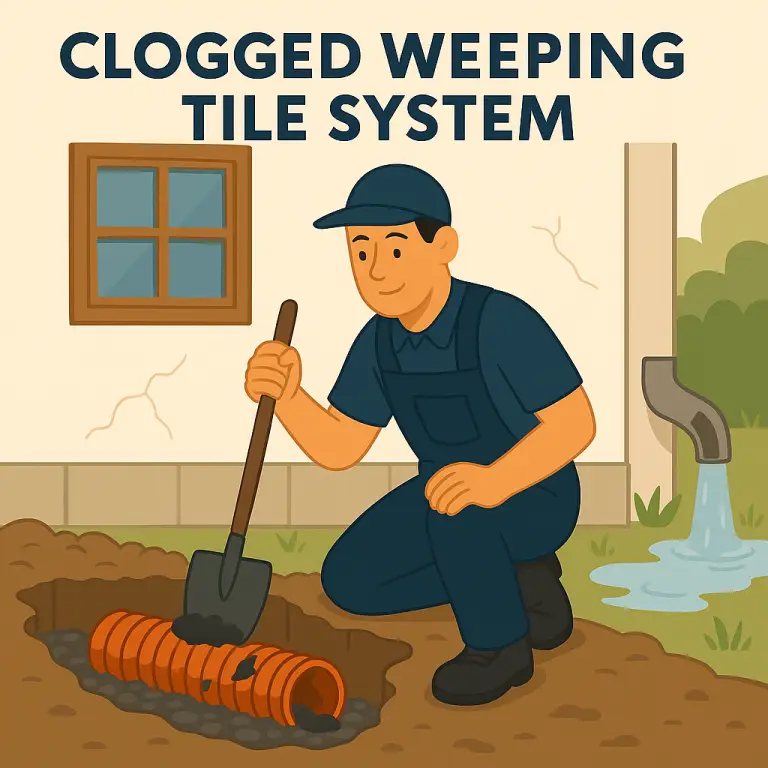
A weeping tile system sits around the footing of the foundation and is intended to collect groundwater before that water remains against the basement walls for long periods of time. In newer construction this is generally done with perforated drainage pipe surrounded by free-draining material, while older homes may have very different systems that have been underground for decades. At UPR (Underground Plumbing Repair), we repair and replace weeping tile systems throughout Toronto and the GTA when foundation drainage is no longer moving water away from the house the way it should.
Because the system is buried, homeowners usually discover the problem through what begins happening inside or around the basement rather than by seeing the drainage itself. Water may start appearing at the wall-floor joint after heavy rain, one part of the basement may remain damp longer than it used to, or moisture can return in the same area even after the visible surface has dried. Those symptoms can point toward foundation drainage, but they do not automatically prove that the weeping tile is clogged because a foundation crack, poor grading, window-well drainage or another waterproofing condition can create similar moisture patterns.
That is why our larger Basement Waterproofing work begins with understanding where the water is coming from before deciding which underground system needs attention. The weeping tile is only one part of the drainage around the foundation, and the condition that looks like a blockage may actually involve the pipe, the stone around it, the discharge route or another part of the water-management system.
Older foundation drainage can become restricted by sediment, soil intrusion, roots or deterioration over time. In some older systems, individual sections can shift or break, while newer perforated piping can also become compromised if the surrounding drainage material is no longer allowing water to move freely into the system. This is why the word “clogged” can sometimes oversimplify what is happening underground, because there may not be one removable obstruction sitting inside an otherwise healthy pipe.
Once that distinction is understood, the repair becomes much more logical. If the drainage itself is still serviceable and one section is causing the problem, a localized repair may be enough. If larger portions of the system have deteriorated or the surrounding material is no longer functioning properly, the work can become more extensive, but that decision should come from the condition of the system rather than from the age of the house alone.
Repairing Weeping Tile Means Looking at the Entire Drainage Path
When weeping tile is identified as part of the problem, the next step is understanding what still works underground and where the drainage eventually sends the collected water. If access is available, inspection can sometimes help determine whether the issue is limited to one section or whether the system has deteriorated more broadly, although foundation drainage is not always arranged in a way that allows every part to be viewed from one convenient access point.
Where the problem is localized, the repair may involve exposing only the affected area. When larger sections of older drainage are no longer functioning properly, replacement can involve excavating beside the foundation, removing deteriorated material and installing new perforated drainage around the footing with appropriate stone and filter material before the excavation is closed again.
That work naturally overlaps with Exterior Waterproofing because both systems occupy the same area around the foundation. If the wall is already exposed to reach failed drainage, it makes sense to inspect the condition of the foundation surface and existing waterproofing while access is available. This does not mean every weeping-tile repair needs to become a complete exterior waterproofing project, but it would make little sense to open the foundation and ignore an obvious problem sitting directly beside the drainage being repaired.
The discharge route matters just as much as the pipe around the footing. Collected groundwater needs somewhere useful to go, and on some homes the system ultimately relies on a sump basin, which makes the Sump Pump part of the larger drainage system. If the pump or discharge arrangement is not handling the collected water properly, repairing the weeping tile alone may not solve the entire basement-water problem.
Surface drainage should also be considered because the amount of water reaching the foundation can often be influenced long before it reaches the footing. If the property is directing rainwater toward the house, Grading & Drainage Correction can reduce the amount of water the foundation drainage is being asked to manage. A Window Well Drainage problem can create the same kind of concentrated water load along one part of the foundation, which is why those systems should be looked at as connected parts of the same property rather than as completely unrelated services.
The goal is not to replace every drainage component just because one basement wall is wet. The goal is to understand which part of the system has stopped working properly and keep the repair focused there whenever the rest of the drainage remains dependable.
Weeping Tile Repair Across Toronto and the GTA
UPR repairs and replaces foundation drainage systems throughout Toronto and the Greater Toronto Area in homes where groundwater is no longer being carried away from the footing as effectively as it should. Some projects involve one section of drainage beside an area of recurring basement seepage, while others involve older homes where the original weeping tile has been underground for many decades and the true condition of the system only becomes clear once excavation begins.
The age of the house gives us useful context, but it does not decide the repair by itself. If the existing drainage is still functioning and one area can be corrected, there is no reason to replace good sections simply because the system is old. If deterioration has spread around a larger portion of the foundation and repairs keep moving from one location to another, larger replacement may eventually make more sense than continuing to patch the system one section at a time.
What matters most is the way water is behaving around the property and what we actually find once the drainage is exposed. Foundation water should have a reliable path away from the footing instead of remaining beside the house until it eventually finds another way into the basement, and the repair should restore that path without turning every wet-basement problem into the largest possible project.
Once the excavation is closed, the drainage disappears completely from view. Like most underground work, its value is not in what the homeowner sees afterward but in whether the basement stops showing the same signs every time the ground becomes saturated.
If you are dealing with recurring basement seepage and suspect the foundation drainage may no longer be working properly, call UPR. We’ll look at the moisture pattern, the surrounding drainage and the condition of the foundation system before deciding whether the weeping tile needs localized repair, larger replacement or whether the water is actually coming from somewhere else.
UPR — We don’t fix. We solve.