





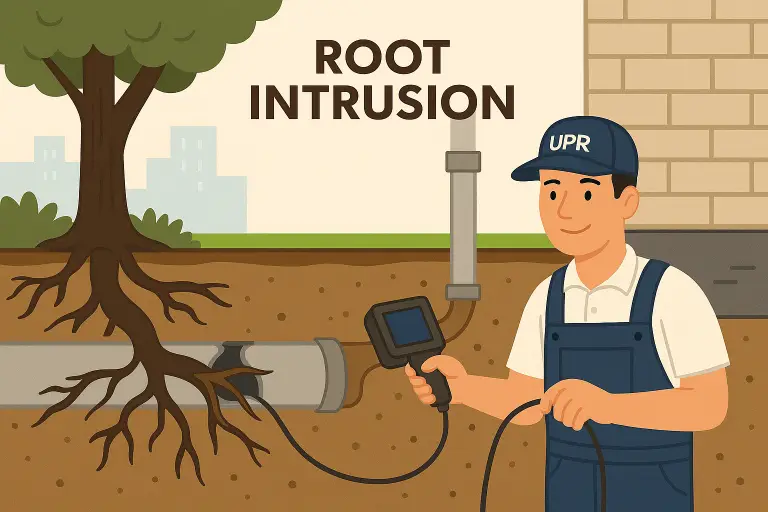
Roots Usually Find a Weak Point Before They Become the Problem
Tree roots do not need a wide-open broken sewer to get inside a drain. In many older underground systems, all they need is a small opening at a pipe joint, a crack, a deteriorated connection or another point where moisture is escaping into the surrounding soil.
Once that opening exists, the drain becomes attractive to roots growing nearby.
At UPR (Underground Plumbing Repair), we diagnose and remove root intrusion from underground drain and sewer lines throughout Toronto and the GTA. We see it most often in older clay drainage systems, but roots can enter other types of pipe as well whenever there is a path into the line.
The important part is understanding the order in which the problem developed.
Roots are often not the original reason the pipe became vulnerable. They found an opening that was already there. Once inside, however, they can turn a small defect into a much larger drainage problem by growing through the pipe and catching everything that passes them.
That distinction matters because cutting roots out of the drain and repairing the place where they entered are two different things.
Sometimes removing the roots is enough to keep the system functioning for a long time. In other situations, the roots are exposing a section of pipe that already needs repair.
We want to know which situation we are dealing with before deciding what happens next.
What Happens Once Roots Enter a Sewer Line
An underground drain carries exactly what roots are naturally drawn toward: moisture.
If a joint has separated slightly or a crack has developed in the pipe, fine roots can begin finding their way through that opening. At first, the intrusion may be small enough that wastewater continues passing without any noticeable problem inside the house.
Over time, that can change.
The roots continue growing inside the pipe while paper, waste and other debris moving through the sewer begin collecting around them. The opening available for wastewater becomes smaller, and what was once a minor intrusion starts acting more like a blockage.
This is why root-related drainage problems often develop gradually.
A homeowner may first notice that the main drain needs to be cleared every few years. Then the interval becomes shorter. Toilets begin gurgling occasionally, a basement drain reacts when other fixtures are used, or the same clogged pipe seems to return despite having been professionally cleared.
Eventually, if enough of the pipe becomes restricted, wastewater may have nowhere to go. At that point the problem can develop into a sewer backup and the first obvious sign of root intrusion may be sewage appearing through a basement floor drain.
The backup is what everybody sees.
The roots may have been growing underground for years before that moment arrived.
Older Clay Sewers Are Particularly Vulnerable
Many older homes throughout Toronto and the GTA still have sections of clay sewer pipe underground.
Clay can remain serviceable for a very long time, but these systems are built from individual sections joined together along the length of the sewer. After decades underground, movement in the surrounding soil, settlement and aging connections can allow some of those joints to open or become displaced.
That creates opportunity.
Fine roots can enter through a very small gap and then expand inside the line. Once established, they do not simply sit beside the opening where they entered. They can spread through the pipe and create a dense network that catches material moving downstream.
This does not mean every old clay sewer needs to be replaced just because trees exist nearby.
There are clay drainage systems that continue functioning properly for decades. There are also properties with mature trees where the sewer remains completely free of roots.
The issue is not simply the presence of trees. It is whether the drainage system has an opening that gives the roots somewhere to go.
That is why we do not recommend replacing an underground line because it is old or because there is a large tree in the front yard. We want to see the condition of the pipe first.
Age gives us context.
Condition gives us the answer.
Removing the Roots Restores Flow — but It Does Not Repair the Entry Point
When roots are blocking a drain, the immediate job is to remove enough of that material to restore proper drainage.
Mechanical drain equipment with appropriate cutting heads can work through root growth inside the line and reopen the path for wastewater. Depending on the size of the sewer and the amount of intrusion, several passes may be needed before the line is open enough to function properly and be inspected.
That part of the work is important because a pipe full of roots cannot be properly evaluated if we cannot get through it.
But root removal needs to be understood for what it is.
We are removing the material that is obstructing the pipe.
We are not automatically repairing the crack, open joint or other defect that gave the roots access.
For some homeowners, periodic mechanical root removal may remain a reasonable maintenance strategy when the pipe is otherwise stable and the interval between problems is long. For others, the roots return quickly because several joints are deteriorated or a damaged section continues providing easy access into the line.
There is no honest way to give every rooted sewer the same recommendation.
The drain has to tell us what condition it is in.
That is why the most useful question after removing the roots is not simply, “Is the water moving again?”
It is, “What does the pipe look like now that we can finally see it?”
The Camera Tells Us Whether We Cleared a Blockage or Found a Damaged Sewer
Once enough of the root growth has been removed, a camera inspection can show us what is happening inside the sewer line.
This is where the difference between maintenance and repair becomes much clearer.
We may find that most of the drain remains in reasonable condition and the roots are entering through one particular joint. We may find several entry points along an older clay sewer. A crack may become visible once the root mass has been removed, or one section of pipe may have shifted enough that roots and debris are collecting around it.
Sometimes the situation looks better than expected.
If the roots have been cleared and the surrounding drain remains structurally serviceable, the homeowner may decide to monitor the system and maintain it rather than immediately replacing pipe.
Sometimes the opposite happens.
The roots turn out to be only the most visible part of a sewer that has deteriorated in several places. Once the line is clear, displaced joints, cracks or structural problems become much easier to see.
Neither result should be decided before the inspection.
This is why UPR does not treat a camera as a sales tool after every root removal. It is a diagnostic tool that helps us answer the question the homeowner actually needs answered: now that the roots are gone, is the pipe itself still good enough to keep?
If the answer is yes, we say so.
If it is not, we can show why.
When Root Removal Turns Into Pipe Repair
There is an important point where repeatedly clearing roots stops making sense.
That point is different for every property.
If a sewer has one small entry point, the line remains otherwise healthy and root growth develops slowly, periodic maintenance may be perfectly reasonable. The homeowner knows what the condition is, understands that the roots may eventually return and can make a practical decision around that.
But imagine a sewer where roots are entering through several joints, the pipe has already shifted in multiple locations and the interval between blockages keeps getting shorter. Mechanically clearing the line may restore flow again, but the drainage system underneath has not become healthier.
At that point, repair deserves a serious conversation.
The scope depends on what the inspection shows. A localized damaged section may be exposed and replaced while leaving the rest of the system alone. If deterioration continues through a much larger section of the sewer, replacing more of the line may make better long-term sense than repeatedly addressing one entry point at a time.
This is exactly why we avoid statements like “old clay pipe should always be upgraded.”
Sometimes it should.
Sometimes it absolutely does not need to be.
The pipe earns that recommendation through its condition.
Trees Do Not Automatically Have to Go
Homeowners sometimes assume that solving root intrusion means removing the tree responsible for it.
That is not necessarily the case.
The underground drain is supposed to be a closed system. If it is structurally sound and properly connected, nearby roots should not have an easy path inside simply because a tree exists above it.
When roots are entering the sewer, our first concern is therefore the pipe.
Where are they entering? Is it one joint or several? Is the surrounding line stable? If the damaged section is repaired properly, can the tree remain where it is without continuing to interfere with the drainage system?
Those questions are usually more useful than immediately blaming the landscaping.
There may be situations where an arborist or other specialist should be involved because of the location or condition of a particular tree, but underground drain repair and tree management are separate decisions.
UPR works on the sewer.
We want the sewer to remain closed enough that the roots stay outside where they belong.
Root Intrusion Across Toronto and the GTA
UPR deals with root intrusion throughout Toronto and the Greater Toronto Area in neighbourhoods where mature trees and older underground drainage systems often exist side by side.
Some calls begin with a main drain that suddenly backed up. Others begin with a homeowner who has been clearing the same sewer every year and wants to understand why. Sometimes roots are discovered during an inspection for another drainage problem entirely.
The approach stays the same.
First we restore access and flow where necessary. Then we look at where the roots entered and what condition the surrounding pipe is in. From there, we can explain whether the line is a good candidate for continued maintenance, whether one damaged section deserves repair or whether the problem is widespread enough that a larger replacement should be considered.
What we do not want to do is remove a mass of roots, watch the water disappear and pretend that alone tells us the condition of the sewer.
The obstruction and the pipe are related, but they are not the same thing.
If roots are repeatedly blocking your main drain, the answer is not always a bigger cutting head.
Sometimes the line simply needs to be cleared.
Sometimes it needs to be watched.
And sometimes the roots are showing you exactly where the sewer has already begun to fail.
If you have recurring main-drain blockages, roots have previously been removed from your sewer or an inspection has shown root growth inside the line, call UPR. We’ll clear what needs to be cleared, inspect what is underneath and explain whether the pipe needs anything beyond that.
UPR — We don’t fix. We solve.