





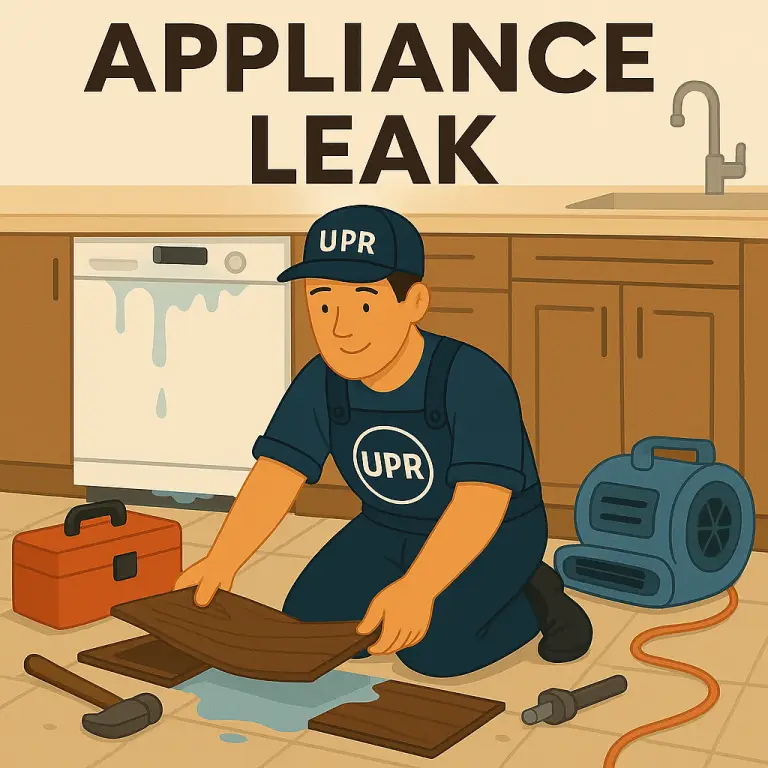
Appliance Leaks Usually Start Small and Travel Quietly
A leaking washing machine, dishwasher or refrigerator does not always create the kind of flood that sends water across the room in a few minutes. Quite often the problem develops quietly behind the appliance, underneath cabinetry or along a finished floor where nobody sees it until the surrounding materials begin to change. A cabinet base starts to swell, flooring lifts at the edge, a stain appears on the ceiling below, or a musty smell develops in an area that looked completely normal a few days earlier.
That is what makes appliance leaks deceptive. The amount of water visible in front of the machine can be very different from the amount that has already travelled underneath it.
A washing machine connection can drip behind the unit without being noticed. A dishwasher drain or supply connection can release water beneath kitchen cabinets where the toe kick hides the first signs of damage. A refrigerator water connection can leak slowly enough that the floor absorbs the problem long before the homeowner sees a puddle. In each case, the appliance may be where the water appears to originate, but the actual failure can be in the valve, supply tubing, drain connection or plumbing serving the unit.
UPR starts by separating those possibilities because the repair depends on what actually failed. If the problem is part of the plumbing connection, we can address that side of the work directly. If the appliance itself has failed internally, the unit may require appliance service or replacement, but the water damage around it still needs to be understood before the kitchen, laundry room or surrounding finishes are simply put back together.
The first visible damage often tells only part of the story. Water can move underneath laminate, engineered wood or vinyl, travel along subfloor seams, soak into the bottom of cabinetry and migrate into drywall beside or below the appliance. When the leak happens on an upper floor, the first obvious sign may even appear downstairs rather than beside the machine that caused it.
That does not automatically mean the entire room needs to be opened. It means the damaged area has to be followed far enough to understand where the moisture stopped.
A refrigerator connection caught quickly may require little more than repairing the line and drying a small area. A dishwasher that has leaked underneath finished cabinets for weeks can create a much larger restoration problem even though very little water was ever visible on the kitchen floor. The amount of work should reflect that difference rather than treating every appliance leak like the same emergency.
The Plumbing Repair and the Damage Around It Need Different Decisions
Stopping the leak is the obvious first step, but the condition of the surrounding materials determines what happens afterward.
Flooring is often where appliance leaks become complicated because water can travel beneath the finished surface while the top appears almost dry. Some materials tolerate short-term moisture reasonably well and can remain once they have dried properly. Others swell, separate, stain or lose their shape once enough water reaches them, and replacing only the visible edge can leave damaged material continuing farther underneath the appliance or cabinetry.
Cabinets behave differently again. A solid cabinet box may survive a limited leak with little permanent damage, while particleboard or similar materials can swell quickly once water enters from below. Drywall beside the appliance may wick moisture upward even when the original puddle was only a fraction of an inch deep. The restoration has to follow the material and the way it reacted to the water, not simply the height of the original spill.
When access is required, the goal is to open enough of the affected area to dry and repair it properly without turning a localized leak into an unnecessary demolition project. Flooring, trim, drywall or cabinetry should remain wherever their condition allows it, but materials that are badly damaged or trapping moisture should not be hidden behind a new finish simply because removing them is inconvenient.
That is particularly important with slow leaks because the homeowner often cannot say exactly when the problem started. A washing machine hose that fails suddenly creates a clear event; a refrigerator connection leaking a few drops at a time may have been wetting the same area for months. By the time the leak is discovered, the plumbing repair can be very small while the surrounding restoration is considerably larger.
Where a pressurized waterline has failed independently of an appliance, Burst or Leaking Pipe Repair & Restoration is often the more appropriate direction because the problem belongs to the plumbing system itself rather than the appliance connection. When prolonged dampness has already created recurring odour, staining or visible growth, Mould & Moisture Restoration may also become part of the work.
The important thing is not to force every wet kitchen or laundry room into the same category. A plumbing connection can be repaired in minutes, while the area underneath it may need considerably more attention before it is ready to disappear behind flooring, trim or cabinetry again.
Restoring the Room Without Making the Job Bigger Than It Needs to Be
Appliance leaks usually happen in finished areas of the house, which makes the restoration almost as important to the homeowner as the plumbing repair itself. Nobody wants a dishwasher connection fixed properly and then to spend the next month looking at an unfinished cabinet opening or a section of missing floor.
At the same time, rushing to make the room look finished again can be exactly how moisture becomes trapped where nobody can see it.
UPR handles appliance leak restoration with that balance in mind. Once the source has been stopped, the affected area can be opened where necessary, dried, cleaned and evaluated before damaged finishes are replaced. If only a small portion of the room was affected, the work should stay small. If water has travelled farther than the visible damage suggested, the restoration should continue far enough to deal with what is actually there.
This is also where having the plumbing repair and restoration connected under one project can make the process simpler. The person repairing the source already understands where the water came from, how long the failure may have been occurring and which parts of the plumbing were exposed during the repair. That information helps make better decisions about the surrounding space rather than treating the damage as an unrelated cosmetic problem after the plumber leaves.
Our broader Restoration Services cover the same principle across larger water-damage projects: the original failure has to be understood, the damaged area has to be dealt with honestly, and the room should only be rebuilt once the conditions behind the finished surfaces make sense again.
Some appliance leaks end with a replaced connection and a small section of repair. Others expose damaged flooring, cabinetry or drywall that has been wet much longer than anyone realized. Neither situation should be exaggerated, and neither should be ignored simply because the appliance is working again.
If a washing machine, dishwasher, refrigerator or another appliance connection has leaked and water has reached the surrounding floor, cabinetry, walls or ceiling below, call UPR. We’ll locate the plumbing source, deal with the leak and restore the affected area around the actual extent of the damage rather than around a standard package.
UPR — We don’t fix. We solve.