




The Underground Pipe Supplying the Entire House Has to Be Diagnosed as a System
The main waterline, often called the water service, is the buried pipe that brings municipal water from the service connection toward the house. Every faucet, shower, toilet, washing machine and other water-using fixture eventually depends on that one supply, yet most homeowners never have a reason to think about the line until something changes in the way the house receives water.
Sometimes the change is obvious. Water appears in the yard where the ground should normally be dry, the service loses flow suddenly, or an underground failure becomes serious enough that the house can no longer be supplied properly. Other problems develop much more gradually, with several fixtures becoming noticeably weaker when they are used together, an older service becoming restricted internally or a renovation increasing demand on a waterline that was sized for a very different version of the home.
At UPR (Underground Plumbing Repair), we repair, replace and upgrade main waterlines throughout Toronto and the GTA. With more than 20 years of hands-on plumbing and underground experience, we begin by determining whether the buried service is actually responsible for the problem before recommending excavation or replacement.
Weak flow at one faucet does not automatically point to the underground waterline, and even poor performance throughout the house can sometimes originate at a valve, meter connection or the interior plumbing after the service enters the building. The diagnosis needs to separate those possibilities because replacing an underground line will not correct a restriction that sits somewhere inside the house.
The Main Waterline and Interior Plumbing Have Different Jobs
The underground service supplies the building, while the interior waterlines distribute that supply throughout the home. They work together, but a problem on one side can easily be mistaken for a problem on the other when the system is judged only from what is happening at a fixture.
An older house may have a relatively new underground service feeding original interior piping, while another property may have modern copper or PEX throughout the house connected to an older service outside. In the first situation, interior restrictions can limit performance even though the buried waterline is perfectly capable of delivering more water. In the second, excellent interior plumbing may still struggle because the incoming service has become restricted or simply does not provide enough flow for the demand placed on it.
This is why Interior Waterline Repair & Repiping and main-waterline work need to be diagnosed as two connected parts of the same water-supply system. The location of the restriction or failure determines where the repair belongs, and looking at both sides of the transition helps prevent perfectly good plumbing from being replaced because the problem was assumed to be somewhere it was not.
The transition itself matters as well. Once the service enters the building, it needs to work properly with the main shut-off, meter arrangement and the interior distribution piping that takes over from there. A strong underground service connected to deteriorated fittings or badly restricted interior piping can still leave the homeowner with poor results.
Low Pressure and Poor Flow Are Not Always the Same Problem
Homeowners often describe any weak fixture performance as low water pressure, but pressure and available flow are not exactly the same thing. The municipal system supplies water at a certain pressure, while the diameter, length and condition of the private service influence how much water can move through that connection when several fixtures are operating at the same time.
An undersized or internally restricted service can create a noticeable drop in performance when demand increases. One shower may seem perfectly acceptable, but opening another fixture at the same time can make the limitation much easier to feel. Increasing the service size can improve available flow and reduce friction loss when the existing line is genuinely limiting the house, but a larger pipe cannot manufacture municipal pressure that is not available at the street.
That distinction becomes especially important during renovations. Adding bathrooms, larger showers, laundry equipment or other water-using fixtures can substantially change simultaneous demand compared with what the original plumbing was expected to handle decades earlier. Before upgrading the buried service, we look at the existing line, available supply and interior plumbing together so the recommendation reflects what the house actually needs.
A waterline project should therefore begin with system behaviour rather than with the assumption that bigger pipe automatically means better pressure. The objective is to correct a real restriction or capacity issue, not simply install the largest service that can fit underground.
An Underground Leak Can Show Up in More Than One Way
A main-waterline leak is not always dramatic enough to create water spraying from the lawn. Small underground failures can release water into the surrounding soil where it remains hidden for some time, particularly when the service runs through permeable ground that allows the leaking water to disperse.
Unusual wet areas, unexplained changes in water use, reduced supply performance or visible water near the service route can all justify investigation, but none of those symptoms proves the exact location of a leak by itself. Irrigation, drainage conditions, groundwater and other underground systems can create wet areas as well, which is why the property and water service need to be considered together before excavation begins.
When a leak is confirmed, the condition of the remaining service becomes part of the repair decision. A relatively modern pipe with one isolated damaged section may be a reasonable candidate for a focused repair, particularly when the location can be reached efficiently and the rest of the service remains dependable.
An older line with repeated failures, extensive deterioration or significant restriction tells a different story. Opening the property repeatedly to repair one short section after another can eventually cost more and create more disruption than replacing the service once and rebuilding the supply properly.
Repair, Replacement and Upgrade Are Three Different Decisions
Repairing an underground waterline means correcting a specific failure while leaving the surrounding service in place. Replacement means removing the existing line from service and creating a new dependable connection along the required route. Upgrading goes a step further by changing the capacity or configuration of the service because the existing line no longer matches the needs of the property even if it has not completely failed.
Those decisions should not be blended together. A leaking fitting or one damaged section does not automatically justify replacement, while a severely restricted older service should not automatically receive another small repair simply because that is the least excavation possible today. The condition of the pipe, material, repair history, size, route and long-term plans for the property all need to be considered together.
Renovations are a good example. If a homeowner is already opening the property, replacing extensive interior plumbing or substantially increasing water demand, evaluating an older service at the same time can make sense. That does not mean every renovation requires a waterline upgrade, but it is better to understand the incoming supply before the house is rebuilt around a system that may already be close to its practical limit.
The best scope is the one that solves the condition actually present. Sometimes that remains one repair, while other properties have reached the point where rebuilding the buried service is the more sensible long-term decision.
Older Service Materials Need Different Considerations
The material of an older water service can influence both performance and the reason replacement is being considered. Galvanized steel can become heavily restricted internally over time, reducing the usable opening through which water reaches the building even when the outside of the pipe does not show an obvious failure.
Lead requires a different kind of consideration because the concern is not limited to leakage or flow. Where lead is confirmed in the drinking-water service, Lead Pipe Replacement needs to consider the private portion of the line, the municipal portion where applicable and the procedures required for that property so the replacement is coordinated correctly.
Other water-service materials can fail because of physical damage, movement, installation conditions, age or changes around the route of the pipe. Material therefore contributes to the diagnosis, but it should not replace the diagnosis. Two services of the same age and material can be in very different condition depending on how they were installed and what has happened around them since.
The objective is to understand the line that is actually in the ground rather than applying one replacement rule to every older home.
Conventional Excavation and Reduced-Excavation Installation Both Have Their Place
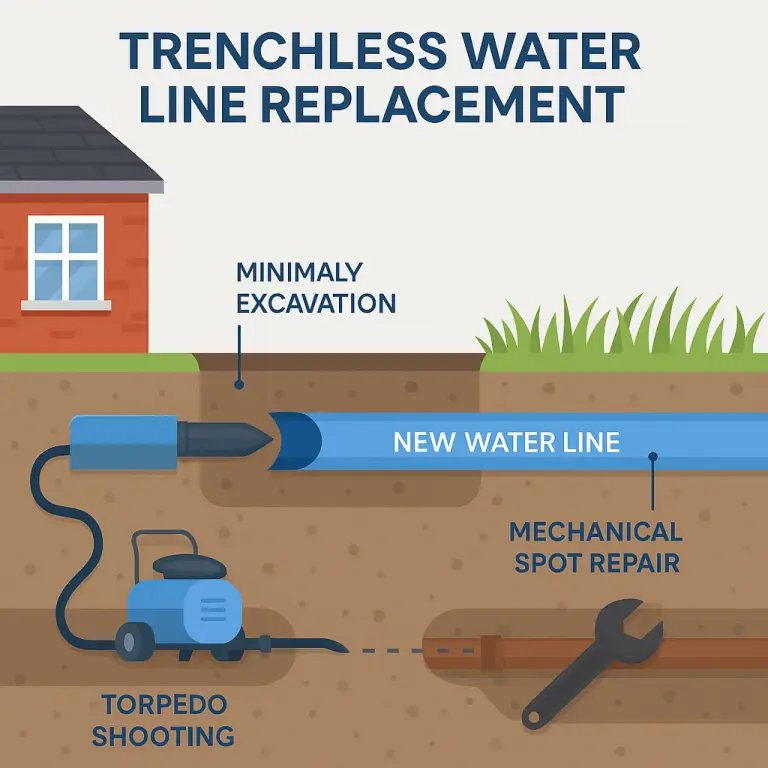
Replacing a buried waterline does not always require opening one continuous trench across the entire property. Where the route, soil and underground conditions allow it, reduced-excavation methods can create a new service path between planned access points and limit how much lawn, driveway, walkway or landscaping needs to be disturbed.
That approach can be extremely useful, but it should be described accurately. Reduced excavation still requires access, and underground utilities, soil conditions, elevation, the route into the building and connection points all influence whether the method makes sense. There are also properties where conventional excavation remains the better choice because direct access provides more control or the existing route contains conditions that need to be physically exposed.
Open excavation has advantages when a problem area needs to be inspected directly, when obstacles must be dealt with along the route or when the ground needs to be prepared carefully around the replacement. Reduced-excavation installation has advantages where the route is suitable and avoiding a long continuous trench significantly reduces restoration afterward.
Neither method is automatically superior. The installation method should follow the property and the waterline, rather than becoming the reason a particular scope is recommended.
The Connection Inside the House Is Part of the Same Project
A new underground service eventually has to pass through the foundation and connect to the plumbing inside the building. This transition can expose conditions that were previously hidden, including older shut-off valves, meter connections, corroded fittings or restricted interior piping close to the entry point.
Those conditions need to be judged individually. If the surrounding interior plumbing remains sound, there is no reason to turn an underground replacement into unnecessary whole-house repiping. If the connection immediately inside the building is already deteriorated or clearly unsuitable for the new service, leaving that weakness untouched simply because it sits a few feet beyond the excavation does not make much sense either.
Water meter relocation can also become relevant on properties where renovation plans or an existing configuration require the meter arrangement to change. That work needs to follow the requirements that apply to the property and should be coordinated with the rest of the water-service project rather than improvised after the new line has already reached the building.
A main-waterline installation is complete only when the buried service and the plumbing receiving it work properly together.
Repeated Freezing Can Point to a Service-Line Problem
A frozen water service is sometimes the result of unusually severe weather, but a line that freezes repeatedly deserves more attention. Depth, exposure, routing and conditions around the service can all influence how vulnerable the pipe becomes during prolonged cold.
The immediate priority during a freeze is restoring water without damaging the service or surrounding plumbing. Frozen Pipe Repair & Thawing addresses that immediate condition, but a recurring pattern may eventually justify investigating whether the buried service itself needs a more permanent correction.
Repeated thawing without asking why the same line keeps freezing can leave the homeowner facing the same problem every winter. At the same time, one freeze during exceptional weather does not automatically justify excavation and replacement.
As with other water-service problems, the history matters. The repair should respond to the pattern the system is actually showing.
Municipal and Private Portions Need to Be Understood Before Work Begins
A water service connects private plumbing to municipal infrastructure, which means there can be a division of responsibility along the route. Exactly where that division sits and what procedures apply can vary by municipality and by the type of work being completed.
That becomes especially important when older materials such as lead are involved, when the connection near the property line needs attention or when municipal coordination is required as part of the project. The private portion cannot simply be treated as though the entire route belongs to the homeowner without understanding how the local water-service arrangement is structured.
UPR plans the work around the requirements that apply to the specific property rather than assuming every municipality in the GTA follows the same process. Confirming those details before excavation helps avoid reaching a connection point underground and only then discovering that another party or approval needs to be involved.
The underground line may physically look like one continuous pipe, but the administrative responsibilities surrounding it are not always equally simple.
A Waterline Upgrade Should Match the Future House, Not Just the Current One
Some water-service projects are best considered before there is an emergency. A homeowner planning a substantial renovation may already know that the finished house will contain more bathrooms, additional fixtures or a different plumbing layout than the property has today.
That is a reasonable time to evaluate whether the existing service will remain appropriate after the work is complete. If the current line is already marginal under today’s demand, adding more simultaneous use without considering the incoming supply can leave a newly renovated house performing poorly despite extensive plumbing work inside.
The opposite is equally important. If the existing service is in good condition and provides adequate capacity for the planned property, replacing it simply because renovation is taking place creates work without solving a real problem.
UPR looks at water-service upgrades as part of the future plumbing demand rather than as an automatic addition to every large renovation. The goal is to make sure the buried supply is appropriate for the finished home without replacing a dependable line unnecessarily.
Main Waterline Repair & Replacement Across Toronto and the GTA
UPR provides main waterline repair, replacement and upgrades throughout Toronto and the Greater Toronto Area for properties dealing with underground leaks, restricted water services, older service materials, recurring failures or supply that no longer matches the way the home is being used.
Some projects involve one confirmed underground failure that can be repaired while the rest of the service remains in good condition. Others involve older or repeatedly failing lines where replacement makes more sense than continuing to open the property for additional repairs, while planned renovations may create an opportunity to evaluate capacity before the demand inside the house increases.
The method and scope depend on what we actually find. We look at the performance of the system, the buried service, interior connection, material, route, access and future requirements of the property before deciding whether the right answer is repair, replacement or upgrade.
If your home has an underground waterline leak, poor flow throughout the property, an older service that may be restricting supply or a planned renovation that could change the demand on the water system, call UPR. We’ll determine whether the problem belongs to the buried service, the plumbing inside the house or both, then build the work around the part of the system that genuinely needs to change.
UPR — We don’t fix. We solve.