





Before You Repair an Underground Drain, It Helps to See What Is Actually There
Most of a home’s drainage system does its work where nobody can see it. Pipes run beneath concrete, behind finished walls and underground between the house and the municipal sewer. When something begins going wrong, the symptoms usually appear upstairs long before the actual problem becomes visible.
A drain starts clogging more often. A toilet begins gurgling when another fixture is used. Water moves slowly through several drains at once, or a basement floor drain reacts every time the washing machine empties. Sometimes a sewer backs up completely, gets cleared, and the homeowner is left with the most important question still unanswered: why did it happen?
That is where a drain camera becomes useful.
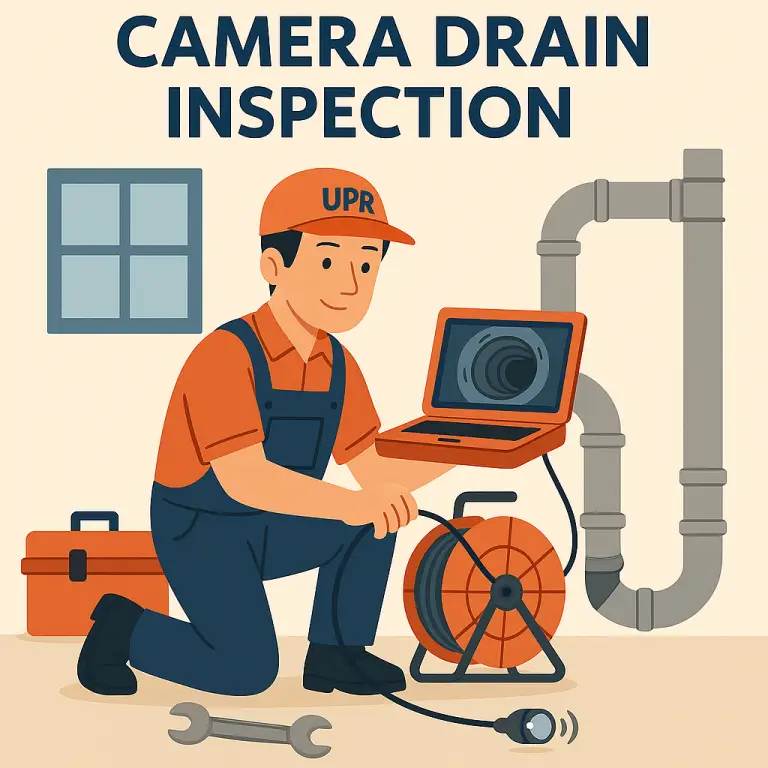
At UPR (Underground Plumbing Repair), we perform camera inspections throughout Toronto and the GTA to look inside drain and sewer lines before making decisions about larger repairs. A waterproof inspection camera travels through the drainage system and sends live video back to the technician, allowing us to see conditions that would otherwise remain hidden beneath the house or property.
The camera does not repair anything. That is not its job.
Its value is information.
Instead of deciding from the surface that a recurring blockage must be roots, or assuming an old clay sewer needs replacement simply because of its age, we can look inside the pipe and see what condition it is actually in. Sometimes that inspection confirms there is a structural problem. Sometimes it gives the homeowner much better news and shows that the line is still healthy after an obstruction has been removed.
Both answers are valuable because the point of an inspection is not to find a reason to excavate.
It is to understand the drain before we decide what happens next.
What We Can Learn From Inside the Pipe
A drain camera can reveal a surprising amount about an underground system when the line is open enough for the equipment to travel through it.
We may see a cracked pipe that is still carrying wastewater even though part of the pipe wall has failed. Fine root intrusion may be entering through an older joint and growing farther into the sewer. A clogged pipe may turn out to be ordinary accumulated debris, or the blockage may be collecting around a displaced connection or another irregularity inside the line.
The same inspection can reveal heavy grease buildup coating a kitchen drain, standing water through a sagging section, deterioration inside older piping or areas where separate sections of the sewer are no longer aligned the way they should be.
What matters is not simply finding something that looks imperfect.
Underground drainage, particularly in older homes, does not always look brand new on camera. A joint may show its age while continuing to function perfectly well. A section of cast iron may have a rough interior but still be structurally serviceable. A small amount of standing water in one area does not automatically justify opening the basement floor.
We look at what the camera shows in the context of the problem the homeowner is actually experiencing.
If the same sewer blocks repeatedly and the camera shows roots entering through several deteriorated joints, those two pieces of information belong together. If the main drain backed up once, was properly cleared and the inspection afterward shows a structurally healthy pipe, that tells a very different story.
That is why interpreting the footage matters just as much as producing it.
A camera can show us what is inside the line. Experience helps us decide what those images actually mean for the house.
A Camera Inspection Is Most Valuable When There Is a Reason for It
Not every slow bathroom sink needs a sewer camera.
If a simple fixture drain has collected hair or ordinary buildup and professional clearing restores normal flow, there may be nothing useful to gain from inspecting the entire underground system afterward.
The value of camera inspection increases when the problem has a history.
A main drain that keeps clogging after repeated cleaning deserves more attention. Several fixtures beginning to react together suggest the problem may be farther downstream than one sink or toilet. A previous sewer backup deserves an explanation once the line has been reopened. Roots that keep returning give us a reason to investigate where they are entering. A homeowner considering a major underground repair should know what condition exists beyond the first damaged section before concrete or soil is opened.
A camera can also be useful before purchasing an older property when the condition of the private sewer is an important concern. Homes throughout Toronto and the GTA can contain clay sewer pipe, cast iron, previous PVC repairs or combinations of several materials installed at different times. The plumbing visible inside the mechanical room does not necessarily tell you what continues underground toward the street.
But even in those situations, we do not like calling camera inspections a guarantee against “surprises.”
There are limits to what any inspection camera can tell us. Heavy debris or a complete obstruction may prevent the equipment from travelling farther. A collapsed section can stop the camera entirely. The camera sees the inside of the pipe, not every condition in the soil surrounding it. Some defects become much clearer once the pipe is physically exposed than they appeared from inside.
That does not make the inspection less useful.
It means we use the camera for what it does exceptionally well: giving us a direct visual look at a system that would otherwise be completely hidden.
The more we can learn before excavation begins, the more deliberate the repair can be.
The Camera Should Help Make the Repair Smaller, Not Automatically Bigger
One of the biggest reasons we use camera inspections is to avoid unnecessary work.
Imagine a homeowner who has been told the main sewer needs complete replacement because the drain has blocked several times. Once the line is cleared and inspected, we may discover that the majority of the sewer remains in good condition and only one localized section is causing the problem.
That changes the project.
The opposite can happen too. A homeowner may expect one small repair because a blockage keeps appearing in the same area, but the camera shows several deteriorated joints, extensive root entry or damage continuing farther through the line.
That changes the project as well.
Neither result should be decided before we look.
If the problem can be handled with cleaning, we do not need to turn it into drain repair. If one damaged section needs attention, we should not automatically replace the entire sewer. And if a larger portion of the line has genuinely deteriorated, patching the first visible failure while ignoring everything around it may not be the smartest use of the homeowner’s money.
The camera helps us build the scope around the actual condition of the pipe.
It can also help us decide how that repair should be approached. If a large underground section needs replacement and the route and condition are suitable, trenchless sewer services may reduce the amount of excavation required above the line. On another property, direct excavation may give us better access and control.
Again, the inspection does not choose the method by itself.
It gives us better information before we choose.
That is the difference between using a camera as a diagnostic tool and using it as something impressive to show on a screen.
Camera Inspections Across Toronto and the GTA
UPR performs drain and sewer camera inspections throughout Toronto and the Greater Toronto Area for homeowners, contractors and properties where the condition of the underground drainage needs to be understood before the next decision is made.
Some inspections begin after a blockage has been cleared. Others are part of diagnosing recurring sewer problems, investigating root intrusion or planning an underground repair. We also use cameras during larger projects when seeing the condition and route of the existing drainage helps us understand what needs to happen next.
Every inspection has the same basic purpose: replace assumptions with information.
We feed the camera through the accessible drainage system, watch how the line behaves and explain what we are seeing in language that makes sense. If the pipe is healthy, we are happy to tell you that. If something needs attention, we show you where the problem is and explain how serious it appears to be in the context of the rest of the drain.
Sometimes the answer is cleaning.
Sometimes it is one targeted repair.
Sometimes the pipe has reached the point where a larger replacement makes more sense.
And sometimes the best outcome of the inspection is realizing that nothing underground needs to be replaced at all.
That is what good diagnosis is supposed to do.
If your main drain keeps clogging, you have experienced a sewer backup, roots continue returning or you simply need to know what condition your underground drainage is in before making a repair decision, call UPR.
We’ll look inside the line, show you what we find and explain what the drainage system actually needs before anybody starts opening the property.
You cannot make a good underground decision from above the floor.
Sometimes you need to see the pipe first.
UPR — We don’t fix. We solve.
OR