





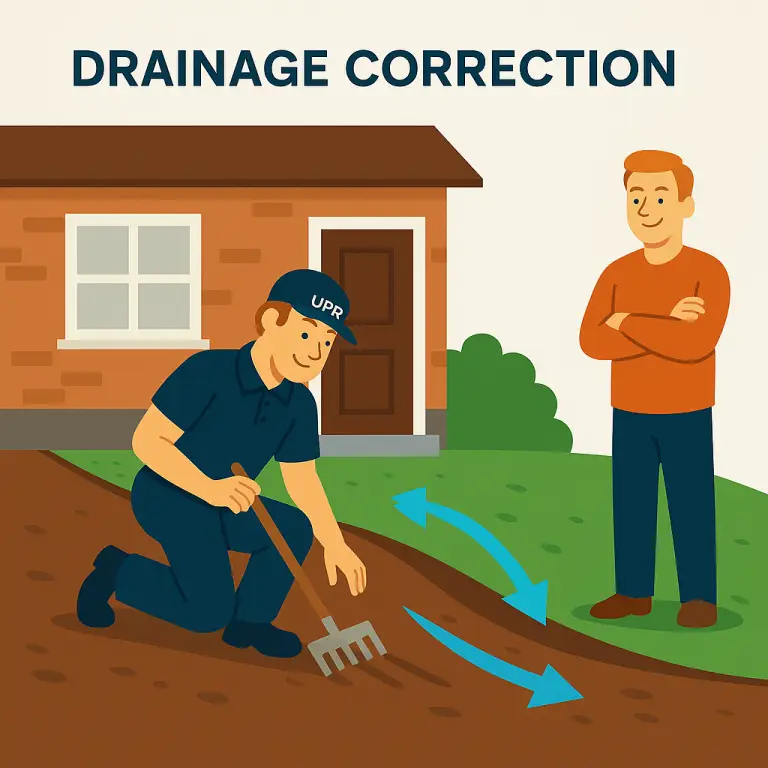
Water Problems Around a Property Rarely Have One Standard Answer
Water around a home can come from several directions and move through several layers of the property before it becomes a problem. Rain falls from the roof and travels across lawns, patios and walkways, snowmelt saturates the ground, and groundwater continues moving below the surface long after a storm has passed. When those paths are working properly, water has somewhere reasonable to go and the foundation is not being asked to manage more moisture than necessary.
Problems begin when one part of that movement changes. Soil settles, a low area develops, landscaping alters the original slope, a window well starts filling, or water remains trapped below the surface because there is no effective route for it to continue. Two homeowners can both describe “water beside the house” while dealing with completely different conditions underneath.
At UPR (Underground Plumbing Repair), we provide drainage improvements throughout Toronto and the GTA by first identifying which part of the property’s water-management system is no longer doing its job. That matters because installing the wrong drainage solution can be just as ineffective as doing nothing at all.
Drainage problems rarely fit one standard repair, so the first job is understanding which part of the property’s water-management system needs attention before deciding whether the answer is grading, a French drain, foundation drainage, window-well work or something else.
Start With the Water, Not With the Product
It is easy to look at a wet yard and immediately think about installing a drain. The better question is why the water is staying there in the first place.
A low section of lawn may simply lack enough surface slope to move runoff naturally. Water beside a basement window may be arriving because the surrounding ground is directing rainfall toward the well. Saturated soil farther from the house can indicate that water is collecting below the surface, while moisture around the footing may involve the foundation drainage system rather than the landscaping above it.
Those conditions can look similar from a distance because they all involve unwanted water, but each one needs a different response. Before choosing an improvement, we look at where the water begins, how it reaches the affected area, how long it remains there and what realistic route exists for moving it somewhere more appropriate.
That approach keeps the solution tied to the property rather than forcing the property to fit whatever drainage product happens to be easiest to install.
Surface Water Should Be Managed While It Is Still on the Surface
The simplest drainage problems are often the ones that can be corrected before water enters the soil in the first place. When the ground slopes toward the foundation or a settled area traps runoff beside the house, grading and drainage correction may be enough to restore a useful surface path.
The surrounding property has to be considered at the same time. Downspouts can concentrate large amounts of roof water into one area, patios and walkways can redirect runoff much faster than soil, and neighbouring elevations can determine whether water has somewhere to continue once it reaches the side of the house.
Simply adding soil beside a foundation does not automatically solve those conditions. The new grade needs somewhere to lead, and that route has to work with doors, windows, siding, walkways, driveways and neighbouring property lines.
When surface drainage is the real problem, correcting it early is often the cleanest solution because it reduces the amount of water entering the ground around the foundation in the first place.
Some Water Needs a Controlled Route Below the Surface
There are properties where surface grading alone cannot provide enough drainage. The yard may contain a natural low area, the available elevations may be too limited to create useful surface flow, or water may continue moving through saturated soil even after rainfall has stopped.
A French drain can be useful in those situations because it creates a controlled underground path through which water can collect and move. The system typically uses a trench, drainage stone and perforated pipe positioned where subsurface water is actually travelling.
Placement matters more than the name of the system. A French drain installed in an area that water does not naturally reach will accomplish very little, while one installed at the correct elevation but without a sensible discharge point can simply collect water without solving where it ultimately needs to go.
The surrounding grade still matters as well. A French drain should not be expected to compensate indefinitely for obvious surface runoff being directed into the same area if that runoff can reasonably be corrected before it enters the soil.
Good drainage often comes from making the different layers of the property work together rather than asking one system to manage everything.
Window Wells Need Their Own Drainage Logic
A below-grade basement window creates a deliberate opening in an area that would otherwise be continuous foundation wall. The window well creates space around that opening, but it also forms a low point where water can collect if runoff is directed toward it or drainage at the bottom stops working properly.
When water repeatedly accumulates in the well, window well drainage needs to be looked at as a localized system. The condition of the drain below, the elevation of the surrounding soil and the amount of surface water entering the well all influence whether it can manage rainfall safely.
Improving the drain at the bottom while leaving surrounding soil pitched directly toward the window may reduce the problem without correcting the reason the well keeps being overloaded. In the opposite situation, excellent surface grading cannot compensate for a blocked or disconnected drain if water naturally reaches the well during severe weather.
Window-well problems are a good example of why drainage improvements cannot be reduced to one standard installation. The visible water may be concentrated in one small area, but understanding why it accumulates there determines whether the repair belongs above ground, below ground or in both places.
Foundation Drainage Works at a Different Level
Water that has already moved into the soil around the house eventually reaches the lower portion of the foundation. This is where the weeping tile system becomes important.
Weeping tile is installed around the footing to collect and manage water at the base of the foundation. Its job is very different from grading the yard or installing a French drain farther across the property, because by the time water reaches the footing it has already travelled below the surface.
When that system becomes restricted, damaged or disconnected, water can remain around the foundation longer than intended and increase the pressure against below-grade walls. Depending on how the drainage is arranged, collected water may move toward a storm connection or into a sump basin where a sump pump completes the path by moving it away from the home.
That entire route needs continuity. Improving the surface can reduce how much water eventually reaches the footing, but surface work cannot physically reopen a failed foundation drain. In the same way, replacing foundation drainage does not make sense if the real problem is simply a low section of lawn sending rainfall toward one corner of the house.
A Sump Pump Is Only One Part of the Drainage Path
When foundation drainage terminates in a sump basin, the pump becomes the final mechanical step in moving collected groundwater away from the house. It is an important piece of flood protection, but the pump can only handle water that successfully reaches the basin.
If the drainage leading toward the sump is blocked or poorly configured, installing a larger pump does not necessarily improve collection around the foundation. Likewise, if the property is delivering excessive surface water toward the house during every storm, the sump system may be forced to work much harder than it otherwise would.
Frequent sump operation can therefore be useful information rather than an automatic sign that the pump itself has a problem. We look at what is feeding the basin, whether the drainage path is functioning properly and whether conditions outside the home are contributing an unnecessary amount of water.
A drainage system works best when each component is doing the job it was actually designed to do instead of compensating for a failure somewhere else.
When Water Reaches the Basement
Once water is already appearing inside the basement, the investigation changes because drainage outside the home is no longer the only consideration. We need to understand how moisture is crossing the foundation and whether the entry point is localized or part of a wider below-grade condition.
A visible foundation crack may provide one direct route. Water appearing along the wall-to-floor joint can suggest another path, while broad dampness across a wall may indicate that the foundation is dealing with moisture over a larger area.
Drainage improvements can still be an important part of the solution because reducing unnecessary water around the house lowers the burden on the foundation. They should not, however, be used to pretend a leaking foundation wall has been repaired when it has not.
When water entry has already become part of the problem, the investigation may extend into basement waterproofing so the condition of the foundation and its surrounding drainage can be considered together.
Property Drainage Is Not the Same as Household Drainage
The word “drain” gets used for several completely different systems around a home, and that can create understandable confusion. A French drain in the yard and the pipe leaving a kitchen sink may both disappear underground, but the water travelling through them has a completely different origin and destination.
Property drainage is different from the wastewater pipes serving kitchens, bathrooms and fixtures. Household drains and sewers carry wastewater away from the building, while grading, French drains and foundation drainage manage rainwater and groundwater around it. Both may run underground, but they solve very different problems.
If sinks are backing up, toilets are affecting the basement drain or wastewater is not leaving the house properly, that belongs to the drain repair side of the plumbing system. Changing the yard grade or installing a French drain will not repair a collapsed sewer, just as snaking the household drain will not move standing rainwater away from the foundation.
Keeping those systems technically separate helps us diagnose them properly. The water itself tells us which system we need to follow.
Sometimes Several Drainage Conditions Are Connected
A property does not always present one perfectly isolated problem. A downspout may discharge into a settled side yard, that low area may keep the soil against the foundation saturated, and an older foundation drainage system may already be struggling to manage groundwater at the footing.
Correcting only one element may still improve the situation, but the amount of improvement depends on what the remaining systems can handle. This is where looking at the complete water path becomes particularly useful.
The solution also does not automatically mean installing everything available. A combination might involve regrading one area and adding a subsurface drainage route, while another property may need only a window-well correction. A third home may have perfectly acceptable landscaping and require attention entirely at the foundation drainage level.
The point is to combine systems only when the conditions actually connect them.
Drainage Changes Over the Life of a Property
A drainage plan that worked when a house was built can change gradually as the property around it changes. Soil settles, trees mature, landscaping is rebuilt, driveways and walkways are replaced, additions alter roof areas and neighbouring properties may change elevation.
None of those changes has to be extreme to affect water movement. Raising one garden bed can alter a surface path, while replacing an old driveway can change the direction of a significant amount of runoff. Even normal settlement beside the foundation can gradually reverse a slope that originally carried water away correctly.
Toronto and GTA properties can make those changes particularly noticeable because many lots have limited room between homes. In a narrow side yard, a relatively small difference in elevation can determine whether runoff continues toward the street or rear yard or remains trapped between two foundations.
That is why drainage should be evaluated based on how the property works today rather than how it was intended to work decades ago.
Heavy Rain Often Reveals the Weakest Part of the System
A drainage system may appear perfectly adequate during ordinary rainfall and struggle only when a major storm delivers water faster than the property can move it. That does not automatically mean every component needs to be rebuilt.
Severe weather is useful because it exposes the points where water concentrates. A low area fills first, a window well begins receiving runoff, a sump basin fills rapidly or the soil beside one wall remains saturated long after other areas have drained.
Those observations help us understand capacity as well as direction. The system may be routed correctly but unable to handle exceptional flow, or the storm may simply make an existing grading problem much easier to see.
Snowmelt can reveal similar weaknesses because frozen or partially frozen soil absorbs water differently from summer ground. A property that handles normal rainfall well may experience significant surface runoff during a rapid thaw, particularly where snow has accumulated beside the house.
Drainage improvements need to account for the conditions the property realistically experiences, not just how the yard behaves on a dry day.
Building the Improvement Around the Actual Property
There is no useful one-size-fits-all drainage package. A wide property with room to create natural surface flow gives us options that may not exist between two closely spaced Toronto homes, while a deeply landscaped yard presents different constraints from an open lawn.
Existing structures matter as well. Driveways, patios, decks, retaining walls, walkways, fences and finished landscaping can all influence both the way water moves and how practical it is to reach the areas that need attention.
For that reason, we look at drainage as a route rather than as an individual component. Water has an origin, a path and eventually needs a destination. A useful improvement changes one or more of those parts so water stops accumulating where it creates trouble.
With more than 20 years of hands-on plumbing, waterproofing and underground experience, UPR approaches these properties from both above and below grade. That allows us to recognize when the answer can stay on the surface and when the real condition sits deeper around the foundation.
Drainage Improvements Across Toronto and the GTA
UPR provides drainage improvements throughout Toronto and the Greater Toronto Area for properties dealing with standing water, saturated soil, runoff toward the house, window-well drainage problems and foundation drainage that is no longer performing effectively.
Some properties need one targeted correction. Others have several contributing conditions that developed gradually as soil settled, landscaping changed or older drainage systems became less effective. The purpose of the assessment is to separate those conditions and understand which ones actually need to be changed.
If grading can create a reliable path, the work can stay focused on grading. If subsurface water needs to be intercepted, a French drain may be appropriate. If one window well is taking on water, the solution can concentrate there, while problems at the footing require us to look deeper at the foundation drainage system.
If water repeatedly collects around your property and you are not sure which type of drainage work you actually need, call UPR. We’ll follow how the water is moving, determine which part of the system is failing and build the improvement around the property rather than around a predetermined product.
UPR — We don’t fix. We solve.