





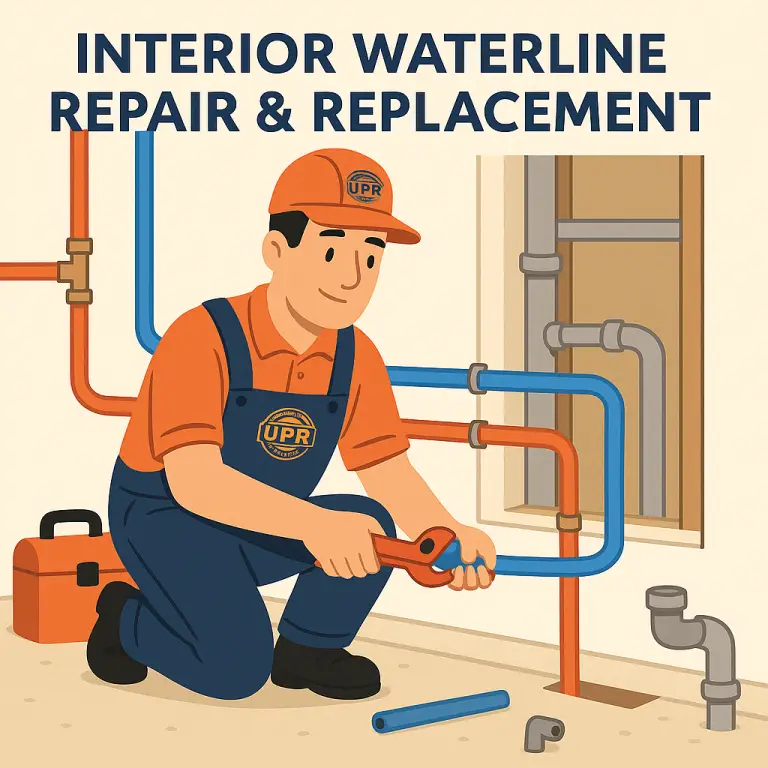
The Waterline You See Leaking Is Only One Part of the System
Most interior waterlines spend their entire working life hidden behind walls, above ceilings, below floors and inside mechanical spaces. When everything is working properly, there is little reason to think about them. Water arrives at the kitchen sink, the shower maintains the temperature you expect, the washing machine fills normally and every fixture receives the supply it needs without drawing attention to the piping that makes it possible.
Usually, homeowners begin thinking about those pipes only when something changes. A stain appears on a ceiling, a section of drywall becomes damp, water begins collecting inside a cabinet, an exposed connection shows corrosion or a supply problem starts affecting one part of the house. In some homes, the issue turns out to be one isolated failure. In others, it becomes the latest problem in a plumbing system that has already been repaired several times.
At UPR, we repair and replace the pressurized water piping that distributes water through the home after the service enters the building. Problems in the buried service bringing municipal water to the property are handled separately because the two systems are connected but diagnosed and repaired differently.
Understanding that distinction is important because a water problem inside the house does not automatically mean the interior piping is responsible. Moisture beneath a sink may come from a faucet connection, a shut-off valve, a drain or the waterline itself. Water appearing through a ceiling may originate from a pressurized supply pipe, but it can also travel from another fixture or plumbing connection before becoming visible somewhere else.
The first job is therefore not deciding what to replace. It is finding where the water is actually coming from and understanding what the surrounding plumbing is telling us.
One Leak Does Not Automatically Mean the House Needs Repiping
A single leaking fitting or damaged section of pipe can be exactly that: one localized failure. If the surrounding waterlines remain in good condition and the rest of the system has been performing reliably, repairing the affected section may be all the house needs. There is no reason to turn one isolated leak into a larger repiping project simply because more plumbing exists behind the wall.
The situation changes when the history of the system begins showing a pattern. If walls have already been opened several times for leaks in different locations, if older piping is visibly deteriorating or if previous repairs have created a patchwork throughout the house, continuing to repair one short section after another may stop making sense. At that point, it becomes reasonable to look at the condition of the interior water distribution system as a whole rather than concentrating only on the pipe that happened to fail today.
A proper recommendation depends on more than age. The material, condition, previous repair history, accessibility and future plans for the home all matter. An older system that remains sound can continue performing reliably, while a newer installation with poor connections or workmanship can create problems much sooner than expected.
That is why UPR approaches interior waterline work from the condition of the plumbing rather than from a blanket rule about when piping should be replaced. With more than 20 years of hands-on plumbing and underground experience, we have seen homes where one focused repair was clearly the right answer and others where years of recurring failures finally made repiping the more practical long-term decision.
Finding the Source Before Opening Finished Walls
Water can travel surprisingly far from the place where a leak actually begins. It may run along framing, follow a pipe, collect above a ceiling or move behind finished surfaces before it finally becomes visible. The first wet spot a homeowner finds can therefore be an important clue without necessarily identifying the exact location of the failure.
That matters because opening finished walls or ceilings should not be the first step when the location of the problem can be narrowed down beforehand. We look at when the moisture appears, which fixtures are being used, where the waterlines run and whether nearby plumbing components could be responsible. A leak that occurs continuously behaves differently from one that appears only when a particular fixture operates, and those differences help guide the investigation.
Pressure and flow complaints also require the same discipline. Reduced flow at one faucet may be caused by the fixture, aerator, cartridge, shut-off or a localized restriction nearby. When several fixtures throughout the property are affected, the investigation needs to widen because the cause may be farther upstream.
The goal is to follow the symptoms back toward the actual problem before disturbing more of the house than necessary. Good diagnosis saves unnecessary demolition, but more importantly, it keeps the repair focused on the plumbing that actually needs attention.
Repairing Copper, PEX and Mixed Plumbing Systems
Homes throughout Toronto and the GTA often contain plumbing installed during different periods. One part of the house may still contain older copper while a renovated bathroom, kitchen or basement has newer PEX. Previous repairs may have introduced transitions between materials, and additions can create completely new branches connected to plumbing that has been in service for decades.
Having more than one plumbing material in the same home does not automatically mean there is a problem. Copper and PEX are both widely used for interior water distribution, and each can provide dependable service when it is properly installed and suited to the application. What matters more than having every pipe look identical is the condition of the existing material, the quality of the connections and whether the system is performing reliably.
When we repair one section of waterline, the replacement needs to make sense with the piping around it. Connections should be made properly, piping should be supported correctly and valves or fittings that require future access should not be buried somewhere they cannot reasonably be reached again. Once the water is restored, the repaired section also needs to be checked under operating conditions before walls or ceilings are closed.
Repiping requires the same attention on a larger scale. The objective is not simply to remove older pipe and replace it with newer material. The new layout should serve the fixtures properly, avoid unnecessary routing, provide sensible isolation where appropriate and work with the way the home is currently configured rather than recreating weaknesses from an old installation with new pipe.
Water Pressure and Flow Problems Need Proper Diagnosis
Homeowners often describe weak flow as low water pressure, but what is felt at the fixture can be influenced by several parts of the plumbing system. A restriction in aging interior piping can reduce performance, but so can a partially closed valve, a problem at the fixture or a limitation elsewhere in the supply system.
When the problem affects only one fixture, we first look locally because replacing interior piping throughout the house would make little sense if the restriction is sitting inside one faucet or valve. When several fixtures are affected, especially when using more than one fixture causes a noticeable drop in performance, the investigation becomes broader.
Interior piping is only one part of that picture. The underground main waterline brings the municipal supply toward the home, and the interior system distributes that water after it enters the building. A problem with either side can affect what the homeowner experiences at the fixture, which is why poor performance should be traced through the system rather than automatically blamed on whatever pipe is easiest to reach.
Replacing sound interior waterlines cannot correct a problem that originates in the buried service, just as replacing the underground service will not solve a restriction located inside one bathroom. Finding the correct side of the system before recommending work is what keeps the solution proportional to the actual condition.
Renovations Are an Opportunity to Look at What Will Soon Be Hidden Again
Renovation work often exposes plumbing that has not been visible for many years and may not be easily accessible again once new drywall, tile, cabinetry and finished ceilings are installed. That does not mean every exposed waterline should automatically be replaced, but it does create a valuable opportunity to look at the condition of the system before everything is covered again.
If a bathroom renovation exposes sound piping that has been performing reliably, there may be no reason to disturb it beyond the connections required for the new layout. If the same renovation reveals deteriorated pipe, questionable previous repairs or a history of leaks in nearby sections, addressing those conditions while the walls are already open may make considerably more sense than rebuilding the finished room around plumbing that is already causing concern.
The same principle applies during a washroom rough-in, laundry rough-in or larger basement plumbing rough-in. New fixtures need water supply planned around their final locations, and existing lines may need to be extended, redirected or upgraded to support the new layout. Looking at the entire exposed area allows the old and new plumbing to work together instead of treating each connection as an isolated piece.
The objective is not to use an open wall as an excuse to create more work. It is to avoid closing expensive finishes over a known problem that would have been far easier to address while access was available.
Partial Repiping Can Sometimes Make More Sense Than All or Nothing
Repiping does not always need to mean replacing every waterline in the house. In some properties, one area may have deteriorated or become unreliable while another portion of the plumbing remains in good condition. A renovation may also make one section readily accessible while the rest of the system is performing normally and hidden behind finished areas.
In those situations, partial repiping can sometimes be the most practical approach. A deteriorated run can be replaced, a group of fixtures can receive new supply piping or an accessible section of older plumbing can be upgraded without automatically disturbing dependable piping elsewhere in the home.
The decision still needs to look beyond the immediate opening in the wall. If the remaining system has already developed repeated leaks or shows the same deterioration as the section being replaced, limiting the work may only postpone the next repair. On the other hand, replacing reliable plumbing simply because another section failed does not automatically create a better result.
The scope should follow the evidence. That may lead to a localized repair, a larger partial replacement or a complete interior repipe, but the recommendation should come after looking at the system rather than before.
Good Waterline Work Is About What Happens After the Wall Is Closed
Most interior waterline repairs eventually disappear. Drywall is restored, cabinetry goes back into place and the homeowner stops seeing the pipe altogether. The quality of the plumbing underneath those finished surfaces therefore matters much more than how impressive the work looks while the wall is open.
Proper routing and support help protect the system over time, while good connections reduce the chances of future leakage at the repair. Shut-offs need to work when they are eventually required, and any transition between piping materials should be made intentionally rather than improvised simply because two different systems happened to meet in the same wall.
This is especially important during repiping, where decisions made during installation can affect maintenance many years later. A cleaner and more logical layout can make future plumbing easier to understand, while carefully planned isolation can allow individual fixtures or sections to be serviced without unnecessarily shutting water down throughout the home.
The pipe itself is only part of the installation. How the entire system is arranged determines how well that pipe can do its job.
Interior Waterline Repair & Repiping Across Toronto and the GTA
UPR provides interior waterline repair and repiping throughout Toronto and the Greater Toronto Area for homes dealing with active leaks, aging supply piping, recurring failures, renovation work and plumbing systems that are no longer performing as reliably as they should.
Some projects begin with one visible leak and end with one properly repaired section of pipe. Others reveal a longer history of failures that makes a partial or larger repipe worth considering, while renovation projects often provide an opportunity to improve aging plumbing before the walls and ceilings are closed again. Each situation deserves to be judged by what is actually happening inside that particular home.
We do not assume that older plumbing automatically needs replacement, and we do not assume that every leak should be treated as an isolated problem. We look at the failed section, the surrounding piping, the repair history and how the system is performing as a whole, then recommend a scope that makes sense for the condition we find.
If you have an interior waterline leak, recurring supply-pipe problems, poor water flow or plumbing exposed during a renovation, call UPR. We’ll trace the problem, determine which part of the water system actually needs attention and build the repair around what will make the plumbing dependable again.
UPR — We don’t fix. We solve.