




When the Pipe Itself Becomes the Problem
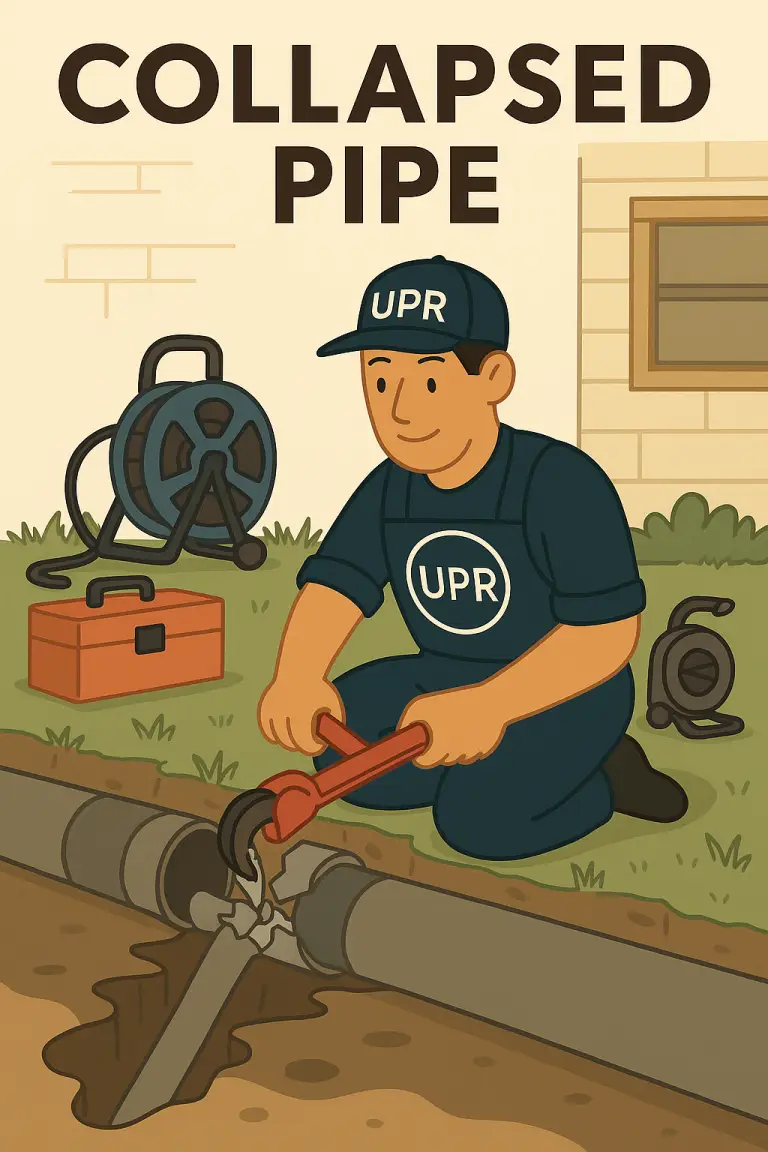
A clogged drain and a collapsed drain can sometimes look surprisingly similar from inside the house. Water begins moving slowly, a toilet starts gurgling, the basement floor drain reacts when another fixture is used, or the main line backs up and needs to be cleared. The difference is that a blockage is something inside the pipe. A collapse means the pipe itself has lost its shape, position or structural integrity and can no longer carry wastewater the way it was designed to.
That changes the repair completely.
At UPR (Underground Plumbing Repair), we diagnose and repair collapsed underground drain and sewer lines throughout Toronto and the GTA. Some failures happen beneath basement floors, while others are located outside the foundation along the sewer connection running toward the municipal system. The pipe may have deteriorated gradually over decades, shifted as the surrounding soil moved, failed at a weakened joint or been damaged after roots entered through an opening and continued growing.
Whatever caused it, the important part is determining exactly where the failure begins, how much of the line is affected and what condition the remaining pipe is in before deciding how much needs to be replaced.
A collapsed sewer is not something we diagnose from a slow sink alone. We follow the symptoms, open the line where possible and investigate what is actually happening underground.
A Pipe Usually Does Not Collapse Overnight
Underground drainage systems live in a difficult environment. Once a pipe is installed, it spends the rest of its life surrounded by soil, carrying wastewater while the property above it continues changing. Houses settle, soil moves, tree roots grow, driveways and landscaping are rebuilt, and older materials continue aging below everything we can see.
Clay sewer pipe is common in many older homes throughout the GTA. Clay itself can remain underground for a very long time, but the line is made from individual sections connected by joints. As those connections age or move, small openings can develop. A slight displacement may begin catching waste, groundwater or soil can interact with the damaged area, and roots may discover the moisture inside.
Root intrusion can make the condition progressively worse. Fine roots may enter first and continue expanding inside and around the pipe. Over time, the joint can become more damaged while the growing roots collect paper and waste moving through the sewer. What first appears to be an ordinary blockage can eventually become part of a much larger structural problem.
Cast-iron drains fail differently. As the material ages, corrosion can make the interior increasingly rough and eventually weaken the pipe itself. Other lines may be affected by settlement, inadequate support beneath the pipe, shifting soil or previous installation work that did not provide the drain with the stability it needed.
Even newer pipe is not indestructible if the conditions around it are wrong.
This is why we do not look at one failed section and automatically assume every foot of drain needs to disappear. We want to understand what caused that section to fail and whether the same condition continues farther through the system.
Sometimes the problem is isolated. Sometimes the collapse is simply the worst part of a drain that has been deteriorating for a long time.
Those are two very different jobs.
What a Collapsed Drain Usually Looks Like From Upstairs
The homeowner almost never sees the collapsed section itself. What they see is everything the damaged pipe causes.
A line may begin with recurring clogs that become increasingly difficult to clear. Several fixtures may start draining slowly because they all depend on the same restricted main line. Toilets can gurgle, floor drains may react when another fixture discharges, and eventually wastewater may have difficulty leaving the property at all.
A partial collapse can still allow some water through, which is one reason these problems can drag on for months. The system works just well enough to make the homeowner believe the latest drain cleaning solved it, then another blockage develops in the same area.
A complete collapse is different. If the pipe has closed to the point where wastewater cannot pass, the drainage system upstream has nowhere to send what the house is producing. The result can quickly become a sewer backup, especially when several fixtures are being used.
Sometimes there are signs outside the house as well. Depending on the location and type of failure, an exterior sewer problem can contribute to unusually wet soil, settlement or changes in the ground along the path of the line. Those symptoms are not proof of a collapsed sewer by themselves, but together with recurring drainage problems they give us another reason to investigate.
Finding a Problem We Cannot See From the Surface
Before concrete is opened or an exterior excavation begins, we want as much information as possible about where the damaged section is located.
When the line can be opened sufficiently, a camera inspection allows us to travel through the drain and see the condition of the pipe from the inside. A camera can reveal cracks, displaced joints, roots, deterioration, standing water and sections that have begun losing their proper shape.
A complete collapse may stop the camera entirely.
That is information too.
If the camera travels normally through the system and repeatedly stops at the same location because the pipe is physically closed or severely damaged, the problem can be located much more accurately than simply guessing from where symptoms appear inside the house. Depending on the situation and equipment being used, the camera or locating equipment can also help establish where that point sits beneath the floor or outside the building.
This matters because underground repair should be as deliberate as possible.
If six feet of pipe has failed beneath one part of a basement, there is no reason to randomly open twenty feet of concrete hoping to find it. The same principle applies outside. Before excavation begins, we want to understand the path of the sewer and where the failure appears to be located.
There are situations where the line is too badly obstructed for the camera to provide a complete view. There may be heavy roots, standing wastewater or a collapse so severe that the equipment cannot pass. In those cases, diagnosis becomes a combination of what the camera can show us, where it stops, the drainage layout and what we find once the affected section is exposed.
The purpose of the equipment is not to make underground plumbing look high-tech. It is to reduce unnecessary excavation and give us better information before we start opening the property.
Repair One Section or Replace the Line?
Finding a collapse does not automatically answer the next question.
The real decision is whether the failed section can be replaced while leaving the surrounding pipe in service, or whether the condition of the rest of the drain makes a larger replacement the more sensible solution.
Imagine an otherwise healthy drainage system that has one localized failure caused by settlement or damage at a particular point. If the pipe before and after that section remains in good condition, replacing the failed area can solve the problem without disturbing the rest of the system.
Now imagine an older clay sewer where the collapsed section is only one of several problems visible during inspection. Joints are displaced farther down the line, roots are entering at multiple locations and other sections are already showing significant deterioration. Replacing only the worst five feet may restore flow today while leaving several obvious future failures behind.
That does not mean every old sewer should be completely replaced. Age alone is not enough.
It means we look beyond the hole.
At UPR, drain repair is based on what the complete picture shows. We consider the material, location and condition of the pipe, how much of the system is affected, whether there have been previous repairs and what caused the collapse in the first place. Then we explain the difference between repairing the damaged section and replacing a larger portion of the line.
Once concrete is poured back or an exterior excavation is restored, nobody wants to reopen the same area because a clearly deteriorated section two feet away was ignored. At the same time, nobody should be replacing perfectly healthy pipe simply because one section failed.
The right scope lives somewhere between those two mistakes.
Excavation and Trenchless Replacement Both Have Their Place
Collapsed underground pipe can be repaired in different ways depending on where the failure is located and what condition the existing line is in.
Traditional excavation remains one of the most reliable ways to deal with a severely damaged section because it gives direct access to the pipe. Beneath a basement floor, that may mean opening the concrete, excavating to the drain, removing the failed section and installing new pipe before the area is properly backfilled and the floor restored. Outside the home, excavation may be required to reach a collapsed portion of the sewer and rebuild the connection directly.
There are also situations where trenchless sewer services can reduce how much of the property needs to be opened. Pipe bursting, for example, can replace an existing underground line through strategically located access points while pulling a new pipe through the path of the old one.
But trenchless replacement is not a magic answer for every collapse.
The route of the existing sewer, accessibility, changes in direction, connections along the line and the condition of the failed pipe all influence whether a trenchless method makes sense. A severely collapsed section can also limit what equipment can pass through the existing line.
This is why we do not decide on “dig” or “no dig” before understanding the sewer.
Sometimes trenchless replacement can save a driveway, landscaping or a long excavation and is clearly the better approach. Sometimes direct excavation gives us the access and control the repair requires.
The method should follow the pipe—not the advertisement.
What Happens Beneath the Finished Surface Matters Most
The part of collapsed-pipe repair that homeowners eventually see is usually the restoration.
Concrete gets poured back. Soil is returned. The excavation disappears and life above the drain begins looking normal again.
But the most important part of the project is what disappears underneath that finished surface.
A replacement drain needs proper slope so wastewater continues moving in the right direction. Connections between old and new piping need to be made correctly. The pipe needs proper support and bedding so it is not left hanging over voids or surrounded by conditions that can allow unnecessary movement later.
Backfill matters too.
Underground pipe should not be repaired beautifully and then buried carelessly. The work around the pipe helps support what we just installed, which means the repair is not finished simply because the new section is connected and water flows through it.
That is one reason UPR places so much emphasis on underground work before the surface is restored. Once the concrete or soil goes back, most homeowners will never see that pipe again.
That is exactly what we want.
Real quality underground is not something you should need to keep checking. It is something you should be able to forget about because it continues doing its job.
Collapsed Pipe Repair Across Toronto and the GTA
UPR repairs collapsed and structurally damaged drains throughout Toronto and the Greater Toronto Area, in homes where the underground plumbing can be as different as the houses above it.
Some properties still rely on original clay sewer lines. Others contain old cast iron beneath the basement floor, newer PVC from previous renovations and several generations of repairs connected together over time. We see drains beneath finished basements, driveways, front lawns and additions where access and repair strategy have to be considered just as carefully as the damaged pipe itself.
That is why we do not arrive with one standard repair already decided.
We locate the problem, determine how much of the line has actually failed and look at the condition of what remains. If a localized repair makes sense, we keep the work localized. If the system shows that a larger section has reached the end of its useful life, we explain why replacing more now may make more sense than repeatedly reopening the property later.
A collapsed drain cannot be snaked back into shape, and a broken section cannot be repaired by simply getting wastewater to squeeze past it one more time.
At some point, the pipe itself has to be dealt with.
If your main drain repeatedly blocks, several fixtures are draining poorly, sewage has backed up or a previous inspection has shown a damaged or collapsed underground line, call UPR. We’ll locate the failure, show you what we find and build the repair around the actual condition of the pipe.
UPR — We don’t fix. We solve.