




Grease Does Not Disappear Just Because It Went Down the Sink
Kitchen drains deal with something most other drains in the house do not: fats, oils and grease entering the system little by little over many years.
A small amount left on a frying pan may not seem important. Neither does the residue from a plate, a pot of sauce or the water used to wash greasy dishes. Everything appears to disappear once it passes through the sink opening, especially when hot water is running behind it.
The problem is that disappearing from the sink is not the same as disappearing from the drainage system.
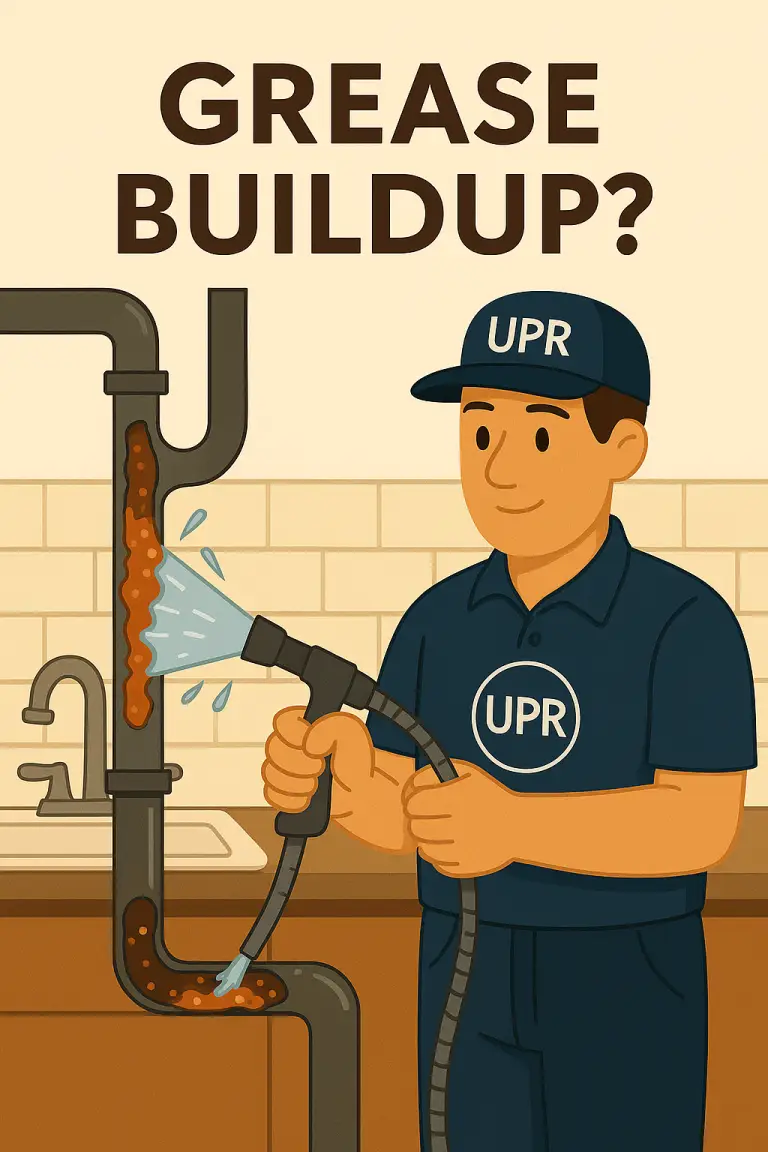
Once fats, oils and grease travel farther into the pipe and begin cooling, they can stick to the inside surface of the drain. More material arrives later and attaches to what is already there. Food particles and other debris can become caught in the buildup, and the inside of the pipe gradually becomes narrower even though nothing looks different from the kitchen above it.
At UPR (Underground Plumbing Repair), we deal with grease buildup in drains throughout Toronto and the GTA, from residential kitchen lines that have gradually become restricted to larger drainage systems where years of accumulated material are affecting normal flow.
The process usually happens slowly.
A kitchen sink that once emptied immediately starts taking a little longer. Then it begins holding water after dishes are washed. The drain gets cleared and works again, but several months later the same problem returns. Eventually the homeowner is no longer dealing with one unusual blockage. They are dealing with a pipe whose inside surface has accumulated enough material that clogging has become part of its normal behaviour.
That is when simply getting water through the drain is no longer the whole story.
Hot Water Can Move Grease Farther Down the Drain Without Making It Go Away
One of the most common ideas around kitchen plumbing is that hot water will flush grease through the pipe.
It can certainly move warm grease away from the sink.
That does not mean it removes it from the drainage system.
As the wastewater travels farther from the fixture and cools, fats and oils can begin hardening and attaching themselves to pipe walls farther downstream. Toronto specifically warns that fats, oils and grease cool, harden and stick inside sewer pipes, eventually creating blockages. The City also cautions that using hot water or other agents to move grease through commercial interceptors can simply shift the problem farther along the plumbing, where the material may harden again.
That is why grease problems are often found farther from the kitchen sink than homeowners expect.
The first few feet of visible piping beneath the cabinet may look completely reasonable while the branch line inside the wall, beneath the floor or farther downstream has become heavily restricted.
As the opening becomes smaller, water has less room to move. Solids passing through the drain have more opportunity to catch, and a line that originally had a grease problem can eventually behave like any other clogged pipe.
Clearing that blockage restores flow, but the amount of buildup left behind matters.
If the line has only a localized obstruction, ordinary mechanical clearing may solve the problem. If years of grease have coated a long section of the pipe, simply creating one small passage through the middle can allow the sink to drain again without returning much of the pipe to a cleaner usable opening.
That is why we pay attention to the history.
A kitchen drain that blocked once after an unusual event is one thing. A kitchen line that needs attention every few months is telling us there is probably more happening inside than one object lodged in one place.
The Goal Is to Remove the Buildup Without Pretending Every Slow Kitchen Drain Needs Major Work
Grease buildup should not automatically become an excavation project.
If the pipe itself remains healthy, the problem is inside the drain—not the structure of the drain.
Professional mechanical cleaning can often restore flow by breaking through and removing accumulated material. The equipment and approach depend on the size, material and condition of the line, as well as how extensive the restriction appears to be.
Older piping deserves more judgment than simply applying the most aggressive cleaning method available.
A badly deteriorated cast-iron drain, displaced joint or structurally damaged section needs to be understood before equipment is repeatedly forced through it. A cleaning method that is appropriate for healthy pipe may not be the right approach for a line whose structure has already become questionable.
This is one of the advantages of working with a company that does both drain cleaning and underground repair.
We are not only interested in whether the blockage opens. We are paying attention to how the line behaves while it is being cleared and whether anything about that behaviour suggests the problem goes beyond grease.
If the drain opens normally and continues accepting water properly afterward, that may be the end of the job.
If the same line has a long history of blockages, if cleaning repeatedly provides only temporary relief or if something about the pipe raises concern, a camera inspection can help us look farther into the system.
The camera may show that the pipe is structurally healthy and simply dealing with heavy buildup. That is useful information because it means there may be nothing to repair.
It can also reveal that grease is collecting around something else: an older rough section of cast iron, a displaced connection, a sag in the line or another defect that gives material an easy place to settle.
That distinction changes the conversation completely.
If grease is the problem, clean the grease.
If the pipe is helping create the grease problem, then we need to understand the pipe too.
Keeping Grease Out of the Drain Is Easier Than Removing It Later
Once a kitchen line has been properly cleared, the best way to reduce future buildup is not another product poured into the sink.
It is keeping as much fat, oil and grease out of the drainage system as reasonably possible.
Cooking grease and oils should be allowed to cool and disposed of appropriately rather than poured into a sink or toilet. Plates, pans and cookware can be scraped or wiped before washing so less material enters the drain, and sink strainers can help catch food solids before they become part of the problem.
Toronto gives homeowners essentially the same advice: fats, oils and cooking grease should not go down household drains because they can harden inside private plumbing and municipal sewer systems and contribute to blockages and backups.
This matters because there is no drain-cleaning service that can make a pipe permanently immune to everything sent through it afterward.
We can remove buildup.
We cannot make grease stop behaving like grease.
If the same amount continues entering the drainage system every day, material can accumulate again over time. The length of time that takes depends on the pipe, the amount entering it and the way the kitchen is used.
Commercial kitchens take that issue to another level. Restaurants and other food-service operations produce significantly more fats, oils and grease than an ordinary household, which is why grease interceptors exist in the first place. In Toronto, qualifying food-service establishments are required to install and maintain grease interceptors on drainage receiving grease-containing wastewater.
Whether we are looking at a family kitchen or a much larger commercial system, the principle underneath it is the same: the less grease that reaches the sewer, the less grease there is available to build up inside it.
When Grease Buildup Is Hiding Another Drain Problem
Most grease-related drain problems do not mean the pipe needs replacement.
But recurring buildup can sometimes expose another condition that has been there all along.
Older cast iron can become increasingly rough inside as it deteriorates, giving grease and food debris more surface to collect on. A sagging section can hold wastewater instead of letting it move continuously downstream. A displaced joint can create an edge where material repeatedly catches. Previous repairs can also introduce changes in the line that affect the way solids travel through it.
In those situations, cleaning the grease may restore drainage without changing the condition encouraging the buildup.
That does not mean we automatically recommend replacing the pipe.
It means we explain what we found.
There are many situations where continuing to maintain an older drain remains completely reasonable. There are others where the homeowner is repeatedly paying to clear a line that is structurally contributing to the same blockage over and over again.
If inspection eventually shows that the drain itself has reached the point where cleaning is no longer a sensible long-term answer, UPR also handles complete drain repair and replacement.
But that decision needs to come from the pipe—not from the presence of grease.
A dirty drain needs cleaning.
A damaged drain may need repair.
They are not automatically the same job.
Grease Buildup Drain Cleaning Across Toronto and the GTA
UPR clears grease-related drain restrictions throughout Toronto and the Greater Toronto Area in homes, commercial spaces and properties where kitchen drainage has gradually become slower or repeatedly blocked.
Some jobs are simple. The line has accumulated material, we clear it properly, normal flow returns and the homeowner changes what goes into the sink afterward.
Others have a longer history. The kitchen drain has been snaked several times, every service seems to help for a while and then the same problem comes back. That is when we want to look beyond the latest blockage and understand whether the pipe is simply accumulating grease again or whether another condition is giving that grease somewhere to keep collecting.
We do not need to turn kitchen drain cleaning into something complicated.
We simply need to be honest about what the drain is telling us.
If it needs cleaning, clean it.
If it keeps needing cleaning, find out why.
If your kitchen sink has become slow, grease-related blockages keep returning or you suspect years of buildup are restricting the line, call UPR. We’ll clear the drainage properly, look deeper when the history calls for it and tell you whether the pipe needs anything beyond cleaning.
The best grease problem is the one that never gets poured into the drain.
The next best thing is dealing with it before the opening disappears completely.
UPR — We don’t fix. We solve.