




Managing Water That Moves Below the Surface
Not every drainage problem is visible while the rain is falling. Some properties look reasonably dry on the surface and still remain saturated underneath for days afterward because water continues moving slowly through the soil. Other yards develop the same wet area repeatedly, even when the surrounding grade appears acceptable, because subsurface water naturally follows the elevations below ground and settles where it has no effective route to continue.
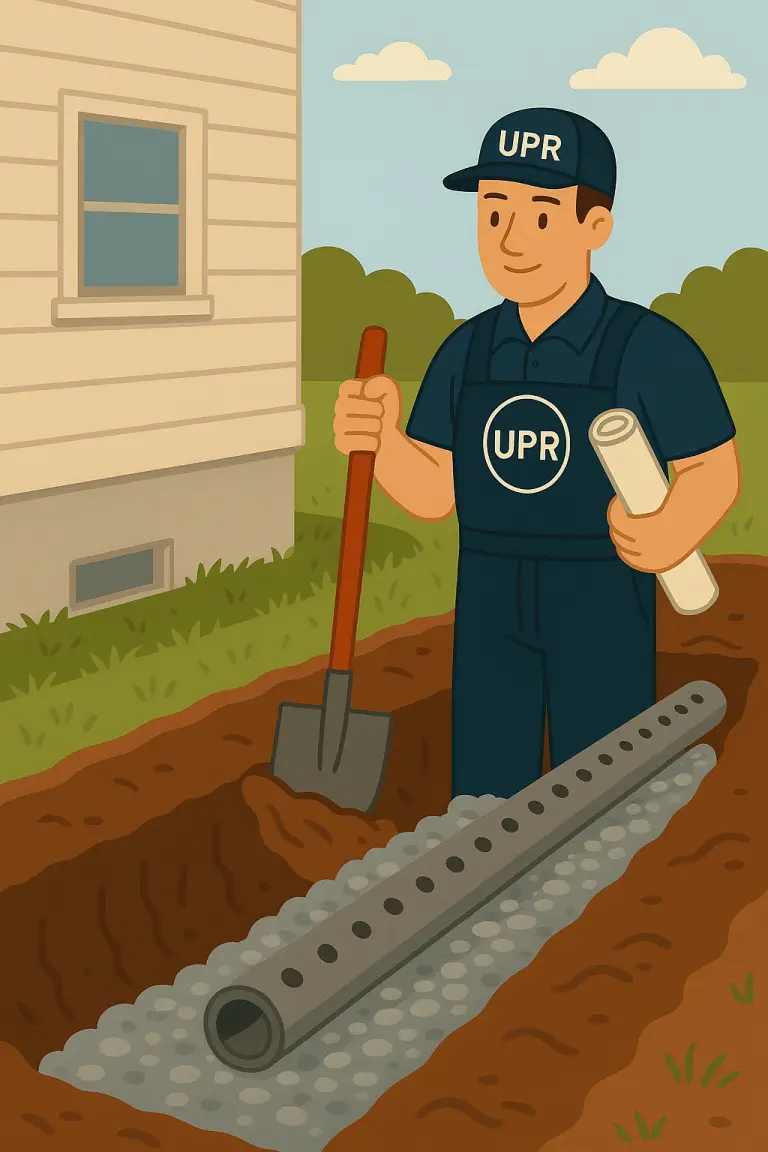
A French drain is designed to intercept that water and give it a controlled underground path. The system typically uses perforated drainage pipe surrounded by clean drainage stone so moisture moving through the surrounding soil can enter the trench and travel toward a suitable outlet instead of remaining trapped in one area. When it is properly positioned, a French drain can reduce persistent saturation and help prevent subsurface water from continually moving toward a low part of the yard, foundation area or another section of the property where it creates problems.
At UPR (Underground Plumbing Repair), we install French drains throughout Toronto and the GTA for homes dealing with wet soil, recurring standing water and drainage conditions that cannot be corrected through surface grading alone. With more than 20 years of hands-on plumbing, waterproofing and underground experience, we approach the system from the complete water path rather than simply digging a trench through the wettest part of the property.
The location of the drain, the depth of the trench, the available elevation and the final discharge point all need to work together. A French drain can use excellent pipe and stone and still perform poorly if it is installed in the wrong place or has nowhere useful to send the water it collects.
Finding the Water Path Before Choosing the Route
A wet yard does not automatically need a French drain. Surface runoff can collect because the lawn slopes toward a low point, a downspout releases roof water into the wrong area, a walkway redirects rainfall or settlement has changed the original grading around the property. When the problem is happening mainly above ground, grading and drainage correction may solve it more directly.
Subsurface drainage problems behave differently. The surface may dry while the soil below remains saturated, or water may continue migrating from a higher part of the property toward a lower section long after the rain has stopped. In those cases, the most useful location for a French drain may not be directly beneath the visible puddle. Intercepting the water earlier along its route can sometimes prevent the lower area from becoming saturated in the first place.
We therefore look at the shape of the property, neighbouring elevations, downspouts, hard surfaces, landscaping and the way the wet areas change after rainfall. The objective is to identify whether we are dealing with one natural drainage path, several independent sources or a simple surface problem that does not justify an underground system.
Planning begins with understanding where the water is coming from and where it is trying to go. Once that is clear, the trench can be positioned to work with the property rather than against it.
A French Drain Needs a Beginning, a Route and an Outlet
Collecting water is only the first part of a drainage system. Once water reaches the perforated pipe, it needs enough elevation and a clear route to continue toward an appropriate discharge point. That destination should be established before excavation begins because a drain that collects water successfully but cannot carry it anywhere useful has not solved the problem.
Where the property provides enough natural fall, gravity can move water through the system without mechanical assistance. This is usually the simplest arrangement because there are fewer components to maintain, but not every property has that option. A low backyard surrounded by higher land, a narrow side yard between buildings or a heavily finished property can limit the available elevation and restrict where collected water can reasonably be directed.
The outlet also has to be suitable for the amount of water the system may collect. Moving saturation from one part of the yard only to create erosion or standing water somewhere else is not an improvement, and a drainage correction should not simply push water toward a neighbouring property. Site conditions and local requirements therefore become part of the design when deciding where a French drain can discharge.
This is why the outlet is never an afterthought. The collection area, pipe route and final destination need to make sense as one continuous system before the trench is opened.
Depth and Elevation Have to Match the Problem
Water does not always move through soil at the same depth. Near the surface, rainfall and snowmelt can temporarily saturate the upper soil before drying, while in another part of the property water may consistently travel through a deeper layer above denser material.
A French drain should be installed at an elevation that allows it to intercept the water it is intended to manage. A shallow system can be effective for near-surface saturation but may not influence water moving deeper through the ground. Digging deeper is not automatically better either because additional depth can make discharge more difficult and may place the drain below the elevation of any practical outlet.
The trench therefore has to be planned in relation to both the water and the destination. Changing the depth at one end changes what is possible farther downstream, and every additional foot of excavation affects the available slope through the rest of the route.
The best installation is not the deepest trench or the largest pipe. It is the one positioned at the right elevation to collect the problem water and still move that water efficiently toward the outlet.
Building the Drain So Water Can Reach the Pipe
The perforated pipe inside a French drain does not pull water from the soil. Water first needs to move naturally into the drainage trench, which is why the material surrounding the pipe is such an important part of the system.
Clean drainage stone creates open space where water can travel much more freely than it can through compacted soil. A suitable filter or separation fabric helps reduce the movement of fine soil into that stone, protecting the spaces that allow water to reach the pipe over time. Once water enters the trench, the perforated pipe provides a defined path toward the outlet.
The dimensions of the trench, amount of stone, pipe size and overall design should reflect the conditions of the property rather than follow one standard formula. A small localized wet area does not necessarily need the same system as a long slope carrying groundwater across a large portion of the yard.
Good materials matter, but they cannot compensate for poor placement. The system works because the trench is located where water naturally reaches it, not simply because perforated pipe has been buried underground.
French Drains and Surface Drainage Often Work Together
Grading and drainage correction manages water before it enters the soil, while a French drain manages water after it has begun moving below the surface. On some properties, changing the surface slope is enough to solve the problem and there is no reason to add underground drainage.
Other properties have limited grading options because driveways, neighbouring homes, mature landscaping or existing structures fix the surrounding elevations. Even with reasonable surface drainage, the soil may remain saturated because water continues moving underground. A French drain can provide another path when surface corrections alone cannot reasonably carry that water away.
There are also properties where both approaches make sense. Surface runoff can be directed away from the problem area while subsurface drainage handles the portion that still enters and travels through the soil. The important part is making sure the two systems support each other instead of expecting one to compensate for an obvious weakness in the other.
A French drain should not spend its life receiving avoidable roof runoff or surface water that could have been redirected more simply, and grading should not be expected to dry soil that is continually being fed from below.
Downspouts Can Create a Drainage Problem Very Quickly
Roof drainage can concentrate a large amount of water into one relatively small part of the property. During heavy rainfall, a single downspout can discharge enough water to saturate an area much faster than ordinary rainfall falling directly onto the lawn.
If the outlet is located beside a low area or releases water onto soil that already drains poorly, the yard may remain wet long after the storm has passed. Before installing a French drain, we look at whether that concentrated roof water can be redirected more effectively and whether doing so changes the drainage problem enough to reduce the amount of underground work required.
There are situations where a French drain may still be useful near a downspout discharge, but we do not automatically connect roof water directly into the system simply because both involve drainage. Concentrated downspout flow behaves differently from groundwater entering slowly through perforated pipe, and the system has to be designed for the volume and destination if those flows are ever combined.
Reducing unnecessary water at the source is often just as important as improving the drainage path below.
A French Drain and Weeping Tile Do Different Jobs
A weeping tile system and a French drain can look similar because both may contain perforated pipe surrounded by drainage stone, but their location and purpose are different.
Weeping tile is positioned around the foundation footing and manages groundwater directly around the base of the house. It is part of the foundation drainage system and is intended to reduce the amount of water remaining against the lower portion of the foundation.
A French drain is usually located elsewhere on the property to intercept water travelling through the surrounding soil before that water reaches a problem area. It may run across a slope, through a saturated side yard or along another section of property where subsurface drainage needs to be improved.
The distinction matters when a basement is experiencing water. A French drain installed in the yard cannot repair damaged footing drainage beside the foundation, while replacing functioning weeping tile will not necessarily solve a wet area farther away from the house. Both systems can be part of a larger drainage strategy, but each needs to be used where it can actually influence the water.
A French Drain Does Not Waterproof the Foundation
Improving subsurface drainage can reduce the amount of water travelling toward the house, but a French drain does not physically repair or waterproof a leaking foundation wall.
If water is entering through deteriorated exterior waterproofing, a foundation crack or another opening in the structure, that condition needs to be evaluated separately. Reducing groundwater around the property may lower the amount of pressure against the foundation, but an established route through the wall can still require basement waterproofing or a more localized foundation repair.
This is particularly important when homeowners first notice the problem inside rather than outside. A damp basement wall and a wet yard may be connected, but the presence of one does not automatically prove that treating the other will solve everything.
When the basement itself is taking on water, we determine how that water is reaching the structure before deciding whether the main repair belongs in the yard, at the foundation or in both areas.
Window Wells Need Their Own Drainage Path
A wet area beside a basement window can make a French drain seem like an obvious solution, but the window well itself has a separate drainage job.
If water is repeatedly collecting inside one below-grade well and reaching the window, the surrounding grade and window well drainage should be inspected directly. A blocked or poorly arranged drain beneath the well may be the main problem even if the nearby yard also remains wet after storms.
A French drain can sometimes support the area by intercepting subsurface water before it reaches the well, but that only makes sense when the water path actually crosses the proposed trench. Installing underground drainage nearby simply because both problems involve water does not guarantee that the two conditions are related.
The repair should follow the route. If the well is the isolated problem, keep the work focused there. If a larger subsurface flow is feeding the entire area, then a French drain may become part of the broader solution.
Soil Conditions Affect How Quickly Water Can Reach the Drain
Different soils allow water to move at different rates. Granular soils can transfer moisture relatively quickly, while dense soils may hold water for longer and release it more gradually. Disturbed backfill from previous excavation may also behave very differently from undisturbed ground only a short distance away.
Those conditions affect how rapidly water enters the drainage trench and how large an area one French drain can realistically influence. A drain cannot instantly remove every drop of moisture from the surrounding soil, because water still has to migrate through that material before reaching the stone and perforated pipe.
This is why the history of the wet area matters. Soil that remains saturated for days after moderate rainfall tells us something different from a lawn that puddles briefly during an extreme storm and dries soon afterward.
Understanding how the soil holds and releases water helps us decide whether subsurface drainage is likely to provide a meaningful improvement and where the system should be placed to intercept the greatest amount of problematic flow.
Trees, Landscaping and Existing Features Affect the Route
The most direct drainage route on paper may not be the best route through an established property. Mature trees, garden beds, retaining walls, fences, irrigation lines, walkways and underground utilities can all influence where excavation is practical and how the system should be installed.
Tree roots deserve particular attention because they naturally seek areas where moisture is available. The design needs to consider the surrounding environment and choose a route and construction method that gives the drainage system a reasonable chance of remaining serviceable over time.
Restoration matters as well. Once the underground work is complete, the trench needs to become part of the property again. Lawn, garden areas and other finished surfaces should be restored appropriately so the drainage can continue doing its job below without leaving the yard looking permanently disturbed.
The best route therefore balances hydraulic performance with the physical reality of the property above it.
French Drains Can Last a Long Time, but They Are Not Maintenance-Free
A well-installed French drain can operate for many years with very little attention, but no underground drainage system should be described as permanently maintenance-free.
Fine sediment can gradually move into drainage material, tree roots and landscaping can change, outlets can become blocked and later work on the property can alter the elevations the system originally relied on. Most of the drain is hidden, which makes protecting the accessible parts of the system particularly important.
The outlet should remain open and able to discharge water freely. Where the design includes a cleanout or another inspection point, maintaining access can make future assessment easier if drainage performance changes years later.
Durability comes from good location, proper materials and a clear outlet, but long service life does not mean the surrounding property will never change. A drainage system should be designed with that reality in mind.
Several Wet Areas May Be One Larger Drainage Problem
A property can develop several visible wet spots even when one broader subsurface water path is responsible for all of them. Water may move downhill beneath the surface and become visible only when it reaches several lower points along the way.
In that situation, installing a separate small drain in every puddle can treat each symptom without addressing the route connecting them. A properly positioned interception trench farther uphill may provide a cleaner way to collect the same water before it reaches several problem areas.
The opposite can happen as well. Two wet areas located close together may have completely different sources, particularly where one receives roof runoff and the other is being fed by natural groundwater movement.
Looking at the entire property prevents us from assuming that every visible puddle needs its own system or that every wet area automatically belongs to one long drain.
Snowmelt Can Reveal Subsurface Drainage Problems
Spring thaw often exposes drainage conditions that remain less obvious during summer.
Partially frozen soil can limit how quickly water moves downward, causing melting snow to travel sideways through shallow soil layers or across the surface. Areas with poor drainage may become heavily saturated even when they do not regularly flood during summer storms.
Snow piled beside a fence, retaining wall or higher section of the yard can also release a significant amount of water into one area over a short period. Once that water enters the ground, it may continue moving through the property for days after the visible snow has disappeared.
These seasonal patterns give us more information about the direction and persistence of subsurface flow. A French drain should be planned around how the property behaves under real Toronto and GTA conditions rather than only how the lawn looks during dry weather.
What We Look at Before Recommending a French Drain
Before recommending excavation, we want to understand how the property is carrying water from beginning to end. We look at the location of saturated soil and standing water, surrounding elevations, downspouts, neighbouring grades, hard surfaces and any existing drainage systems that may already influence the area.
We also look for a realistic destination. If there is no sensible outlet and no practical way to create one, installing perforated pipe simply because the yard is wet does not create a complete drainage solution.
The amount of time the area remains wet matters as well. Temporary saturation during an exceptional storm is different from soil that stays wet for days after ordinary rainfall, and that history helps determine whether the condition justifies underground interception.
If surface grading can solve the problem more simply, we keep the solution on the surface. If water is clearly moving through the soil and the property provides a workable route and outlet, a French drain may be the right way to control it.
French Drain Installation Across Toronto and the GTA
UPR installs French drains throughout Toronto and the Greater Toronto Area for properties dealing with persistent soil saturation, recurring standing water, poorly drained low areas and subsurface flow that continues moving toward parts of the property where it creates trouble.
Some systems are relatively short and focused on one problem area, while others need to intercept water moving across a larger section of the property. The size of the project should reflect the actual drainage pattern rather than an assumption that more pipe automatically creates better drainage.
Every successful French drain depends on the same fundamentals: it must intercept the right water, allow that water into the drainage zone, maintain a workable route and discharge somewhere appropriate. If those pieces fit together, the system can provide a dependable underground path for water that otherwise has nowhere useful to go.
If sections of your yard remain saturated long after rainfall, water repeatedly collects in the same low area or subsurface drainage is continually pushing water toward the house, call UPR. We’ll look at how the property is carrying water, determine whether a French drain is the right solution and plan the route from collection to discharge before anything is buried.
UPR — We don’t fix. We solve.