





When One Foundation Crack Is Actually the Problem
A visible crack in a concrete basement wall can look straightforward: water appears along the crack during heavy rain or snowmelt, the surrounding wall remains dry, and the same narrow path becomes wet each time outside conditions become severe. In situations like that, the source of the leak may truly be concentrated in one opening through otherwise sound concrete.
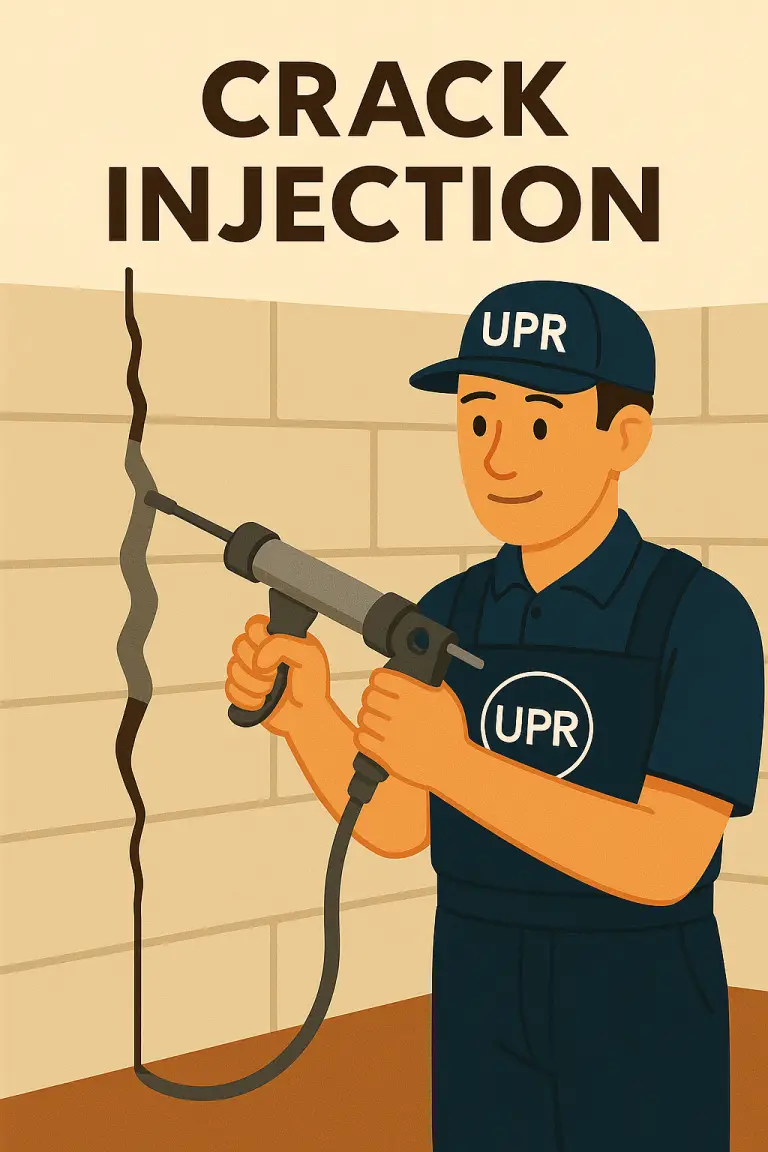
Crack injection is designed for exactly this kind of repair when the condition of the wall and the crack make injection appropriate. Rather than coating only the visible surface, injection material is introduced into the crack so the repair follows the opening through the wall and blocks the path water has been using to enter the basement.
At UPR (Underground Plumbing Repair), we use foundation crack injection as a focused waterproofing repair when the evidence points to a suitable crack as the source of water entry. The important word is suitable, because not every crack should automatically be injected and not every wet basement can be solved by sealing the most obvious line in the concrete.
When one suitable crack is the clear path for water entry and the surrounding foundation remains sound, the repair can stay focused on that opening. If seepage extends beyond the crack or appears across a larger area, the waterproofing strategy may need to address the wall or foundation drainage more broadly.
That distinction is what keeps crack injection useful. It should solve the condition it is good at solving rather than being treated as a universal answer to every basement water problem.
Concrete Can Crack Without the Foundation Being in Failure
Concrete is strong, but it is not completely motionless. As a house settles, concrete cures, temperatures change and the soil around a foundation goes through seasonal wetting, drying, freezing and thawing, cracks can develop in foundation walls.
The presence of a crack by itself does not tell the entire story. A narrow vertical crack that has remained stable may be very different from a crack that is widening, shifting, running horizontally or appearing alongside visible movement in the wall. Water also changes the significance of what the homeowner is seeing because even a relatively small opening can become a convenient path once moisture builds against the exterior foundation.
For waterproofing purposes, we are interested in both the crack and the behaviour around it. Has water actually entered through this location? Does staining follow the crack from top to bottom? Does leakage occur only during unusually heavy rain, or is the surrounding wall damp more generally? Has the crack changed noticeably over time?
Those observations help determine whether the job is primarily about sealing a water path or whether the crack deserves further structural evaluation before a waterproofing repair is chosen.
Crack Injection Works From Inside the Opening, Not Just on the Surface
A surface patch can hide a crack without necessarily sealing the pathway through the depth of the concrete. Injection takes a different approach by introducing material into the opening so the repair reaches beyond what can be seen from the basement side of the wall.
For leaking foundation cracks, polyurethane injection is commonly used because the material can travel into irregular openings and react within the crack to form a water-resistant seal. Different materials and methods may be appropriate depending on whether the objective is waterproofing, bonding concrete or addressing another specific condition, which is why identifying the crack correctly comes before choosing what goes into it.
The wall is prepared so the injection can be controlled, and the material is introduced through a series of points along the crack. The objective is to fill the available pathway progressively rather than simply covering the front edge where the crack is easiest to see.
Once the injection is complete and cured according to the system being used, the former water path is sealed from within the crack. Because the repair is completed from the basement side, suitable cracks can often be addressed without excavating the exterior foundation.
That makes injection particularly valuable when the surrounding waterproofing is otherwise performing properly and one isolated foundation crack is responsible for the leak.
The Pattern of the Water Tells Us a Lot
A homeowner will often notice the water before paying much attention to the crack itself. There may be a narrow wet line running down the wall, staining concentrated around one location or a small amount of water reaching the floor after particularly heavy rainfall.
When that pattern consistently follows one visible crack, injection may be a logical repair. The surrounding foundation can remain dry while water uses the crack as a direct route through the concrete, especially when saturated soil outside creates enough pressure to push moisture through the opening.
A different pattern points toward a different conversation. If the wall is damp across a broad area, water appears where the wall meets the floor, several cracks are leaking at the same time or moisture is entering from multiple locations, sealing one crack may improve one part of the problem without addressing the overall way water is reaching the basement.
That is why we look beyond the line in the wall before reaching for injection equipment. The most visible crack is not automatically responsible for every sign of moisture nearby.
When Crack Injection Is a Good Fit
Crack injection makes the most sense when a definable crack through a poured-concrete foundation wall is providing a localized path for water entry and the surrounding condition does not indicate that a larger waterproofing system is required.
Access from the interior is another important factor. The crack needs to be exposed well enough for the repair area to be prepared and for the injection process to follow the opening properly. In a finished basement, drywall, insulation or framing may conceal portions of the crack, and enough access may have to be created to understand where it begins and ends.
Previous repairs also deserve attention. A crack that has already been patched from the surface and continues leaking may still be repairable, but the old material can affect preparation and may need to be removed before the actual opening can be assessed properly.
The key is that injection should match the failure. When water has one clear route through one suitable crack, a focused repair avoids turning a localized problem into unnecessary excavation or a full-wall waterproofing project.
When Injection Is Not Enough
Some basement leaks happen near a crack without being caused only by that crack. Water pressure outside the foundation may be affecting a larger section of wall, the exterior waterproofing may have deteriorated, or foundation drainage may no longer be managing groundwater effectively.
In those circumstances, sealing the crack can close one route while moisture continues looking for another. Water may begin showing up beside the repair, farther along the wall or at the wall-to-floor joint because the larger condition around the foundation remains unchanged.
This is where basement waterproofing needs to be considered as a system rather than as one product. Depending on how and where the water is entering, interior waterproofing may be used to collect and manage seepage from inside the basement, while exterior waterproofing addresses the foundation from the outside when excavation is appropriate.
Neither approach is automatically better simply because it is larger. If one injection can reliably address one isolated leaking crack, building an entire waterproofing system around it may be unnecessary. If the basement is showing broader water-entry conditions, however, repeatedly injecting individual cracks may never address the real problem.
The repair has to match the scale of the water problem.
Water Pressure Around the Foundation Still Matters
A foundation wall separates a dry interior space from soil that can become heavily saturated during rain, rapid snowmelt or prolonged wet weather. When the ground around the house contains more water than the surrounding drainage can comfortably manage, pressure against the foundation increases and existing openings become more likely to show themselves.
A crack does not create groundwater, but it can provide groundwater with a route into the basement. Sealing that route can be very effective when everything around it is functioning normally. When water pressure is consistently excessive because of drainage conditions around the property, the crack may be only one part of what needs attention.
This is also why the timing of the leak is useful information. A crack that remains dry through ordinary weather but leaks during exceptional storms tells a different story from a basement wall that stays damp for long periods after relatively normal rainfall.
We look at that behaviour because waterproofing is not just about finding where the water appeared inside. It is about understanding what brought the water to the foundation in the first place and whether closing one opening is enough to keep it out.
Some Cracks Deserve Structural Attention Before Waterproofing
Crack injection is a waterproofing technique, and waterproofing should not be confused with structural diagnosis. Certain crack patterns or signs of movement can justify evaluation beyond simply stopping water.
A crack that has noticeably widened, a wall that appears displaced or bowed, significant horizontal cracking or other visible movement may indicate forces that need to be understood before the area is treated as an ordinary leaking crack. In situations where the structural condition is uncertain, an appropriate structural assessment may be the correct next step before deciding how the wall should be repaired.
This does not mean that every foundation crack is structural or dangerous. Many cracks in poured concrete foundations are associated with shrinkage, settlement or ordinary movement and can be dealt with as waterproofing issues when water begins using them as a pathway.
The point is to recognize the difference. Injection is excellent at sealing the right kind of crack, but it should not be used to disguise a condition that first needs a different kind of assessment.
Finished Basements Can Hide the Evidence
In an unfinished basement, a leaking crack can be relatively easy to recognize because the concrete wall is visible. Finished basements complicate the picture because insulation, framing and drywall can hide both the crack and the path water takes after it enters.
A homeowner may notice staining at the bottom of the drywall or damp flooring without seeing any obvious defect in the foundation itself. Water entering higher up the wall can travel behind the finished surface before collecting at floor level, making the lowest wet point look like the source even when it is not.
Creating controlled access can help determine whether a crack is responsible and whether the moisture is truly localized. That is often preferable to injecting based only on an assumption made from where the water eventually became visible.
Once the source has been confirmed and the crack is suitable for injection, the repair can be completed before the finished wall is restored. The objective is to understand what is happening behind the basement finish once, correct it properly and avoid rebuilding over uncertainty.
A Previously Repaired Crack Can Leak Again
Not every old crack repair was completed using the same method, and not every visible patch means the crack itself was fully sealed. Some older repairs consist primarily of surface material placed over the interior face of the wall, which can deteriorate or separate while the original opening remains behind it.
If a previously repaired location begins leaking again, we want to understand what was done before deciding how to approach it now. Surface material may need to be removed, the concrete around the crack cleaned and the actual opening exposed sufficiently to determine whether injection is still appropriate.
There are also cases where the previous crack repair remains intact but water begins entering nearby because the broader waterproofing condition has changed. That is another reason not to assume that every wet mark beside an old repair means the old injection itself failed.
The history is useful, but the current water path still needs to be identified.
Crack Injection Without Turning One Crack Into an Entire Basement Project
One of the biggest advantages of crack injection is that it can remain a very focused repair. When one suitable crack is responsible for one localized leak, there is no benefit in pretending the homeowner needs a much larger waterproofing project simply because larger systems exist.
UPR approaches crack injection with that proportion in mind. We inspect the crack, look at the water pattern around it and consider whether anything else in the basement suggests a broader condition. If the evidence stays concentrated at that opening, the repair can stay concentrated there as well.
If the inspection shows something different, we explain it before expanding the scope. Water across several areas of the foundation, repeated seepage at the base of the wall or signs that drainage around the house is contributing to the problem may justify a wider waterproofing plan, but that recommendation should come from what the basement is actually showing us.
With more than 20 years of hands-on plumbing, waterproofing and underground experience, UPR has worked on enough wet basements to know that the largest solution is not automatically the best one. A good repair is the one that addresses the path the water is actually using.
Crack Injection Across Toronto and the GTA
UPR provides foundation crack injection throughout Toronto and the Greater Toronto Area for suitable cracks in poured-concrete foundation walls. We work with homeowners who have noticed visible seepage, staining along a crack, recurring leakage during heavy rain or an older foundation repair that needs to be reassessed.
Every crack begins with an inspection because the repair depends on what the wall is telling us. We look at the shape and condition of the crack, how the water appears, what is happening around the surrounding foundation and whether injection can reasonably solve the problem by itself.
When the crack is the problem, we keep the repair focused on the crack. When the water pattern shows that the foundation is dealing with something broader, we look beyond the opening and determine what part of the waterproofing or drainage system needs attention.
If you have a foundation crack that is leaking or showing signs of moisture, call UPR. We’ll determine whether crack injection is the right repair and, just as importantly, whether the water problem extends beyond the crack you can see.
UPR — We don’t fix. We solve.