





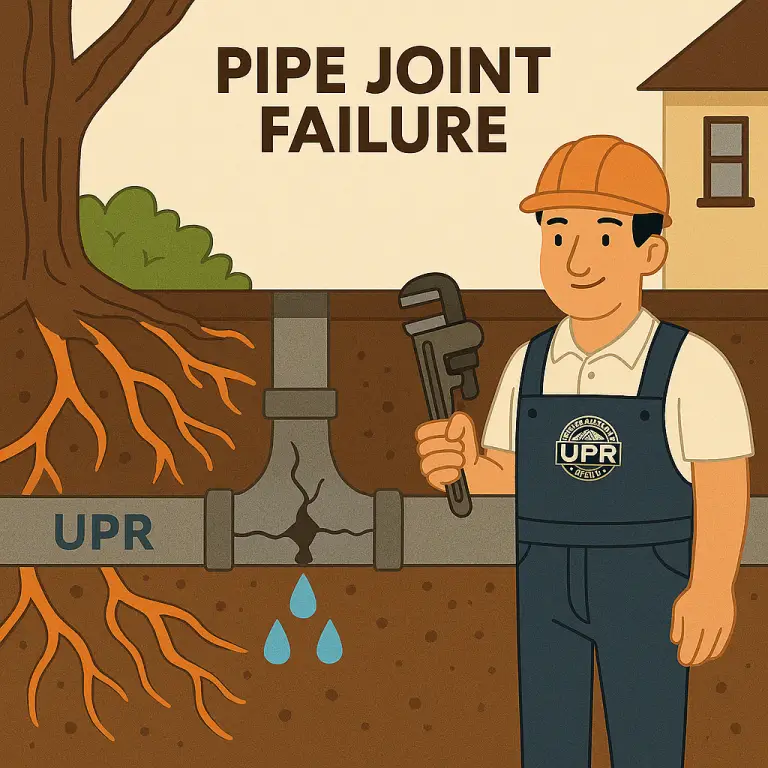
Sometimes the Pipe Is Fine but the Connection Between Two Sections Is Not
An underground drainage system is not always one continuous piece of pipe. Older sewer lines in particular can be made from individual sections joined together one after another, creating connections throughout the route from the house toward the municipal sewer. When those joints remain properly aligned and sealed, wastewater moves through the line and nobody has any reason to think about them. When one begins to separate, shift or deteriorate, however, that connection can become the weak point in an otherwise functioning drain.
At UPR (Underground Plumbing Repair), we diagnose and repair failed pipe joints throughout Toronto and the GTA, most often in underground drain and sewer systems where the problem has been developing out of sight for years. The joint may have moved slightly as the surrounding soil settled, an older connection may have deteriorated, or two pipe sections may no longer line up the way they did when the sewer was originally installed.
A small amount of movement does not always stop the drain from working. Wastewater can continue passing through an imperfect connection for a surprisingly long time, which is why a joint failure may first appear as something much less dramatic: a recurring blockage, roots that keep returning, a sewer odour, or a main drain that simply does not behave as reliably as it used to.
The important thing is understanding what the joint is actually doing to the drainage system. One slightly imperfect connection that has remained stable for decades is very different from a badly displaced joint that catches waste every time something travels through the sewer. The camera image may show both as defects, but that does not mean both require the same repair.
We want to know whether the connection is simply imperfect or whether it has become part of an active drainage problem.
What Changes When Two Pipe Sections Stop Lining Up Properly
A gravity drain depends on more than simply having an open hole from one end to the other. Wastewater needs a reasonably smooth path so solids can continue travelling downstream without repeatedly encountering places where they can collect.
When two sections of pipe shift at a joint, that path can change.
One pipe may sit slightly higher or lower than the next. The opening between the sections can widen. An internal edge can develop where waste and paper begin catching instead of passing cleanly through. Water may continue flowing through the connection while solids gradually build around the displaced area, which is why the first obvious symptom can be a blockage rather than a visible leak.
The opening can also allow interaction between the sewer and the soil around it. Wastewater may escape through a badly failed joint, while groundwater or fine soil can find a path toward the drain from outside. In older underground sewers, an open joint can also provide exactly the kind of moisture-filled entry point roots are looking for.
Once root intrusion begins, the joint problem can become much more noticeable. Fine roots enter first, then continue growing while collecting paper and waste travelling through the line. The homeowner may have the sewer mechanically cleared and everything works normally again for a while, but the opening where those roots entered has not disappeared.
That is why root removal and joint repair are not automatically the same service.
Sometimes periodic maintenance is reasonable because the connection remains structurally serviceable and the homeowner understands the condition. In another sewer, the displaced joint may be severe enough that constantly cutting roots or clearing debris is simply managing the symptom of a connection that has already failed.
There is no useful way to make that decision from above the basement floor.
We need to see the joint.
The Camera Shows Us More Than Whether the Pipes Are Still Connected
A camera inspection is especially useful with joint problems because it allows us to look at the relationship between one section of pipe and the next.
A properly aligned connection should provide a relatively continuous path through the drain. When a joint has shifted, the camera may show an offset between the pipe sections, an opening at the connection, root growth entering at that point or material accumulating around the irregular surface.
The severity matters.
Not every visible joint in an older sewer is a failure that demands excavation. Underground drainage is rarely perfect after several decades, and repairing every minor imperfection simply because a camera can see it would make no sense. We are much more interested in whether the defect is affecting how the sewer works, allowing significant root entry, contributing to repeated blockages or showing evidence that movement around the pipe is continuing.
The rest of the line also provides context.
If one joint has shifted while everything before and after it remains aligned and structurally sound, a localized repair may be all the sewer needs. If several joints throughout an older clay line are open, displaced or heavily rooted, then repairing only the most obvious connection may leave the homeowner dealing with the same problem a short distance farther down the pipe.
That does not automatically mean the entire sewer needs to be replaced either.
It means the scope of repair should come from the condition of the whole line rather than one dramatic-looking frame from a camera inspection.
This is one of the things we care about most with underground work. A camera should help us understand the sewer, not give us an excuse to make every problem larger than it really is.
Repairing the Joint Means Restoring the Drain Around It
When a failed joint genuinely needs repair, the solution depends on where it is located, how severe the displacement is and what condition the surrounding pipe is in.
For a localized underground failure, the affected area can be exposed so the misaligned or damaged connection is removed and rebuilt properly. Inside the home, that may mean opening the basement floor and excavating down to the drain. Outside, it may require access through the soil above the sewer.
Once the pipe is exposed, we can see something the camera cannot fully show from inside: what happened around the joint.
The surrounding bedding may have settled. One pipe section may no longer be properly supported. An old repair may have been installed under different conditions than the original drain, or the joint may simply have reached the point where rebuilding that section is the sensible answer.
The new connection then needs more than a watertight fitting. The pipe sections need to meet at the correct elevation, maintain the drainage grade and remain properly supported after the excavation is closed. There is little value in replacing a failed joint beautifully and then leaving the new connection sitting on unstable ground.
The repair is the pipe and what supports it.
There are also projects where trenchless sewer services may form part of a larger replacement strategy when joint failures continue through a substantial length of sewer and the existing route is suitable. But one displaced connection does not automatically become a trenchless project any more than it automatically becomes a complete excavation from the house to the street.
If the problem is one joint, we want to think like it is one joint.
If the inspection shows that the entire line is telling a different story, we deal with that story honestly too.
That balance matters because underground plumbing is expensive to reopen. Once the concrete, driveway, soil or landscaping has been restored, the homeowner should have confidence that the scope of work made sense before everything disappeared again.
Pipe Joint Repair Across Toronto and the GTA
UPR repairs failed and displaced sewer joints throughout Toronto and the Greater Toronto Area, particularly in older drainage systems where individual pipe sections have been underground for many decades.
Clay sewers are a common place to see joint-related problems because the line contains many individual connections along its route. But joint misalignment and leakage are not exclusive to clay; connections in other gravity-sewer materials can also develop defects when installation, support or surrounding ground conditions change over time. Joint misalignment and leakage are recognized defects in gravity sewer systems, and open joints can create pathways for infiltration and root intrusion.
The repair still comes back to the same questions. Is the joint actually interfering with drainage? Is it giving roots a way inside? Is one section shifting relative to another? Is the problem isolated, or are several connections throughout the line showing the same deterioration?
Those answers matter much more than the age printed on the history of the house.
If one connection has failed and the rest of the sewer remains healthy, we want to repair the connection and leave the healthy pipe alone. If multiple joints have deteriorated throughout the line, then the homeowner deserves to understand that before spending money opening and closing the property around one small section.
What we do not want is to repeatedly clear a drain around a joint that is obviously catching material and pretend the underground condition has changed. At the same time, we do not want to excavate an older sewer simply because a camera found a connection that is not picture-perfect.
Good underground work lives between those two extremes.
If your main drain repeatedly blocks, roots keep returning at the same location or a previous camera inspection has shown an open, shifted or displaced pipe joint, call UPR. We’ll inspect the line, understand how the failed connection is affecting the rest of the sewer and explain whether the problem needs a localized repair or something more.
Once that connection goes back underground, we want wastewater moving through it—not stopping there.
UPR — We don’t fix. We solve.