




Replacing an Underground Sewer Does Not Always Mean Opening Everything Above It
When homeowners hear that an underground sewer line needs to be replaced, the first picture that usually comes to mind is a trench running across the property. Sometimes that is exactly what the job requires, and there is absolutely nothing wrong with conventional excavation when it is the right way to reach and rebuild a damaged drain. But there are also properties where opening the entire route of the sewer would mean removing a finished driveway, established landscaping, walkways or other parts of the property that are expensive and difficult to restore afterward.
That is where trenchless sewer replacement can make a real difference.
At UPR (Underground Plumbing Repair), we provide trenchless sewer replacement throughout Toronto and the GTA when the condition and layout of the existing line make it suitable. The method we most often work with is pipe bursting, which allows us to replace a substantial length of underground sewer through strategically located access points instead of excavating continuously from one end of the line to the other.
The word “trenchless” can make the process sound almost magical, but that is not how we like to describe underground work. Some excavation is still required. We need access to the existing sewer, space for the equipment and proper areas where the replacement line can be connected into the drainage system. What trenchless technology can often eliminate is the need for one long open trench following the entire sewer route.
That difference can be enormous when there is a lot sitting above the pipe.
If the sewer runs beneath an open lawn and access is straightforward, conventional excavation may be perfectly practical. If the same sewer runs beneath a finished driveway, mature landscaping or another difficult surface, reducing the amount of excavation may save a significant amount of disruption and restoration afterward.
That is why we do not begin by deciding that a job has to be trenchless.
We begin with the sewer.
The Pipe Has to Make Sense Before the Method Does
A recurring clogged pipe does not automatically need to be replaced. A cracked pipe may have one localized failure while the surrounding line remains perfectly serviceable. Even a collapsed pipe does not tell us, by itself, whether five feet of sewer needs attention or whether deterioration continues much farther along the line.
Before we talk seriously about trenchless replacement, we want to understand what is actually underground.
That normally means looking at the history of the drainage problem, the material and route of the existing sewer, where the damage appears to be located and what condition the rest of the line is in. If the house has experienced a sewer backup, we also want to understand whether that event came from structural sewer failure, roots, a severe blockage or something else entirely.
The surface above the line matters too.
A sewer-replacement method should not be selected only by looking at the pipe in isolation. The real project includes the basement, lawn, driveway, walkway, landscaping and anything else sitting between the access points. If conventional excavation would destroy a large amount of finished property, trenchless replacement can become extremely attractive. If the sewer is already easily accessible and restoration is simple, the difference may be much smaller.
This is why UPR performs both trenchless and conventional underground work. We do not need every sewer replacement to fit one technique.
Sometimes pipe bursting is clearly the smarter way to go.
Sometimes excavation gives us better access and more control.
The important thing is knowing the difference before the project begins.
How Pipe Bursting Replaces the Existing Sewer
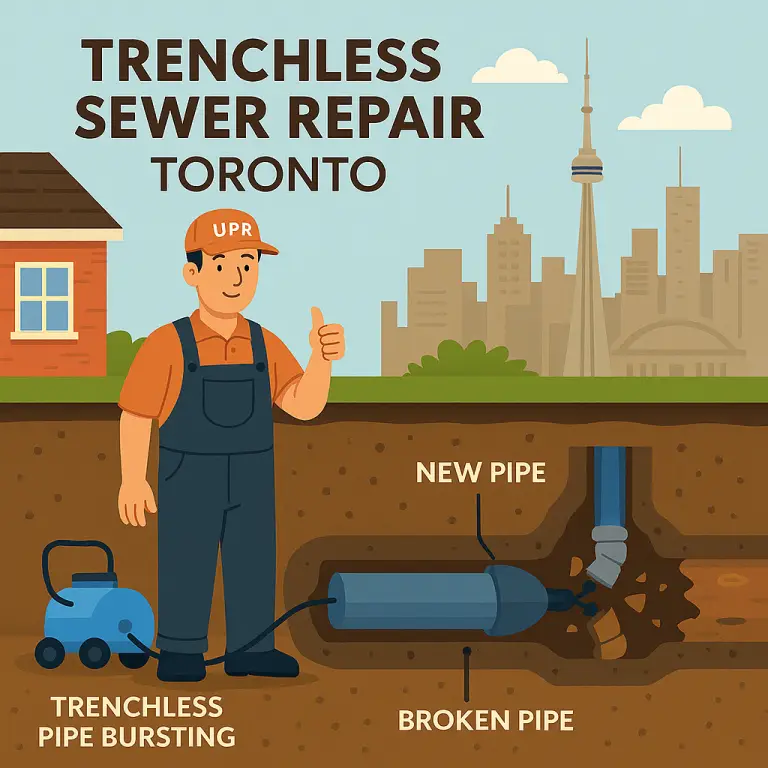
Pipe bursting uses the path of the existing underground sewer to install the new line.
Once the project has been assessed and the required access points are opened, specialized pulling equipment is positioned so a bursting head can travel through the existing sewer route. As it moves forward, the old pipe is broken or displaced outward while the replacement pipe is pulled into position behind it.
Instead of exposing every foot of the old sewer from above, much of the replacement takes place underground between the access points.
That sounds simple when it is reduced to one sentence, but the planning around it matters just as much as the equipment.
Older homes throughout Toronto and the GTA can have very interesting underground plumbing. A line may begin as cast iron beneath the basement floor, transition into original clay outside the house and then include a PVC repair completed years later. The sewer may have changes in direction, previous access points or connections that were added during renovations.
Pipe bursting has to work with the system that is actually underground.
That means we need to understand where the sewer starts, where it ends and whether its route will allow the new pipe to be pulled properly through the existing path. Access also has to be created in locations where the connections can be rebuilt correctly once the new line is in place.
The replacement method may be different, but the finished sewer still has to meet the same standard as any other underground drain. Wastewater needs to move properly, the connections need to be right, and the work around the access points has to be backfilled and restored carefully.
Trenchless technology changes how we reach the pipe.
It does not change what good underground plumbing looks like.
Less Excavation Can Mean Less Restoration
The real value of trenchless sewer replacement often becomes clearer when you stop looking only at the underground plumbing and start looking at everything above it.
Traditional sewer replacement can require a continuous excavation following the drain from one point to another. When that route passes through open soil, the restoration may be relatively straightforward. When it passes through a driveway, walkway or heavily landscaped area, the cost and disruption above ground can become a large part of the overall project.
Pipe bursting can change that equation because the property normally only needs to be opened at selected access locations rather than continuously along the entire sewer.
That does not mean trenchless work is always cheaper.
There are projects where the specialized equipment, access requirements or underground conditions make the trenchless option more expensive than simply excavating the line directly. There are other properties where the underground plumbing cost is similar but avoiding a large driveway replacement or major landscaping restoration makes trenchless work the better overall value.
This is why we never liked the old advertising language that says trenchless is automatically cheaper, cleaner or faster.
Sometimes it is.
Sometimes it is not.
What it can often provide is less surface disruption, and for the right property that is the advantage that matters most.
A homeowner should be able to look at both approaches and understand not only the plumbing cost, but what the property will look like during the work and what will need to be restored when the new sewer is already underground.
That is a much more useful comparison than simply putting “dig” and “no dig” beside each other.
There Are Still Jobs Where Excavation Is the Better Answer
Trenchless replacement is a powerful option, but it is not a reason to stop excavating sewers.
Some lines have complicated changes in direction. Others have connections along the route that need direct access. The existing pipe may be severely displaced or the underground conditions may make it difficult to follow the old path reliably. There are also localized failures where opening one relatively small area and rebuilding the damaged section directly makes far more sense than bringing in pipe-bursting equipment.
Direct excavation gives us something trenchless work cannot: complete physical access to the affected pipe and the soil around it.
Sometimes we need that.
If a section has lost support, a connection needs to be rebuilt or there is something unusual happening underground that needs to be seen properly, opening the area may be the most sensible solution. That is not an inferior repair. It is simply a different way of reaching the same underground system.
The mistake would be trying to make every property fit whichever method a contractor prefers to sell.
UPR works from the opposite direction.
We find out what failed, look at what is above the sewer and decide which method gives the property the strongest overall repair with the least unnecessary work.
If that means pipe bursting, we use trenchless.
If that means excavation, we dig.
The method is secondary to the result.
Trenchless Sewer Replacement Across Toronto and the GTA
UPR provides trenchless sewer replacement throughout Toronto and the Greater Toronto Area for homes where damaged underground drainage needs substantial replacement and reducing surface excavation provides a real advantage.
Some properties come to us after years of recurring root problems. Others have a sewer that has cracked, shifted or collapsed. Sometimes the homeowner has already been told the line needs to be replaced and simply wants to know whether opening the entire driveway or yard is really the only option.
That is exactly the question trenchless technology allows us to answer.
We look at the pipe, the route, the damage and the property above it. If the existing sewer is a good candidate for pipe bursting, we can explain how the new line would be installed and where access would be required. If something about the layout or condition makes conventional excavation more sensible, we explain that too.
There is no value in performing a “trenchless job” just so the word trenchless can appear on the estimate.
The value is replacing the failed sewer properly while avoiding disruption that did not need to happen.
When the conditions are right, pipe bursting can do exactly that.
If your sewer repeatedly backs up, has severe root intrusion, cracked sections or structural failure and you want to know whether trenchless replacement is realistic for your property, call UPR. We’ll look at the existing system, explain the options and choose the method around the actual sewer instead of forcing the sewer around the method.
UPR — We don’t fix. We solve.