
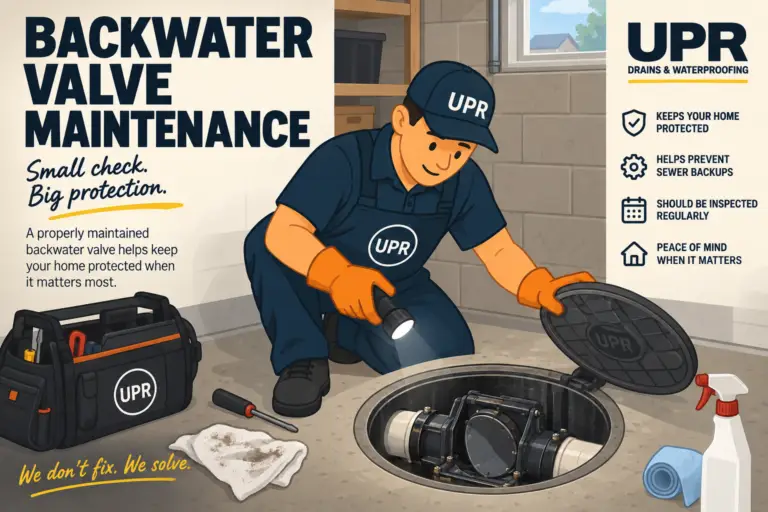
There is something unusual about a backwater valve. When it is installed properly, most homeowners hope they never actually see it working.
It sits beneath the basement floor, usually hidden behind a small access cover, while everyday life continues above it. Toilets flush, showers run, washing machines drain, and thousands of litres of wastewater leave the house without anyone giving much thought to the small piece of flood-protection equipment sitting inside the main drainage system.
After a while, it becomes easy to forget that it is even there.
And in a way, that is understandable. Nothing has happened. The basement is dry. There has not been a sewer backup. Several heavy storms may have come and gone without a problem, so naturally the homeowner assumes the backwater valve installed years ago is still sitting underneath the floor in exactly the same condition as the day it went in.
Unfortunately, plumbing does not stay frozen in time.
A backwater valve lives inside one of the hardest-working systems in the house. Day after day, wastewater passes through the drainage system carrying soap, grease, hair, paper, sediment and everything else that eventually finds its way down household drains. Inside the valve is a moving component that must remain free enough to open during normal drainage and close when water suddenly tries to travel in the opposite direction.
And when that moment arrives, there is very little room for error.
That is why backwater valve maintenance is not optional housekeeping around a plumbing fixture. It is maintenance of the protection you installed to help keep sewage out of your home.
During normal operation, wastewater from your home moves in one direction. Water from toilets, sinks, showers, laundry equipment and other fixtures travels through the building drain and continues toward the municipal sewer.
Then there are the days that are anything but normal.
Toronto has seen what heavy rainfall can do when huge volumes of water reach drainage and sewer infrastructure within a short period of time. During severe rainfall or sewer surcharge conditions, wastewater can begin moving back toward a property instead of away from it. The lowest plumbing fixtures in the house can suddenly become the easiest path for that water to enter.
This is exactly why a properly installed backwater valve can become such an important part of a home’s flood-protection system.
The idea behind the valve is beautifully simple. During normal conditions, wastewater is allowed to leave the house. If flow reverses, the internal flap or gate closes and blocks that path back into the property.
It does not need to make noise. It does not need an engine. It does not need to run every day.
It simply needs to move correctly once, at exactly the right time.
That last part is what matters.
One of the biggest misconceptions around backwater valves is that once one is installed, the job is finished forever.
The concrete gets repaired. The access cover is put back into place. The basement may eventually be finished. Furniture gets moved back. Life continues.
Years later, the homeowner knows there is a valve somewhere beneath the floor, and that knowledge creates a sense of security.
But the better question is not:
“Do I have a backwater valve?”
The better question is:
“When was the last time somebody opened it and checked it?”
That is a very different question.
Think about the environment that valve works in. It is not sitting inside a clean mechanical room waiting untouched for an emergency. It is part of the drainage system. Household wastewater continuously passes through the piping around it.
Over time, grease and sediment can collect. Debris can become trapped. Material can accumulate around the flap, hinge or sealing surface. A mechanism that moved freely when it was installed may not necessarily move the same way many years later.
And a valve does not need to be completely broken before there is a problem.
Sometimes something as simple as debris sitting in the wrong place can prevent the flap from seating correctly. If the valve cannot completely close when reverse sewer flow reaches the house, the protection homeowners believe they have may not perform the way they expect.
That is exactly why the City of Toronto tells homeowners that backwater valves should be maintained and regularly inspected according to the manufacturer’s directions.
The valve is already there to protect the home.
Maintenance is what helps make sure it is still capable of doing it.
A dripping faucet gives you a warning.
A slow drain gets your attention.
A running toilet makes noise until somebody eventually deals with it.
A backwater valve can remain completely silent.
There may be no obvious indication upstairs that material has collected inside it. There may be nothing telling the homeowner that the flap has become difficult to move or that the sealing surface needs cleaning.
For years, everything may appear completely normal.
Then Toronto gets one of those storms.
Rain starts coming down faster than the ground and drainage infrastructure can comfortably handle it. Roads begin collecting water. Catch basins struggle. Neighbours start checking their basements. The municipal sewer system is under pressure.
And suddenly the little device nobody has thought about for seven years may be expected to protect a finished basement from sewage.
That is not the moment you want to start wondering whether the valve still works.
Flood protection should be inspected when everything is calm.
When the basement is dry.
When the forecast is ordinary.
When someone can remove the access cover, look inside, clean what needs to be cleaned and make sure nothing appears to be interfering with the operation of the valve.
Good maintenance is usually boring.
That is precisely why it works.
You deal with the small things before weather turns them into very expensive things.
This is also why accessibility matters so much when a backwater valve is installed.
A valve should not simply disappear permanently beneath new flooring, cabinetry or a finished basement renovation. The entire reason there is an access opening is so the equipment can be inspected and serviced throughout its life.
We always look beyond the day a job is completed.
It is easy to make something look beautiful when fresh concrete goes down and everything gets cleaned up. The bigger question is whether someone can properly service that system five years later.
Or ten.
Or after the house has changed owners.
A good installation considers the next plumber who may need to open that valve, the next homeowner who needs to understand what is underneath the floor, and the next major storm that may finally require the system to perform.
That is part of doing underground plumbing properly.
Real quality is not only what you see when the job is finished. It is what still makes sense years after everyone who installed it has left.
Backwater valve maintenance does not normally mean tearing up the basement again. If the installation was designed properly and the valve remains accessible, inspection is relatively straightforward.
The important part is getting inside the valve rather than simply looking at the access cover and assuming everything beneath it is fine.
The internal area can be examined for buildup or foreign material. The flap can be checked to make sure it moves freely. The sealing surface can be inspected and cleaned where necessary. Components can be looked over for visible damage or abnormal wear, and anything interfering with the movement of the valve can be addressed before the device is asked to perform during an actual sewer event.
Different manufacturers use different valve designs, which is why the manufacturer’s maintenance procedure should always be followed rather than assuming every valve is identical.
What remains the same is the principle behind all of them.
If your flood protection depends on a mechanical part moving, that mechanical part must still be able to move.
Simple as that.
There is another reason an experienced inspection matters.
Homeowners sometimes assume every sewer-related issue must be caused by the valve simply because there is one installed in the house.
That is not always the case.
A home may have a perfectly functional backwater valve while another problem is developing farther along the drainage system. Tree roots may be entering an older sewer. A clay pipe may have shifted. A connection can separate. Heavy buildup can begin restricting the line. In other situations, sections of an older underground drain may be cracked or deteriorating.
When symptoms suggest that something else may be happening inside the drainage system, a camera drain inspection allows us to see what is actually happening inside the pipe instead of guessing from what we can see above the floor.
This distinction matters because maintenance and diagnosis are two different things.
Cleaning a backwater valve will not repair a collapsed sewer line.
Replacing a sewer line will not help a valve whose flap is jammed with debris.
At UPR, we want to know which problem we are actually solving before recommending the solution.
That sounds obvious, but it is one of the biggest differences between repairing symptoms and understanding a drainage system.
There is something every homeowner with a backwater valve should know, and surprisingly many are never told.
When the valve closes during a sewer surcharge, it is doing exactly what you paid for it to do. It is blocking wastewater from travelling backward through the sewer connection and into the home.
But that closed valve may also temporarily prevent wastewater from inside the house from leaving through the same drain.
Imagine what happens if nobody realizes this.
The valve closes.
Someone flushes a toilet upstairs.
Someone else takes a shower.
The dishwasher drains.
Then the washing machine begins pumping out an entire load of water.
All of that water is trying to travel toward a drainage connection that may temporarily be closed.
The City of Toronto specifically advises homeowners not to use plumbing fixtures such as toilets, sinks, dishwashers or washing machines when the backwater valve is closed, because the water may not be able to drain and could back up into the home. The City also notes that homeowners may want to install an alarm so they know when the valve has activated.
This is why owning flood-protection equipment is only half of the conversation.
You should understand how it works.
A backwater valve is not a magic device buried beneath the basement that makes flooding impossible. It is one part of a larger system, and homeowners who understand that system are much better prepared when something unusual happens.
This is especially important because the words backwater valve and basement flooding often get treated as though one automatically solves the other.
It does not.
A backwater valve protects against a particular risk: wastewater moving backward through the sewer connection.
Groundwater coming through a foundation crack is a different problem.
Water accumulating around the footing because of failing foundation drainage is a different problem.
A sump pump losing power during a storm is another problem.
Poor grading, overflowing window wells, damaged waterproofing, broken underground drainage and a blocked private sewer can all introduce water into a home in different ways.
The City of Toronto also recognizes that basement flooding has multiple possible causes, including sewer backups as well as stormwater or groundwater entering through drainage or foundation failures.
That is why we do not believe in selling every homeowner the same piece of equipment and calling the property protected.
A house has to be looked at as a system.
Its sewer line matters.
Its main drain matters.
Its backwater valve matters.
Its foundation drainage matters.
Its waterproofing matters.
Its grading and downspouts matter.
And where groundwater needs to be managed, a properly designed sump pump system may be another important part of that protection.
Water does not care which product you installed.
It finds the weakness that remains.
The job is to understand where those weaknesses are before the next storm finds them first.
This is one of the situations where we would rather see a homeowner ask questions than make assumptions.
You purchase a house and find an access cover in the basement.
The previous owner tells you there is a backwater valve underneath.
Great.
But what do you actually know about it?
You may not know when it was installed. You may not know whether it has ever been maintained. You may not know whether it has activated during a previous sewer surcharge or whether changes have been made to the drainage system since the original installation.
Sometimes there is paperwork.
Often there is not.
That does not mean something is wrong.
It simply means you do not know.
And when a piece of equipment is supposed to protect the home against one of the messiest plumbing emergencies possible, knowledge is considerably better than assumption.
Have it inspected.
If everything looks good, excellent. Clean what needs cleaning, confirm the valve moves correctly and now you know what you have underneath the floor.
If something is wrong, finding it on a dry Tuesday afternoon is infinitely better than discovering it while sewage is trying to come through the basement drain.
People sometimes think about sewer backups only in terms of repairing the drain.
Unfortunately, the damage does not always stop there.
A serious sewer backup can affect flooring, drywall, furniture, storage, mechanical equipment and everything else sitting at the lowest level of the house. Contaminated materials may need to be removed. Professional cleaning and restoration may be required. Insurance becomes part of the conversation. A basement that took years and considerable money to finish can suddenly become unusable.
Then come the fans.
The demolition.
The cleanup.
The rebuilding.
The calls.
The waiting.
Nobody can guarantee that a properly maintained backwater valve will make a property immune to every flood. Homes, weather and drainage infrastructure are far too complicated for promises like that.
But there is also no good reason to ignore a device that was installed specifically to reduce one of those risks.
The valve is already beneath the floor.
Give it the chance to do the job it was installed to do.
There is another reason Toronto homeowners should understand their existing flood-protection system.
As of May 1, 2026, the City of Toronto expanded its Basement Flooding Protection Subsidy Program. For eligible work completed on or after November 12, 2025, the program now provides up to $6,650 per property across qualifying flood-protection measures. For eligible backwater valve work, the City offers up to 80% of the invoiced cost to a maximum of $1,600 per device, for up to two devices, subject to the program’s requirements.
The program can apply to the installation or replacement of eligible backwater valves and alarms, but permits, inspections, contractor licensing, application requirements and other conditions apply. Homeowners considering new work should always verify the current rules directly with the City before proceeding.
Check the current City of Toronto Basement Flooding Protection Subsidy Program
There is a strange thing about good underground work.
When it is doing its job, nobody talks about it.
Nobody walks downstairs every morning and celebrates that sewage did not come through the floor drain overnight.
Nobody thinks about the pipe carrying wastewater beneath the concrete.
Nobody notices the backwater valve sitting quietly underneath an access cover.
And that is exactly how it should be.
But invisible does not mean unimportant.
That little valve may sit there for years before conditions outside the house finally ask it to do the job it was installed for. It may happen during one exceptional storm, one overwhelmed sewer event, one night when the neighbourhood suddenly starts seeing water where water has never appeared before.
When that moment comes, there is no time to perform the maintenance that should have happened six months earlier.
There is no time to clean the flap.
There is no time to discover that flooring was installed over the access cover.
There is no time to figure out what model of valve you have.
The system is either ready or it isn’t.
That is why we would rather inspect flood protection before anyone needs it.
Not because we expect every house to flood.
Because we have seen what happens to the houses that were not ready when it did.
If you have a backwater valve in your home and cannot remember the last time it was inspected, if you recently purchased a property with an existing valve, or if your neighbourhood has experienced sewer backups during major storms, UPR can inspect the valve and look at the drainage system around it to make sure the conversation does not stop at what is visible from above the floor.
Sometimes everything is exactly as it should be.
That is good news.
Sometimes we find something that needs attention.
That is still much better news than finding it during a flood.
Because installing protection is only the beginning.
Making sure it is still ready years later is what completes the job.
Real quality isn’t what you see on day one. It’s what you don’t see ten years later.
UPR — We don’t fix. We solve.