





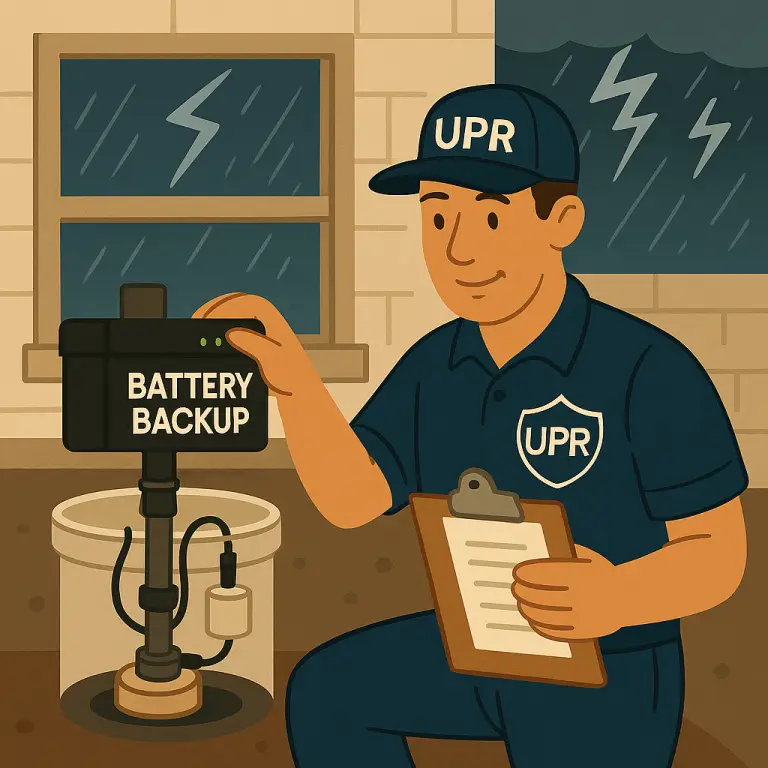
When the Power Goes Out, the Groundwater Does Not Stop
A sump pump can work perfectly for years and still become useless the moment the house loses electricity. That is what makes power outages during heavy rain so dangerous for homes that depend on a sump system. The weather that pushes the most groundwater toward the foundation is often the same weather that brings down power lines, trips equipment or interrupts service long enough for the water level in the pit to keep rising while the primary pump sits silent.
A battery backup system is built for that exact weakness. It gives the sump system a second way to move water when normal power is unavailable or when the primary pump cannot operate, depending on how the backup system is configured. In many installations, the backup is a separate secondary pump with its own float, controller and battery rather than something that simply keeps the existing AC pump running.
That distinction matters because the backup should be independent enough to help when the main system is unavailable. If both pumps depend on the same control, the same electrical supply or the same failure point, the homeowner may have two pieces of equipment but not much real redundancy.
The existing Sump Pump System therefore matters before the battery is ever installed. The pit has to provide enough room for the primary and backup components to operate without interfering with each other, the discharge arrangement has to handle the water being pumped, and the floats have to be positioned so one system can take over without fighting the other. A backup cannot correct a blocked discharge or a poorly arranged sump pit simply because a battery has been added beside it.
This is also why choosing a backup system only by battery size can be misleading. Runtime is affected by much more than the number printed on the battery. The amount of water entering the pit, how often the pump cycles, the pumping height, the condition of the battery and the electrical demand of the backup pump all influence how long the system can continue operating.
During one outage, the pump may run for short intervals and the battery may last a long time. During another, groundwater may be entering the pit continuously and the backup may be working almost without rest. Those are completely different operating conditions, which is why promising a fixed number of hours without considering the property gives the homeowner a false sense of certainty.
A good backup system does not promise unlimited protection. It buys time and keeps another pumping option available when the main system is no longer dependable.
Real Backup Means the Secondary System Has to Be Ready Before the Storm
Battery backup equipment spends most of its life waiting.
That sounds simple, but it creates its own maintenance problem because a system that rarely operates can be forgotten for years. The homeowner sees the battery, hears no alarms and assumes everything is fine until the first major outage reveals that the battery has aged, the charger has failed, the float is stuck or the backup pump has not been tested in a long time.
That is why backup protection should be tested as part of the sump system rather than treated as a sealed box that never needs attention. Our Sump Pump Maintenance work includes looking at how the primary and backup portions of the system behave together, whether the backup activates independently and whether the battery and controls are still functioning the way they should.
The battery itself does not last forever. Its useful life depends on the type of battery, the charger, operating conditions and how often the system has been discharged. A battery can still look perfectly normal from the outside while holding significantly less usable capacity than it did when it was new, which is why age and testing both matter.
The charger and controller deserve the same attention. A backup pump is only useful if the battery is being maintained properly and the system can recognize when it is supposed to operate. Audible alarms or warning indicators can help alert the homeowner when the backup activates, when the battery is weak or when something in the system needs attention, but those indicators are only useful if they are noticed and understood before an emergency.
The discharge side can also become the weak link. If both pumps share a common discharge, the piping and check valves have to be arranged so water does not simply move backward through the inactive pump or return to the pit unnecessarily. If the exterior discharge is frozen, blocked or damaged, neither the primary nor the backup pump can perform properly no matter how much power is available.
This is where battery backup stops being an accessory and becomes part of a complete water-management system. The pump, battery, controller, floats, check valves and discharge all have to support each other. One strong component cannot compensate for everything around it being poorly arranged.
If the primary equipment is already unreliable, adding a battery system beside it may not be the best first move. A weak or damaged pump should be addressed through Sump Pump Repair & Replacement before the homeowner invests in redundancy around a system that is already struggling under normal conditions.
The backup protects the system from a second kind of failure. It should not be used to ignore the first one.
Battery Backup Is One Layer of Flood Protection, Not a Guarantee Against Every Kind of Water
A sump pump battery backup is extremely useful when the risk is groundwater entering the sump pit while normal power is unavailable. That is the problem it is designed to help manage, and it can make a major difference for homes that rely heavily on a sump system during storms or seasonal groundwater.
It does not protect against every way a basement can flood.
If sewage is coming backward through the sanitary drain, the sump battery is not the answer. If water is entering through a leaking foundation wall, the backup pump may reduce the amount collected in the pit but it does not repair the wall. If surface water is being directed toward the house because the grading is poor, adding another pump does not correct the exterior drainage condition that keeps sending water toward the foundation.
Those situations are why Flood Protection Systems should be considered as layers rather than as one universal device. A backwater valve deals with reverse sewer flow. Waterproofing deals with water entering through the foundation. Drainage improvements deal with how water moves around the property. The sump system manages collected groundwater, while the battery backup gives that system another way to operate when electricity or the primary pump becomes unavailable.
Some properties need only one of those layers. Others have several different flood risks that happen to show up in the same basement during a major storm. The useful part is understanding which risk belongs to which system before equipment is added.
UPR installs sump pump battery backup systems across Toronto and the GTA for homeowners who already depend on a sump pump and want another level of protection when normal electrical service becomes unreliable. We look at the existing pit, primary pump, discharge and expected groundwater conditions before deciding how the backup should be configured.
For some homes, the existing system is already well arranged and the backup can be added with relatively little change. In others, the primary pump, discharge or pit layout needs attention first so the new equipment has a proper system to work with. That extra step is often worth doing because a backup system should strengthen the installation rather than simply make it more complicated.
If your basement depends on a sump pump and you are concerned about what happens during a power outage or primary-pump failure, call UPR. We’ll look at the existing setup, determine how a backup can be integrated properly and build the system around the way your property actually handles groundwater.
UPR — We don’t fix. We solve.