





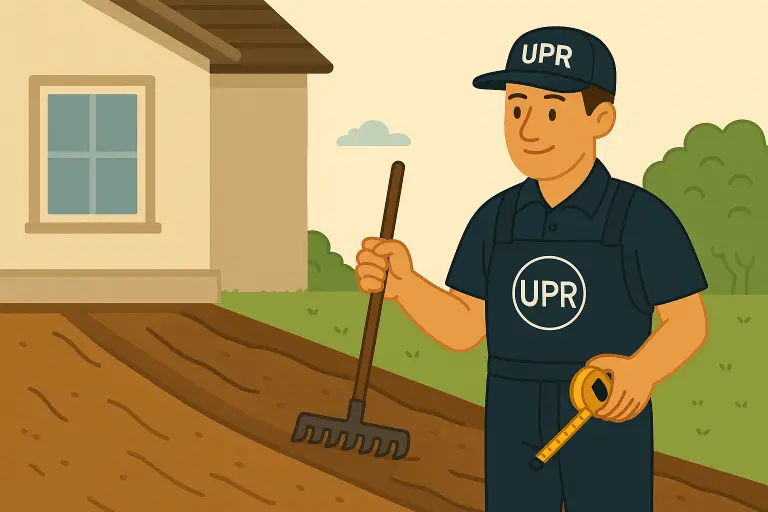
Good Drainage Begins Before Water Reaches the Foundation
Every rainfall creates movement across a property. Water lands on the roof, lawn, driveway, walkway and landscaping, then begins following the elevations around the house. When those elevations work properly, runoff is encouraged away from the foundation and toward an appropriate drainage path. When they do not, water can collect beside the house, remain trapped in low areas or repeatedly return to the same section of foundation after every storm.
The problem is not always dramatic. A section of soil may have settled gradually over many years, changing what was once a positive slope into a shallow depression. A walkway or patio may have been installed slightly higher than the surrounding ground and begun redirecting runoff toward the home. A downspout may release a large volume of roof water into an area that does not have enough fall to carry it away.
At UPR (Underground Plumbing Repair), we provide grading and drainage correction throughout Toronto and the GTA for properties where surface water is moving in the wrong direction. The work starts by understanding how the entire area behaves rather than assuming that every wet yard needs more soil or another drain.
Water always follows elevation. The job is to give it somewhere better to go.
The Shape of the Property Controls the First Part of the Water Problem
A well-graded property does not need to be dramatically sloped. What matters is that the ground immediately around the home encourages surface water away from the foundation instead of creating a route back toward it.
Over time, those elevations can change. Soil settles beside foundations, landscaping is added, gardens are raised, interlocking stone is installed and driveways or walkways are replaced. Each change may seem small on its own, but together they can alter the route rainwater follows across the property.
This is particularly noticeable in narrow side yards where there may be very little room between neighbouring homes. A small difference in elevation can determine whether runoff continues toward the front or rear of the property or becomes trapped between two foundations. In other yards, a low area farther from the house can hold water long after the rest of the property has dried.
The important part is not simply finding the wet spot. We want to understand what feeds it. If water is arriving from the roof, neighbouring grade, driveway and backyard all at once, correcting only the last few feet beside the foundation may not change enough of the overall flow.
Regrading Is More Than Adding Soil Beside the Wall
One of the most common responses to poor grading is to add soil near the foundation and create a visible slope away from the house. Sometimes that is exactly what the property needs, but adding material without considering the surrounding elevations can simply move the water problem somewhere else.
The new grade needs somewhere to finish. If soil is raised beside the foundation but the surrounding yard remains lower in a way that traps runoff, water may collect at the bottom of the newly created slope. If the correction pushes water toward a walkway, neighbouring property or another low point, the original issue may have been relocated rather than solved.
Clearance around siding, masonry, windows and other building components also matters. Soil cannot simply be piled against the house without considering what should remain above grade and where water could enter through openings that were never intended to sit at ground level.
A proper grading correction therefore works with the available elevations instead of fighting them. The objective is to reshape the surface enough to create a useful drainage path while respecting the house, surrounding hard surfaces and realistic discharge points.
Downspouts Can Change the Entire Drainage Pattern
A roof collects a surprising amount of water during a heavy storm, and the downspout decides where that water is released. When the discharge ends directly beside the foundation or empties into a low area, a large portion of the roof runoff can become concentrated in exactly the place where we want the least water.
Extending a downspout can help, but distance by itself is not the whole answer. Water discharged farther from the house still needs a path once it reaches the end of the extension. If the surrounding ground slopes back toward the foundation, the water can travel straight back. If the outlet sits in a depression, it may simply create a new saturated area in the yard.
Underground downspout connections create another consideration because the condition and destination of that drainage are not always obvious from the surface. A blocked, damaged or poorly routed underground connection can prevent roof water from leaving properly and may cause water to surface in places that initially look like a grading problem.
For that reason, roof drainage should be considered as part of the property rather than treated as a separate detail. The yard may have perfectly reasonable grading under ordinary rainfall but still become overwhelmed when a concentrated roof discharge is released into the wrong place.
Hard Surfaces Can Redirect More Water Than the Lawn
Driveways, patios and walkways behave differently from soil because they do not absorb much of the rain landing on them. Water moves quickly across those surfaces and follows their slope, which means a relatively small grading error can direct a considerable amount of runoff toward the house.
A walkway that pitches toward the foundation can continuously feed water along one wall. A patio may drain toward a basement window or door, while a driveway can send runoff toward a side yard that was never intended to manage that volume of water. The problem may become especially noticeable during short, intense storms when water reaches those areas faster than the surrounding soil can absorb it.
Hard surfaces are also more difficult to correct casually because their elevations may be tied to entrances, garage floors, neighbouring structures and finished landscaping. In some cases, adjustments to the adjacent grade can improve the drainage without rebuilding the entire surface. In others, the hard surface itself is controlling the water strongly enough that it needs to be considered in the overall solution.
This is why we look at the property as one connected surface. Water does not care whether it is crossing grass, asphalt, concrete or interlock; it simply follows the route the elevations create.
Low Spots Need an Outlet, Not Just Less Water
Some sections of a property remain wet because they form a natural bowl. Water enters from several directions, reaches the lowest elevation available and has nowhere else to continue. Regrading may be able to reshape that area and restore surface flow, but on some properties there is not enough elevation available to move the water naturally.
That is when another drainage path may make sense. A swale can create a broad, shallow route that guides runoff across the surface, while a French drain may collect water below the surface and move it through a controlled underground path when the site conditions are appropriate.
The destination still matters. Installing a drain without knowing where collected water will discharge only moves the question underground. Any drainage system needs a suitable outlet and enough elevation or another means of moving water toward it.
This is also why there is no standard drainage correction that fits every yard. A wide suburban lot with open space may allow water to be redirected very differently from a narrow Toronto property bounded by neighbouring houses and hard surfaces.
The shape of the property determines what is practical.
Window Wells Often Reveal a Surface-Water Problem Quickly
A below-grade window naturally creates a vulnerable low point beside the foundation. The window well is intended to provide space around that opening while drainage at the bottom helps manage water that reaches it.
Problems begin when the surrounding property continuously funnels runoff into the well. During heavy rain, water can enter faster than the bottom drainage can manage it, allowing the well to fill and place water directly against the basement window.
In that situation, improving window well drainage may be necessary, but the surface around the well deserves equal attention. If the adjacent grade directs water toward the opening every time it rains, asking the window-well drain to manage all of that flow treats only the last point in the water’s journey.
Correcting the grade can reduce how much water reaches the well in the first place. The drainage below can then perform the job it was intended to do instead of continually compensating for poor surface flow.
Surface Drainage and Foundation Drainage Do Different Jobs
The ground above grade and the drainage below grade are connected by the same water cycle, but they control different parts of it. Grading manages rain and snowmelt while that water is still moving across the surface. The weeping tile system works lower around the foundation footing, where it helps manage water that has already entered the soil.
Good surface drainage can reduce the amount of water the below-grade system has to handle, which is valuable during prolonged rainfall and spring thaw. It cannot, however, repair a damaged foundation wall or restore a failed drainage pipe underneath the soil.
Correcting surface drainage can reduce the amount of water reaching the foundation, but it does not repair a leaking foundation wall, failed weeping tile or another below-grade condition. When water is already entering the basement, we look at the complete path before deciding whether the main problem is at the surface, underground or both.
This distinction is especially important when homeowners have already experienced basement seepage. Improving the yard may reduce one source of water pressure, but if a foundation crack is providing a direct route through the wall or the exterior waterproofing has deteriorated, that condition needs to be assessed on its own.
When Grading Helps Protect the Basement
The less surface water that remains beside the foundation, the less water has the opportunity to soak into the soil directly against the house. For many properties, that makes grading one of the simplest and most valuable parts of overall water management.
A section of soil sloping toward the home can keep the ground beside the foundation saturated long after the rest of the yard has begun drying. Repeated storms compound the problem because the soil may receive another load of water before the previous moisture has drained away.
Improving the slope can change that pattern by encouraging rainfall to begin moving away sooner. This does not make the foundation waterproof by itself, but it reduces unnecessary exposure and allows the waterproofing and foundation-drainage systems to work under more reasonable conditions.
That is why grading should not be viewed as a substitute for basement waterproofing, nor should waterproofing automatically be used to compensate for obvious surface water being directed toward the house. When both conditions exist, the strongest result usually comes from addressing each part for what it actually does.
Drainage Problems Between Neighbouring Homes
Narrow side yards deserve particular attention because there may be very little room to create slope. Water from two roofs, two properties and several hard surfaces can end up moving through a strip of ground only a few feet wide.
Changes on either property can affect how that space behaves. A new walkway, raised garden, fence installation or regraded lawn can alter the direction of runoff, and settlement can gradually create a low channel where water remains after every storm.
The objective in a tight area is not simply to create the steepest possible slope. Water needs a controlled route that does not direct it toward either foundation, trap it against a structure or create an inappropriate discharge onto another property.
Depending on the available elevation, the answer may involve reshaping the surface, improving a drainage route or combining grading with another method of collecting and directing water. The limited space makes planning more important because there is less room for water to correct itself naturally once it has been sent in the wrong direction.
Snowmelt Can Expose Problems That Summer Rain Does Not
Drainage issues are not limited to rainfall. Toronto and the GTA go through repeated freezing, thawing and snowmelt cycles, and those conditions can expose weak grading in a different way.
Frozen ground absorbs water poorly, which means melting snow may behave more like runoff across a hard surface. Snow piled beside a home throughout the winter can release a concentrated amount of water into one area once temperatures rise, while frozen low spots can temporarily prevent water from following a route that works properly during warmer months.
This is one reason some homeowners notice moisture around the foundation in spring even when summer storms have not caused obvious trouble. The same elevations are present, but the way the ground handles water has changed.
Looking at where snow is normally stored, where meltwater accumulates and how the property behaves during thaw conditions can add useful context to a drainage assessment. A correction that works only during light summer rain but ignores the property’s seasonal behaviour is not much of a correction.
What We Look At Before Recommending a Change
A useful drainage assessment involves more than standing beside the wettest patch of grass. We look at the foundation perimeter, the direction of visible slopes, low areas, roof discharge, neighbouring elevations, hard surfaces and any existing drainage features that may be influencing the way water moves.
We also want to understand when the problem occurs. Water that appears only after extreme storms may require a different response from an area that remains wet after ordinary rainfall. A low spot that dries within a reasonable period is different from soil that remains saturated for days, while water appearing inside the basement adds another layer that cannot be evaluated from the yard alone.
The condition of the property usually tells a story once the pieces are considered together. A settled strip beside one wall may explain the problem clearly, or several contributing factors may be directing water toward the same location.
Our job is to identify which changes will meaningfully improve that path. Sometimes the answer is simple regrading. Sometimes a swale, French drain, downspout correction or window-well improvement needs to become part of the plan. The solution should follow the water rather than forcing the property into a standard drainage package.
Grading & Drainage Correction Across Toronto and the GTA
UPR provides grading and drainage correction throughout Toronto and the Greater Toronto Area for homes dealing with runoff toward the foundation, standing water, settled soil, saturated areas and drainage patterns that no longer make sense for the property.
Every yard has different elevations, boundaries and obstacles, so we do not approach grading as a fixed amount of soil placed around every house. A correction needs to work with the driveway, walkways, landscaping, neighbouring properties, roof drainage and whatever suitable outlet is available for the water.
Sometimes a small area beside the foundation has settled and can be corrected without changing much else. Other properties need a more complete drainage plan because several surfaces are feeding the same low point or because the available elevation is too limited for grading alone.
If water keeps collecting beside your home, the yard remains saturated long after rainfall or you can see that runoff is moving toward the foundation instead of away from it, call UPR. We’ll look at where the water begins, how it travels across the property and where it can realistically be directed so the correction solves the path rather than simply moving the puddle.
UPR — We don’t fix. We solve.