





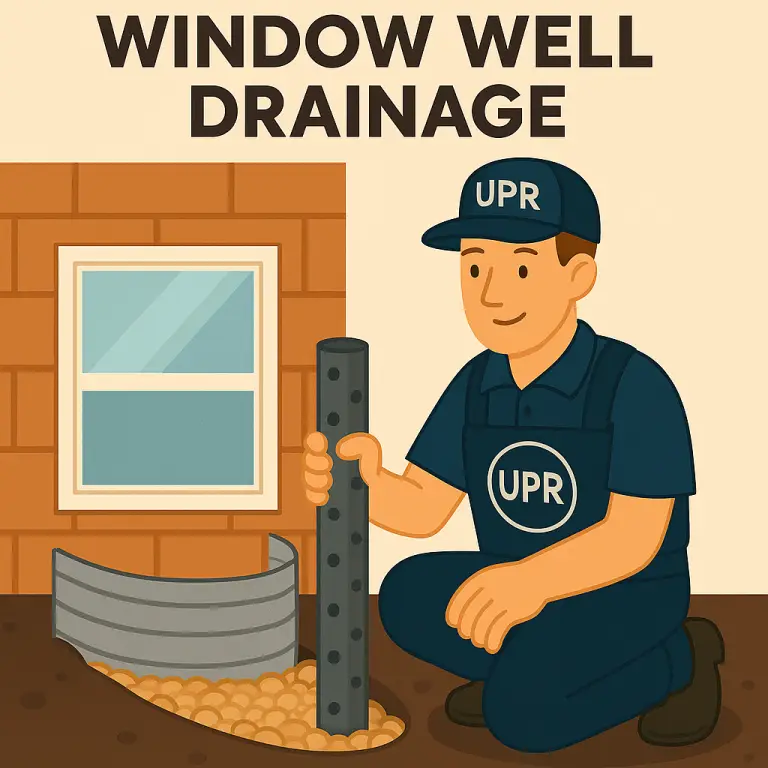
A Window Well Creates a Low Point Beside the Foundation — It Needs a Way to Drain
A basement window below ground level needs open space around it, which is exactly what a window well provides. The well holds the surrounding soil back from the window, allows light into the basement and keeps the opening accessible, but it also creates something that does not exist along the rest of the foundation: a deliberate low point where rainwater, snowmelt and surface runoff can collect.
When that water has a dependable path away, the window well can remain relatively dry even during wet weather. When drainage at the bottom becomes restricted, the surrounding soil directs too much runoff toward the opening or the well was never properly drained in the first place, water can begin rising directly against the basement window.
That is when a small exterior area can become a very direct route into the house.
At UPR (Underground Plumbing Repair), we install and repair window well drainage throughout Toronto and the GTA for properties dealing with standing water, saturated window wells and recurring water entry around below-grade basement windows. With more than 20 years of hands-on plumbing, waterproofing and underground experience, we look at the well as part of the water path around the foundation rather than treating the puddle at the bottom as the entire problem.
The first question is not simply whether a drain exists. We want to understand where the water is coming from, why it is collecting in the well and whether the drainage underneath has somewhere dependable to carry it.
Why Window Wells Fill With Water
A window well can receive water directly from rainfall, but direct rainfall is usually only one part of what it has to manage. The ground around the house determines whether additional runoff is encouraged away from the opening or concentrated toward it.
Soil can settle beside the foundation over time and gradually create a slope toward the well. A walkway, patio or landscaping change can alter the original path of surface water. A downspout located too close to the area can release a large amount of roof water into soil that already has limited drainage capacity, while melting snow piled beside the home can feed the same low point during a rapid thaw.
The well itself may also contribute to the problem. If its upper edge is too low relative to the surrounding grade, surface runoff can enter much more easily. Soil and debris can accumulate inside the well, reducing the depth of free-draining stone at the bottom and allowing water to remain closer to the window.
In other situations, the surface conditions are reasonable and the problem sits below. A drain may be blocked with soil or sediment, damaged, disconnected or connected to foundation drainage that is no longer moving water effectively.
Those conditions can produce the same visible result—a window well full of water—but they should not automatically receive the same repair.
Standing Water at the Bottom Is a Symptom
When homeowners see water sitting in a window well, it is natural to assume that the drain at the bottom must simply be clogged. Sometimes that is exactly what has happened, but standing water can also tell us that the well is receiving more water than the drainage was designed to manage or that the downstream system is no longer giving that water a useful place to go.
That is why clearing or replacing one short drain connection does not automatically solve every window-well problem. If the surrounding grade continues directing runoff toward the opening during every storm, even a functioning drain can be forced to manage far more water than necessary. If the drain connects into an older foundation drainage system that is restricted farther downstream, opening the top of the connection may not restore the full route.
UPR looks at both sides of that equation. We want to know how much water is arriving at the well and whether the system beneath it can actually move that water away.
A good repair reduces unnecessary water entering the well while providing a dependable route for the water that still reaches it.
Surface Drainage Around the Window Matters
A window well should not be expected to act as a catch basin for an entire side of the house. When the surrounding property slopes toward the foundation, runoff can enter the well much faster than ordinary rainfall falling directly into the opening.
This is where grading and drainage correction can become part of the solution. Correcting a settled area or redirecting surface water can reduce the amount of runoff reaching the window before we ask the drainage below to handle it.
Downspouts deserve particular attention because one roof section can collect a significant volume of water during heavy rain. If that water is released beside a below-grade window, the soil around the well can become saturated quickly even when the rest of the property drains reasonably well.
Hard surfaces can create the same effect. Concrete, asphalt and interlocking stone allow runoff to move quickly instead of soaking gradually into the ground, so a walkway or patio pitched toward a window well can deliver water much faster than the surrounding soil alone.
The objective is not to keep every drop of rain away from the well. The objective is to prevent avoidable surface water from being concentrated there.
What Happens Beneath the Window Well
The bottom of a properly functioning window well needs to allow water to move downward rather than remain trapped against the window. Free-draining stone helps water pass through the bottom of the well, while the drainage connection below provides the route that carries collected water away from the opening.
The exact arrangement can differ from one property to another. In some homes, window-well drainage connects into the foundation drainage system around the footing. In others, the existing layout, age of the house or previous renovations may have created a different arrangement.
This is why we do not assume the buried connection until we understand what is actually there.
Where the window-well drain relies on the home’s weeping tile system, the condition of that foundation drainage matters. A perfectly clear vertical drain has limited value if the system it enters cannot move the collected water farther along.
Homes with a sump system add another part to the route. If foundation drainage ultimately brings groundwater toward a basin, the sump pump needs to be able to move that collected water away from the house. In that arrangement, the window well, foundation drainage, sump basin and discharge are different components of one water-management path.
The connection should make sense from beginning to end.
A Window Well Drain Is Not a Substitute for Foundation Waterproofing
Water appearing near a basement window can make the window well look responsible even when the actual problem is elsewhere.
A foundation crack beside the opening may allow water through the concrete while the window-well drainage continues working normally. Deteriorated waterproofing around a larger section of wall can create seepage that becomes visible near the window simply because that is where the finished interior first exposes it. Water can also travel behind insulation or drywall before appearing some distance away from its actual entry point.
That is why we separate a window-well drainage problem from a broader foundation-water problem before deciding what to repair.
If the well repeatedly fills with water and leakage begins as the water level rises against the window, the relationship is usually clear. If the well remains relatively dry while moisture appears beside or below the opening, the investigation needs to look beyond the drain.
When the condition involves a larger section of foundation, basement waterproofing or exterior waterproofing may need to be considered based on how the water is actually entering.
Window-well drainage has a specific job. It manages water around the below-grade opening; it does not repair every possible source of basement moisture nearby.
The Window Itself Can Also Be the Problem
Drainage and the window are two different parts of the same vulnerable area.
A window well can drain properly while an aging window frame, damaged seal or deteriorated connection around the opening allows water to enter. In that case, changing the drainage underneath the well may improve conditions around the window without repairing the actual point where water crosses into the basement.
The opposite can happen as well. The window may be perfectly serviceable, but water rising inside a poorly drained well eventually reaches a height that the assembly was never intended to withstand.
That distinction is important because the repair should follow the failed component. We inspect the condition around the opening, look at the water pattern and consider whether the leak appears only when the well fills or whether moisture is showing up under different conditions.
The goal is to avoid replacing drainage to solve a window problem or blaming the window for water that should never have been allowed to accumulate against it in the first place.
Debris and Sediment Can Slowly Change a Working Well
Window-well drainage can deteriorate gradually without any single dramatic failure. Leaves, soil and organic debris fall into the well, sediment works its way through the stone and years of weather can reduce how quickly water passes through the bottom.
A well that once drained quickly may begin holding water for longer after storms. The homeowner may notice that the gravel stays saturated, water takes hours to disappear or sediment repeatedly collects near the drain opening.
Cleaning the visible debris can help when the problem is limited to the surface, but a deeper restriction requires a closer look. If the drainage below has become packed with soil or the connection has failed, replacing the stone at the top without addressing the buried problem may improve appearance while leaving the drainage capacity unchanged.
The condition of the well should therefore be considered from the top edge down to the point where collected water joins the rest of the property’s drainage.
When the Window Well Itself Needs Attention
Drainage problems are sometimes connected to the physical condition or position of the well rather than only the pipe underneath it.
A well that sits too low relative to the surrounding grade may allow surface water to spill over the edge. Soil can settle around the outside and create openings where runoff enters from behind, while an older well may shift away from the foundation or no longer contain the surrounding soil as effectively as it once did.
In those situations, improving the drainage without correcting the way the well interacts with the surrounding grade can leave an obvious weakness in place.
The final repair depends on what we find. Some projects need attention primarily at the bottom of the well, while others require correction to the surrounding grade or the well itself so water is no longer being delivered into the opening unnecessarily.
We want the entire area to work together once the excavation or repair is complete.
Several Wet Window Wells Usually Point to a Larger Pattern
One window well filling with water can indicate a localized problem. Several window wells along the same side of the house behaving the same way deserve a broader look.
The common factor may be the grade along that wall, the condition of the foundation drainage below or the way roof and surface runoff are being directed across that side of the property. Treating each well independently can lead to repeated work while the condition feeding all of them remains unchanged.
This does not automatically mean the house needs a major waterproofing project. It simply means that the repeated pattern gives us additional information.
A drainage problem affecting one opening can remain a one-opening repair. A pattern affecting several openings should be investigated as a pattern before deciding how many individual drains need to be changed.
That distinction keeps the scope connected to the evidence rather than to the number of products we could install.
Heavy Rain and Snowmelt Put Window Wells Under the Most Pressure
Window-well problems often become obvious during the conditions that deliver water fastest. Intense rainfall can generate more runoff than the soil around the property absorbs naturally, while prolonged storms can saturate the ground until even normally effective drainage begins working much harder.
Snowmelt creates another challenge in Toronto and the GTA. Water released during a rapid thaw can move across partially frozen ground instead of soaking in normally, and snow stored beside the foundation can concentrate that meltwater directly around basement windows.
A well that drains normally during a light summer shower may therefore struggle under very different seasonal conditions.
Understanding when the problem happens helps us assess whether the drainage is genuinely failing or whether the well is being overloaded because of the conditions surrounding it. That difference can determine whether we work primarily at the drain, the surface around the well or both.
What We Look at Before Recommending a Repair
A useful window-well assessment begins above the drain.
We look at the height and condition of the well, the surrounding grade, nearby downspouts and hard surfaces, signs of sediment or standing water and the relationship between the water level outside and any leakage visible inside the basement.
Then we look at what happens below. If drainage is present, we want to understand where it goes and whether the downstream path is functioning. Where foundation drainage or a sump system is involved, those components may need to be considered because the window-well drain cannot operate independently from the system receiving its water.
We also pay attention to the rest of the foundation. If the surrounding wall remains dry and one window well repeatedly causes trouble, that supports a focused repair. If water is entering across a larger section of the basement, concentrating only on the window may leave the main problem untouched.
This approach is deliberately simple: understand how water reaches the well, understand how it is supposed to leave, and repair whichever part of that path is no longer working properly.
Window Well Drainage Across Toronto and the GTA
UPR provides window well drainage installation and repair throughout Toronto and the Greater Toronto Area for homes dealing with standing water, saturated wells and recurring water entry around below-grade basement windows.
Some projects involve a localized drainage failure beneath one well. Others require adjustments to the surrounding grade, investigation of the foundation drainage or correction of several conditions that are all feeding water toward the same opening.
We do not assume that every wet window well needs the same drain installation, and we do not turn one localized problem into an entire waterproofing project without evidence that the wider foundation is involved. The repair should match the path the water is actually taking.
If water is collecting in a basement window well, draining slowly after storms or reaching the window during heavy rain or snowmelt, call UPR. We’ll look at how the water is getting into the well, what is happening beneath it and where that water is supposed to go before deciding what needs to change.
UPR — We don’t fix. We solve.