





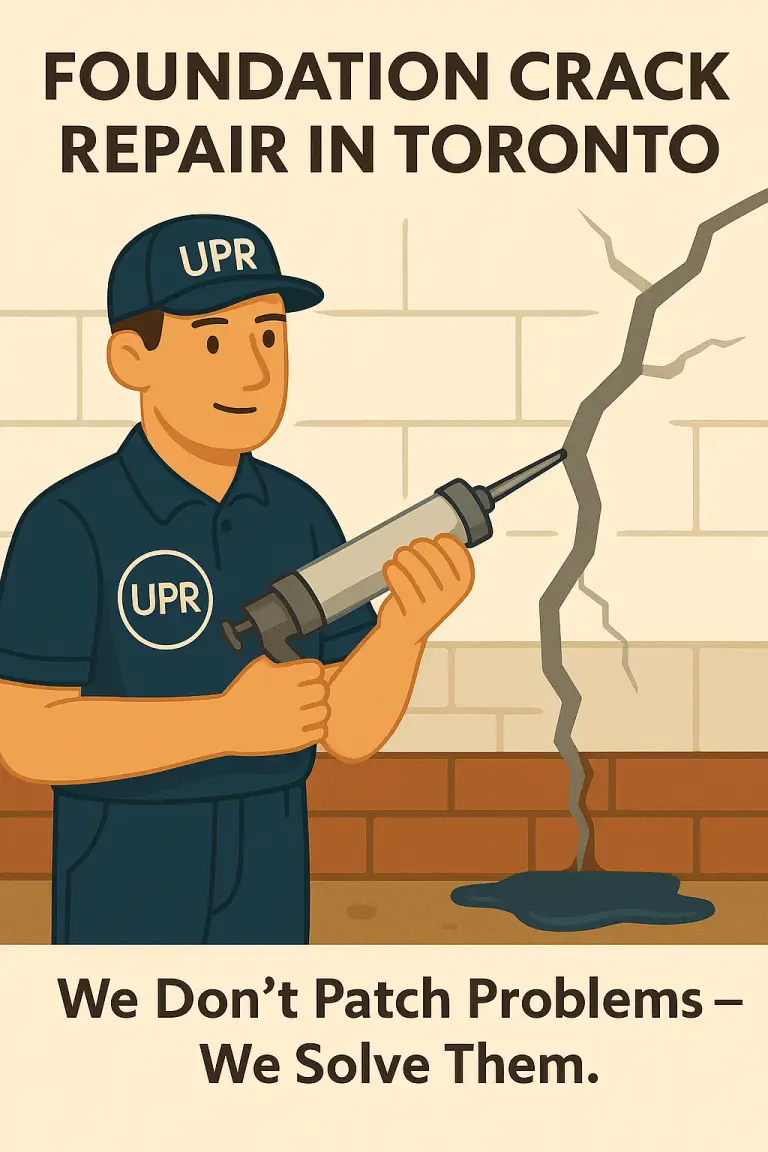
A Crack Is a Record of What the Foundation Has Been Through
Concrete and masonry are strong materials, but they are not motionless. A foundation is built in the ground, carries the weight of the structure above it and spends its entire life surrounded by soil that changes with moisture, temperature and time. Cracks can appear during curing, after normal settlement, following movement in the surrounding ground or because a section of the foundation itself has shifted.
The crack is the visible result. The important part is understanding what produced it.
Some foundation cracks remain narrow, aligned and unchanged for years. Others continue to open, develop displacement between the two sides or appear together with movement elsewhere in the building. Water may also find its way through a crack that is otherwise structurally stable, turning what began as a concrete opening into a basement leak.
Those situations should not all receive the same repair.
A vertical crack through a poured concrete wall may be completely different from a horizontal crack accompanied by wall movement. A stair-step pattern through block or masonry deserves a different look again. Width can provide useful information, but width alone does not determine whether a crack is serious. Direction matters. Location matters. Movement matters. What is happening elsewhere around the wall matters.
Even the history of the crack can tell us something. A homeowner who has watched the same line for ten years without seeing a change is giving us different information from someone who marked a crack six months ago and can now see that it has continued to move.
UPR approaches foundation cracks by looking beyond the surface opening. Is the wall still aligned? Has one side moved relative to the other? Does the crack continue through adjoining materials? Is water entering through it? Are there similar conditions elsewhere around the foundation?
That is how we decide whether the work can remain focused on the crack or whether the condition belongs to a larger Foundation Repair project.
Water entry adds another layer to that decision. A crack can be structurally stable and still become a reliable pathway for groundwater during heavy rain or periods of saturated soil. When the main concern is a suitable leaking crack in poured concrete, Crack Injection can often address the water entry without turning the repair into major foundation construction.
But closing the opening and correcting structural movement are two different things.
If the wall has displaced or the crack is part of a broader movement pattern, simply filling it can make the surface look better without changing the condition that produced it. That is where crack repair moves beyond sealing and into the structure itself.
The goal is not to make every crack sound dangerous. It is to determine which kind of crack is actually in front of us before deciding what belongs inside it.
The Repair Should Follow the Crack, Not a Standard Procedure
There is no single material or method that makes sense for every foundation crack.
In a poured concrete wall where the structure remains stable and the problem is primarily leakage, the repair may be relatively contained. The crack can be prepared and sealed using an appropriate injection or other localized method designed around the condition of the concrete and the way water is entering.
That kind of repair should stay focused when the evidence supports it.
A crack with displacement requires a different conversation. If one side of the wall has moved, if the crack continues to change, or if the pattern suggests that a larger section of the foundation is involved, the opening cannot be considered independently from the structure around it.
Block and masonry foundations introduce their own differences because movement may follow joints rather than passing cleanly through one solid concrete wall. Stair-step cracking, separated joints or movement across several courses can reflect conditions that a simple injection cannot address.
Exterior access may also become useful in some situations, particularly where the outside face of the foundation needs to be exposed or the crack is connected to a broader water-entry problem. Excavation allows the condition of the wall to be seen directly from the soil side and can make it possible to repair the opening while also addressing waterproofing where that work is genuinely required.
That does not mean every leaking crack needs full exterior waterproofing.
If water is entering through one isolated opening in an otherwise sound wall, the repair should not automatically expand into an entire side of the house. If several areas of the foundation are leaking, the wall is showing broader deterioration or exterior water management is clearly contributing to recurring problems, then Basement Waterproofing may become part of the solution.
The surrounding drainage conditions can matter without becoming the explanation for every crack. Water repeatedly collecting beside the foundation, poor grading or a foundation drainage problem can create difficult conditions around the basement, but correcting those conditions does not reverse structural movement that has already occurred.
The reverse is true as well. Repairing a crack does not correct poor drainage somewhere else on the property.
That is why access to the foundation can sometimes reveal more than the original crack. An excavation may expose previous repairs, deterioration in the surrounding wall or drainage conditions that were impossible to see from inside. An interior opening may show that moisture has travelled farther than the visible stain suggested.
When those discoveries matter to the repair, they should be dealt with while access exists. When they do not, they should not become an excuse to make the project larger.
Significant structural movement may also require engineering input before the repair is finalized. If a crack is connected to settlement, wall displacement or another condition affecting how the foundation supports the structure, the repair has to respect the building above it.
There are cases where deeper structural support or Underpinning eventually becomes part of a larger project, but that is a very different level of work from repairing an isolated crack. One visible opening should never be used as a shortcut to assume that the entire foundation needs reconstruction.
A good crack repair is proportional.
Enough work to deal with the actual condition. No less, and no more.
Fix the Crack You Have, Not the One You Are Afraid You Have
Foundation cracks make people nervous for a simple reason: they are visible evidence that something in a part of the house people rarely think about has changed.
That concern is reasonable. It just does not mean every crack is a structural failure.
UPR provides foundation crack repair across Toronto and the GTA for poured concrete, block and other foundation conditions where the opening needs to be understood before it is repaired. Sometimes the answer is a straightforward waterproofing repair. Sometimes the crack needs exterior access. Sometimes the pattern or movement points toward a larger structural concern.
The useful part of the inspection is figuring out which of those situations you actually have.
Older homes can make that investigation particularly interesting because a foundation may already contain decades of history. Previous owners may have patched the same crack from inside, covered it with finished walls or repaired the exterior years earlier. A new stain can therefore be the first visible sign of a condition that has existed much longer than the current homeowner realizes.
Newer foundations can crack as well. Concrete changes as it cures, buildings settle and no structure is completely isolated from the ground around it. Age alone does not determine whether a crack needs repair.
What matters is its condition now.
If the crack is stable and the only problem is water entry, we can keep the repair focused. If there is movement that needs to be understood, we can widen the investigation before anyone covers the evidence. If the surrounding foundation is sound and nothing else needs attention, we are perfectly comfortable leaving the rest of it alone.
That is the difference between repairing a foundation crack and simply hiding one.
More than 20 years of hands-on plumbing and underground experience has put UPR beside a lot of exposed foundations, footings, drains and basement walls. One thing becomes obvious after enough of that work: two cracks that look similar in a photograph can behave very differently once you see the structure around them.
The repair starts with that difference.
If you have discovered a new foundation crack, an existing crack has changed, water is entering through the wall or you simply want to know whether what you are seeing deserves attention, call UPR. We’ll look at the crack, the wall around it and the conditions that matter before deciding what kind of repair belongs there.
UPR — We don’t fix. We solve.