





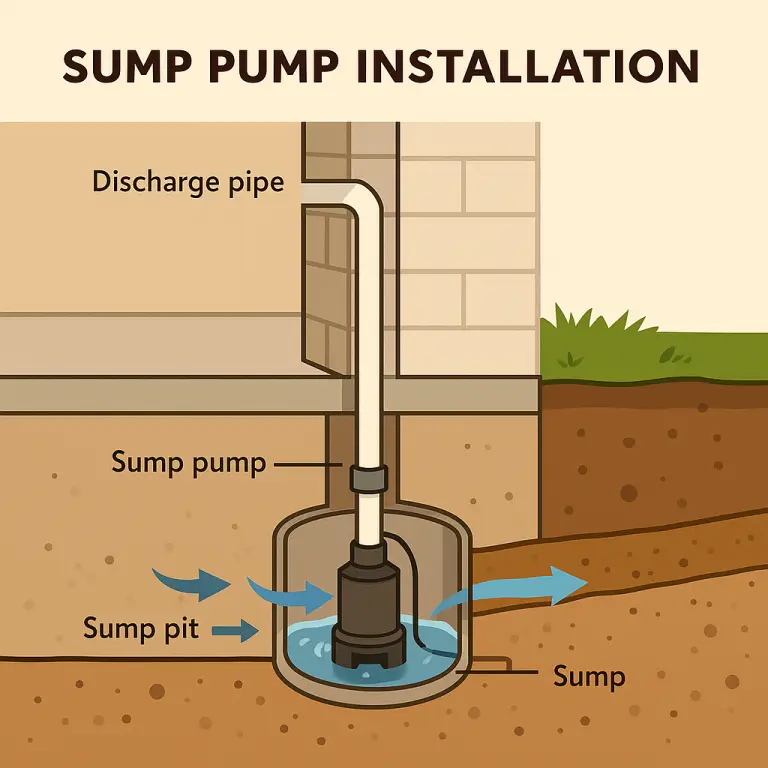
When Water Collects Around the Foundation, It Needs Somewhere to Go
A basement does not have to look wet for groundwater to be working around it. During heavy rain, spring thaw or periods when the ground becomes saturated, water can collect in the soil surrounding the foundation and make its way toward the home’s drainage system. When that water has nowhere reliable to go, the risk of moisture and basement flooding begins to increase.
A sump pump gives that water a controlled way out.
At UPR (Underground Plumbing Repair), we install, replace and service sump pump systems throughout Toronto and the GTA as part of a complete approach to basement drainage and flood protection. A properly planned sump system collects groundwater in a sump basin and pumps it away from the foundation before the water can rise high enough to become a problem inside the basement.
The pump itself may be the part everyone recognizes, but it is only one piece of the system. The basin, foundation drainage, discharge piping, power supply, check valve, backup protection and the location where the water is released all have to work together.
That is why we do not look at sump pump installation as simply putting a pump into a hole in the floor. We look at where the water is coming from, how it reaches the basin and where it is going after the pump turns on.
What a Sump Pump Actually Does
A sump pump is designed to remove groundwater that has collected in a sump basin. In many homes, foundation drains or weeping tiles direct water from around the footing toward that basin, where the water level can rise safely until the pump is activated.
When the water reaches the pump’s operating level, the system turns on and sends the collected water through a discharge line to an appropriate location away from the foundation. Once the water level drops, the pump shuts off and waits for the next cycle.
During dry weather, a properly functioning sump pump may sit quietly for long periods without doing anything at all. During a major storm or rapid snowmelt, the same pump may cycle repeatedly as the drainage system moves significantly more groundwater toward the basin.
That changing workload is one reason the entire installation matters. The system has to be capable of collecting the water, moving it effectively and discharging it somewhere that does not simply send the same water straight back toward the foundation.
A Sump Pump Is Not the Same as a Sewer Backup System
Basement flooding can come from several different directions, and those sources should not be confused with one another.
A sump pump primarily manages groundwater and foundation drainage. It does not repair a blocked main drain, stop sewage from reversing through the building sewer or protect a home from every possible source of basement water.
A backwater valve serves a different purpose. It is installed in the drainage system to help protect against wastewater attempting to travel backward toward the house. A sump pump, by comparison, collects water from the foundation-drainage system and pumps it away.
Some homes benefit from both systems because they are addressing two different risks.
The same distinction applies to ordinary household plumbing failures. A leaking waterline, failed fixture or burst pipe belongs on the plumbing-services side of the house. Installing a larger sump pump does not solve a leaking pipe, and repairing a leaking pipe does not manage groundwater building up around the foundation.
Knowing where the water comes from is the first step toward choosing the right protection.
Understanding the Weeping Tile and Sump System
The sump pump makes more sense once you understand what is feeding it.
A foundation drainage system is designed to collect water from around the footing of the house before that water builds up against the foundation. In many homes, perforated drainage pipe commonly referred to as weeping tile runs around the foundation and directs collected water toward a sump basin.
The basin becomes the collection point.
When that system is working properly, groundwater has a path to follow instead of simply remaining trapped around the structure. The sump pump then takes over and moves the collected water away from the house.
This relationship is important because a pump can only remove water that actually reaches the basin. If the foundation drainage is blocked, disconnected, damaged or poorly configured, replacing the pump alone may not correct the underlying drainage problem.
That is why a sump pump should be considered as part of a system rather than as an isolated appliance sitting in the basement floor.
Installing a New Sump Pump System
Installing a sump system in an existing basement normally begins with understanding the foundation drainage and deciding where the basin needs to be located so it can receive the water the system is intended to manage.
This is more important than simply finding the visually lowest point of the basement floor. The sump basin has to work with the drainage layout beneath and around the house, while also allowing for a practical discharge route and future access to the equipment.
Once the location is established, the concrete floor is opened and the sump basin is installed. Depending on the existing drainage arrangement and the scope of the project, the foundation drainage may then be connected or redirected so collected groundwater can enter the basin.
The pump is installed inside the basin and connected to the discharge piping. A check valve is normally incorporated into the discharge arrangement so water already pumped upward does not simply fall back into the pit every time the pump shuts off.
From there, the discharge route has to be planned carefully. Water needs to leave the system and be directed away from the foundation in a manner that complies with applicable local requirements and does not create another drainage problem somewhere else on the property.
When the work is finished, the basin remains accessible so the pump, float, check valve and other components can be inspected and serviced in the future.
Where the Discharge Water Goes Matters
Moving water out of the sump basin is only half the job.
If the discharge releases water immediately beside the foundation, that same water can soak back into the surrounding soil and eventually return to the drainage system. The pump then ends up moving the same water repeatedly instead of actually getting it away from the house.
The discharge should therefore be planned around the property itself. Grading, neighbouring properties, walkways, landscaping, freezing conditions and municipal requirements can all affect where and how the water should be released.
The goal is simple even when the site is not: once the pump removes the water from beneath the house, we do not want to send it somewhere that creates another problem.
That is why discharge piping should be treated as an important part of the installation rather than an afterthought attached to the pump.
Choosing the Right Sump Pump
A bigger pump is not automatically a better pump.
The correct equipment depends on how much water the system may need to manage, how high the pump needs to lift that water, the discharge arrangement and the way the foundation drainage behaves during wet conditions.
Two neighbouring houses can have very different sump requirements. One basement may receive relatively little groundwater except during the heaviest storms, while another property may have a sump that cycles regularly because of soil conditions, elevation or the amount of water moving through the foundation drainage system.
What matters is matching the equipment to the application.
Installing an undersized pump can leave the system struggling when inflow becomes heavy. Oversizing equipment without considering the system around it is not a substitute for proper planning either. The pump, basin and discharge arrangement should work together instead of being selected as unrelated components.
At UPR, we look at the house and the drainage conditions before deciding what belongs in the pit.
Why the Float and Basin Matter
A sump pump cannot make good decisions about water levels on its own. It relies on a float or similar control to tell it when to turn on and when to stop.
That means the pump needs enough room inside the basin for the float to move freely without becoming trapped against piping, the side of the basin or other equipment. If the float cannot move correctly, even a perfectly good pump may not start when water rises.
The size and layout of the basin also influence how often the pump cycles. A system that switches on and off constantly may create unnecessary wear, while a basin and pump that are properly matched can allow the system to operate in more reasonable cycles.
These details disappear underneath the cover when the installation is finished, but they matter every time groundwater enters the system.
A sump pump does not know whether a storm is serious. It only knows whether the water reached the point where it is supposed to turn on. Everything around that mechanism needs to let it do exactly that.
Battery Backup for the Storm That Takes the Power With It
There is an obvious weakness in relying entirely on an electrically powered pump for storm protection: severe weather and power outages have an unfortunate habit of arriving together.
The primary sump pump may be perfectly healthy and completely useless if the house loses electricity while groundwater is still flowing into the basin.
That is why a properly designed sump pump battery backup system can be such an important second layer of protection.
A backup system is designed to provide pumping capability when normal power is unavailable or when the primary system cannot operate. Depending on the setup, it may use a dedicated backup pump and battery system rather than simply trying to keep the main pump running indefinitely.
Battery backup is not unlimited power. Runtime and pumping capacity depend on the equipment, battery condition, water inflow and how often the system needs to cycle. That makes equipment selection and battery condition important.
The point is not to promise that a battery will run forever. It is to give the basement another line of defence during the period when the primary system cannot do its job.
Sump Pump Alarms Add Another Layer
A pump can fail quietly.
A float can become stuck, a discharge line can become restricted, equipment can lose power or the water entering the basin can simply exceed what the system is able to remove. Without some form of warning, the homeowner may not know there is a problem until the water reaches the basement floor.
A high-water alarm can provide an additional layer of awareness by warning when the water inside the basin rises beyond the normal operating range.
An alarm does not replace the pump and it does not remove any water. Its job is to tell somebody that the system is no longer controlling the water level the way it normally should.
That warning can be extremely valuable because it gives the homeowner an opportunity to investigate while the problem is still inside the sump basin instead of discovering it after the basement has already flooded.
The Pump You Already Have Still Needs Attention
Sump pumps tend to be forgotten because the best ones spend most of their lives doing their job without asking for attention.
That can create a false sense of security.
A pump that worked perfectly three years ago is not automatically ready for tonight’s storm. Float switches can become obstructed, check valves can deteriorate, discharge lines can develop problems and pumps themselves eventually wear.
UPR provides dedicated sump pump maintenance so the system can be inspected before the moment it is needed most.
Maintenance can include checking pump operation, confirming that the float moves properly, inspecting accessible components, checking the discharge arrangement and testing the system to see whether it starts and stops as expected.
Battery backup systems also deserve attention. A battery has a service life and its condition matters just as much as the backup pump connected to it.
Flood-protection equipment should not be treated like a decoration beside the furnace. It needs to remain accessible, understood and periodically tested.
When a Sump Pump Should Be Repaired or Replaced
Not every sump pump problem means the entire system needs to be rebuilt.
A system may have a problem with the float, check valve, discharge arrangement or another component while the pump itself remains serviceable. In other cases, the pump may be aging, noisy, repeatedly failing to activate or simply no longer capable of keeping up with the water entering the basin.
UPR handles sump pump repair and replacement based on what is actually happening with the system.
If an existing pump can be serviced reliably, there is no reason to replace equipment simply because somebody opened the basin. If the pump has reached the end of its useful service life or is showing signs that make continued reliance on it unreasonable, replacement becomes a different conversation.
What we do not want is for the first real test of an aging pump to happen during the heaviest rainfall of the year.
That is a very expensive way to discover that something was no longer working.
Signs a Sump System Deserves a Closer Look
A homeowner does not need to become a sump pump technician, but changes in the way the system behaves are worth paying attention to.
A pump that begins running much more frequently than it used to may simply be responding to unusually wet conditions, but it can also indicate a change in groundwater or drainage around the house. A pump that runs for unusually long periods, makes new noises, cycles on and off rapidly or struggles to lower the water level deserves to be checked.
The opposite can also be suspicious. If the sump basin normally receives water during significant rainfall and suddenly remains completely dry while water is appearing elsewhere in the basement, the issue may be with the drainage feeding the pit rather than the pump itself.
The important thing is understanding what is normal for that particular house.
A sump system develops a pattern over time. When that pattern changes, there is usually a reason.
Sump Pumps During Basement Renovations
A basement renovation is an excellent time to think about flood protection because access becomes much more complicated after new flooring, walls and finishes are installed.
If the home already has a sump system, the renovation should preserve proper access to the basin and equipment. Hiding the lid permanently under finished flooring may make the basement look cleaner for a moment, but it creates a problem the next time the pump needs to be inspected or replaced.
If the house does not currently have a sump system and foundation drainage work is already part of the project, this may also be the right time to determine whether adding one makes sense.
The decision should still be based on the property and drainage conditions rather than simply installing equipment because the floor happens to be open.
The best time to think about underground systems is before they disappear underneath an expensive finished basement.
Sump Pumps and Basement Waterproofing Work Together Differently
A sump pump and waterproofing are often mentioned in the same conversation because both can be part of basement water management, but they perform different jobs.
Waterproofing deals with the ways water reaches or passes through the foundation. A sump pump handles water that has already been collected by the foundation-drainage system and needs to be mechanically removed from the property.
In some homes, one solution is enough. In others, an interior or exterior drainage system may be designed to direct water toward a sump basin so the pump becomes an important part of the overall waterproofing strategy.
The right approach depends on where the water is entering and what the existing drainage around the foundation is doing.
This is why we do not begin every wet-basement conversation by selling a pump. We begin by trying to understand the water.
Once the source is understood, the solution becomes much clearer.
Sump Pump Installation and Municipal Flood-Protection Programs
Some municipalities offer financial assistance for eligible basement flood-protection improvements, including sump pump systems in certain circumstances.
The rules, eligible work and subsidy amounts are not identical everywhere and can change over time, so homeowners should verify the current program requirements before assuming that a particular installation will qualify.
Toronto currently includes eligible sump pump installations, alarms and battery backup systems within its Basement Flooding Protection Subsidy Program. Documentation and eligibility requirements apply, and subsidy approval ultimately belongs to the City rather than the contractor.
UPR can make sure the scope of the plumbing and drainage work is clear and provide the project documentation associated with our work, but no contractor should promise municipal approval before the municipality reviews the application.
The protection should make sense for the house first. A rebate is a benefit when the project qualifies, not the reason to install equipment that the property does not need.
Sump Pump Installation Across Toronto and the GTA
UPR installs and services sump pump systems throughout Toronto and the Greater Toronto Area in homes with very different foundations, drainage layouts and histories.
Some properties have an existing sump basin with an old pump that needs replacement. Some have a working primary pump but no backup protection. Others are undergoing waterproofing work or basement renovations and need an entirely new sump system incorporated into the project.
There are also houses where the first step is not installing anything at all. If water is entering through a foundation crack, backing up through a sanitary drain or leaking from plumbing above, a sump pump may not be the answer to that particular problem.
That is why we look at the system before choosing the equipment.
Once we understand where the water is coming from, how it is being collected and where it needs to go, we can build the sump system around the actual house rather than around a box sitting on a supplier’s shelf.
The Pump Is Small. The Job It Has Can Be Very Big.
Most days, a sump pump gets almost no attention.
It sits below the basement floor, hidden inside a basin, waiting for water that may not arrive for weeks or months. There is nothing particularly exciting about that.
Then the ground becomes saturated, the rain keeps falling and water begins moving toward the foundation much faster than usual. At that point, the little pump nobody was thinking about may be the only thing continuously moving groundwater away from a finished basement.
That is why the details around it matter.
The basin matters. The float matters. The check valve matters. The discharge route matters. Backup power matters. Maintenance matters.
Most of all, understanding where the water is coming from matters.
If you are considering a new sump pump, replacing an existing system or simply have no idea whether the pump already in your basement is ready for the next heavy storm, call UPR. We will look at the drainage system, explain what the pump is actually doing and build the solution around the property in front of us.
UPR — We don’t fix. We solve.