
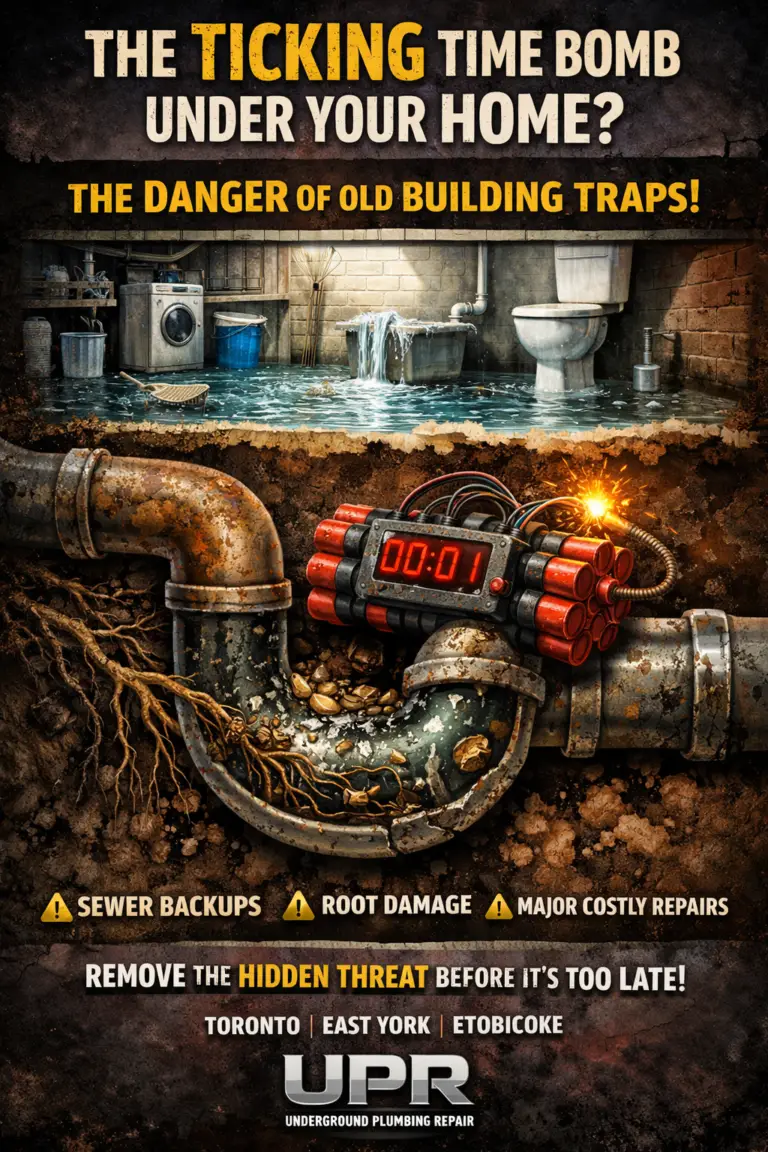
Most homeowners never think about the condition of the drain system buried beneath their home until something goes wrong. Water begins draining slower than usual, a basement floor drain starts gurgling, the smell near a laundry sink becomes harder to ignore, or sewage suddenly backs up where it should never appear. By the time these warning signs become obvious, the real problem has often been developing underground for years.
One of the most overlooked causes of recurring sewer trouble in older homes is the building trap. It is hidden, outdated, and easy to ignore, but when it begins collecting waste, catching debris, or restricting flow, it can create the kind of drainage problems that keep coming back until the trap is properly removed. In many older homes across Toronto, East York, and Etobicoke, this aging part of the sewer system continues to act like a buried weak point beneath the property.
That is what makes it so dangerous. A building trap does not always fail loudly at first. It quietly slows the system down, gives buildup a place to collect, makes cleaning more difficult, and increases the risk of repeated backups. Homeowners often think they are dealing with a simple clog, when in reality the drainage system is fighting against an old restriction that should have been removed long ago.
A building trap is an older section of pipe installed on the main sewer line as it exits the home. Decades ago, it was designed to hold water and block sewer gases from entering the property. At the time, it was considered useful. Today, in many cases, it is considered more of a liability than a benefit.
The reason is simple. The shape of the trap creates a low point in the drainage system, and low points are exactly where waste, grease, sludge, paper, and other debris tend to settle. Instead of allowing sewage to move out of the home as efficiently as possible, the trap gives material a place to collect and build up over time. In older systems, especially those already affected by scale, corrosion, or tree roots, that restriction can become even more severe.
In practical terms, a building trap often turns part of the main sewer line into a choke point. Once that happens, the drainage system may still function for a while, but it is doing so under stress. It becomes more vulnerable to slow drainage, more vulnerable to recurring clogs, and far more vulnerable to the kind of main drain backup that turns into an expensive emergency.
The biggest issue with a building trap is not just that it is old. The real issue is that it interferes with flow at the exact place where the home needs reliable movement the most: the main line carrying wastewater out to the sewer.
A healthy drain system should move waste out of the property with as little resistance as possible. Once you introduce a deep bend that encourages settlement and buildup, you create a place where the system can start losing efficiency year after year. That buildup may begin gradually, but it does not stay small forever. It thickens, hardens, catches passing debris, and makes future cleaning more difficult. If tree roots are already finding their way into older underground piping, the problem becomes even worse.
That is why so many recurring sewer issues never seem fully solved after basic snaking alone. The temporary blockage may be opened, but the underlying condition remains in place. The trap continues to hold debris. Flow continues to be compromised. The system continues to struggle. In many cases, homeowners end up paying repeatedly for symptoms while the actual cause stays underground.
This is especially relevant in neighborhoods with older housing stock, where original or aging drain systems are still common. Homes in Toronto , East York, and Etobicoke areas often have underground conditions that deserve a closer look when recurring drain issues begin to appear.
The phrase “ticking bomb” fits because the danger is not always obvious until the failure becomes messy, urgent, and costly. A building trap can sit underground for years while slowly worsening the condition of the system around it. During that time, the homeowner may notice only minor symptoms: a drain that clears slowly, a fixture that gurgles, or a backup that seems to happen once in a while and then disappears.
What makes that so deceptive is that the trap may still be pushing the system closer to a major failure. The restriction gets tighter. The debris becomes harder to remove. Cleaning equipment has a harder time reaching through effectively. Water and waste begin losing the open path they need to leave the home safely.
Then one day the warning stage ends. A heavy use day, a partial blockage, root intrusion, or additional waste buildup becomes enough to tip the system over. The result can be a full main drain backup into the basement, sewage coming up through lower fixtures, or repeated flooding that damages floors, walls, and finished areas.
When homeowners see a backup happen “all of a sudden,” the truth is often that it was not sudden at all. The problem had simply been building underground for a long time. That is why leaving a building trap in place can be such a serious risk. It is not just old plumbing. It is an outdated restriction with the potential to turn a manageable drainage issue into a major property problem.
Not every older home has a building trap issue, but when certain warning signs appear together, it becomes something worth investigating properly. Repeated sewer backups are one of the strongest clues, especially when the line has already been snaked before and the problem continues returning. Slow drainage in multiple lower-level fixtures can also point to a main line restriction rather than a simple fixture clog. Gurgling sounds, foul odors, and backups that affect basement plumbing first are other signs that the issue may be deeper in the system.
The age of the home also matters. In many older neighborhoods throughout Toronto and the GTA, original underground drain components are still present. If the system has not been modernized and the home has a history of recurring sewer trouble, there is a real chance the building trap is contributing to the problem.
This is where proper diagnosis matters. Without knowing what is underground, it is easy to mistake an outdated system defect for an ordinary blockage. A professional inspection helps determine whether the trap is still in place, how it is affecting flow, and whether removal is the right long-term solution.
A common mistake is assuming that once the drain starts flowing again, the issue has been solved. In reality, a cleared line is not always a corrected line. If the building trap remains underground and continues acting as a collection point for waste and debris, the same cycle can begin again.
That is why homeowners dealing with recurring issues should think beyond temporary clearing. If a line keeps backing up, there is usually a reason. In many older systems, that reason is structural or design-related, not just incidental debris. The building trap may be slowing the line, holding buildup, or making future maintenance less effective.
A proper Toronto camera drain inspection can help reveal whether the trap is still functioning as a major restriction. Once confirmed, removal often becomes the smarter investment because it addresses the condition causing the repeated trouble rather than merely reopening the path for a short time.
Building trap removal is not just about taking out one outdated pipe fitting. It is about improving the flow and serviceability of the entire drain system. Once the trap is removed, the main line can be reconfigured into a cleaner, more direct path that allows wastewater to move more efficiently out of the home.
That matters for several reasons. First, smoother flow means fewer places for waste to settle and collect. Second, future cleaning and inspections become easier because the line is no longer interrupted by an old-style trap structure. Third, the system becomes more aligned with modern drainage practices, which prioritize proper venting and efficient sewer flow rather than relying on outdated underground traps.
In homes already dealing with broader underground issues, building trap removal can also connect with larger drain upgrades. Sometimes the trap problem appears alongside deteriorated clay pipe, root intrusion, or failing sewer sections. In those cases, related work such as East York drain repair and replacement, Toronto trenchless drain repairs, or Etobicoke tree root removal may also be relevant depending on the condition of the line.
This is why the goal should never be to make assumptions. The goal is to inspect the system properly, identify the true source of the restriction, and recommend the repair that makes sense for the property long term.
Older homes in Toronto, East York, and Etobicoke often come with the kind of underground drainage history that makes building trap problems more likely. These neighborhoods contain many homes built in periods when older sewer layouts were common, and many of those homes are still dealing with aging drain infrastructure below ground.
That combination matters. Mature trees, aging pipes, older materials, and outdated sewer components can all work together to create recurring drainage issues that are easy to misread if nobody examines the full system. Homeowners may focus on the backup they can see, while the real issue remains buried in the line itself.
A building trap is one of those underground problems that can stay out of sight long enough to be underestimated. Because it is buried and rarely discussed, many homeowners do not realize how much trouble it can cause until the signs become impossible to ignore. By then, the system may already be struggling with repeated buildup, restricted flow, and a growing risk of backup.
That is why building trap removal matters. It is not simply a technical upgrade. It is the removal of an outdated restriction that can quietly compromise the safety and performance of the home’s drainage system year after year. In older properties, especially across Toronto, East York, and Etobicoke, that kind of hidden weakness should not be ignored.
When a drain system keeps showing signs of stress, the smartest move is not to keep guessing. It is to find out what is really underground, deal with the actual cause, and remove the conditions that allow the problem to keep returning. If the building trap is part of that issue, removing it may be one of the most important steps in protecting the property from future sewer trouble.