





Protecting Your Home Starts Before the Sewer Pushes Back
Most homeowners never think about which direction wastewater is moving through the drain system. Under normal conditions, there is no reason to. Water leaves the house, travels through the building drain and continues toward the municipal sewer exactly the way it was designed to.
The problem begins when that direction changes.
During certain sewer conditions, wastewater can be pushed back toward a property instead of continuing away from it. When there is nothing in the drainage system to stop that reverse flow, the lowest plumbing openings in the home can become the places where the pressure is released. In many houses, that means the basement.
A properly installed backwater valve is designed for that moment.
At UPR (Underground Plumbing Repair), we install and service backwater valves throughout Toronto and the GTA as part of a larger approach to sewer backup and basement flood protection. We do not look at a backwater valve as a plastic fitting that simply gets dropped into a drain. It becomes part of the home’s underground drainage system, which means where it is installed, what it protects, how it can be accessed and what condition the surrounding drain is in all matter.
When the sewer is flowing normally, the valve should stay out of the way. When wastewater tries to travel in the wrong direction, that is when it has one very important job to do.
What a Backwater Valve Actually Does
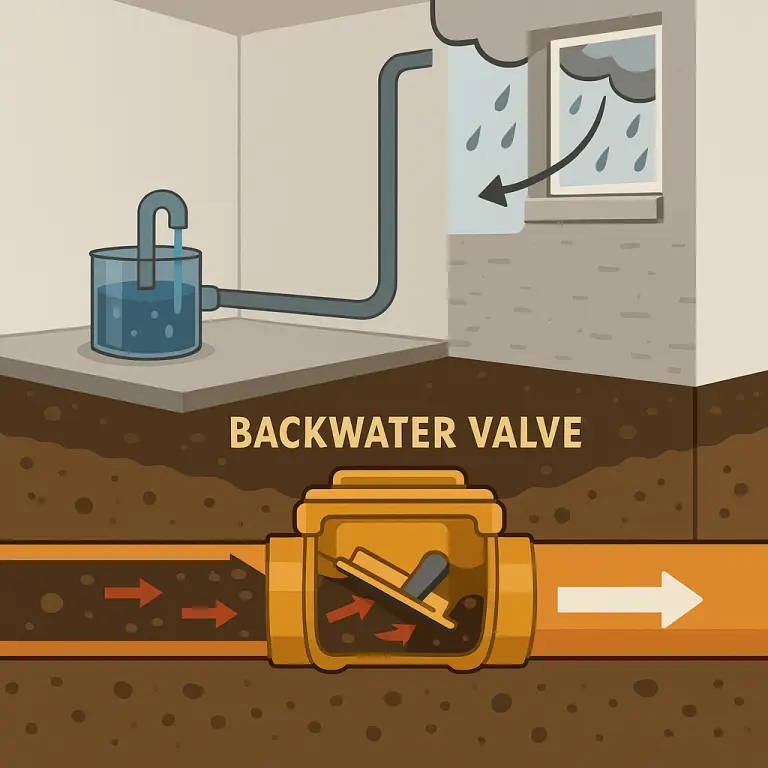
A backwater valve is installed in the drainage system and is designed to permit wastewater to flow away from the house under normal conditions. Inside the valve is a moving flap or gate that responds when flow reverses. If sewage begins pushing back toward the property from downstream, the valve closes and creates a physical barrier intended to stop that reverse flow from continuing toward the protected portion of the home.
It is sometimes casually called a sewer backup valve, which describes its purpose reasonably well. It should not, however, be confused with every device referred to as a “backflow preventer.” Backflow protection is also used on potable water systems, and those are different devices serving a different part of the plumbing system.
A backwater valve deals with drainage.
And more specifically, it deals with wastewater trying to travel backward through that drainage system.
That distinction is important because a backwater valve does not make every type of basement flooding disappear. It protects against one particular risk extremely well when it is selected, located, installed and maintained properly.
Why Sewer Water Can Come Back Toward a House
A drainage system is built around gravity and available capacity. Wastewater leaves the home because there is somewhere downstream for it to go.
Under abnormal conditions, that balance can change. During intense rainfall, sewer infrastructure can become heavily loaded. In some situations, pressure downstream can increase enough that wastewater begins moving back toward connected properties rather than continuing away from them.
That is very different from a blockage inside the homeowner’s own drain.
A severely clogged pipe can also cause wastewater to rise through lower fixtures, but installing a backwater valve does not repair that blockage. The same is true if the private sewer line is cracked, collapsed, root damaged or otherwise failing.
This is why we do not treat every basement backup as proof that the house simply needs a valve.
First we want to understand what happened.
If sewage entered because the private drain was blocked, the drainage problem needs to be addressed. If the line itself is structurally damaged, that needs to be dealt with. If the concern is wastewater travelling backward toward the home from the downstream sewer system, that is where backwater protection becomes particularly important.
Different problem. Different solution.
A Backwater Valve Is Protection, Not a Drain Repair
This is one of the most important things a homeowner should understand before installation.
A backwater valve does not repair a damaged sewer.
It does not remove roots. It does not correct poor slope. It does not clear grease buildup. It does not rebuild a collapsed section of drain, and it does not somehow make an aging clay sewer healthy again.
Its job is to protect the house against reverse flow through the drainage system.
That is why the condition and configuration of the existing drainage system matter. If a property has been experiencing repeated backups during ordinary use, the first question should be why the drain itself is backing up. If the property is vulnerable when the municipal sewer is under pressure during major storms, the conversation may be very different.
Sometimes both conditions exist in the same home.
In that case, the proper solution may involve repairing the private drainage problem and installing backwater protection afterward. Simply adding a valve to a failing sewer line does not make the failed pipe disappear.
At UPR, we would rather understand the entire system first than install equipment and hope we guessed correctly.
Where the Backwater Valve Is Installed Matters
A backwater valve needs to be located where it can protect the intended portion of the drainage system while still allowing the home to function properly under normal conditions.
That sounds obvious, but underground drainage layouts are not identical from one house to another.
Older GTA homes may have original clay drains, cast iron, previous repairs, newer PVC sections or combinations of all three. Branch drains can join the main building drain in different places. Basement fixtures may have been added years after the house was constructed. Some properties have been renovated several times, and what appears straightforward above the floor may look very different once the drainage layout is understood.
That is why location is not simply a matter of finding an open spot in the basement and cutting into the pipe.
The valve has to be integrated into the drain in a way that allows it to perform its intended function. It also needs to remain accessible afterward because a backwater valve contains moving components that should be inspected and cleaned throughout its service life.
Burying a protective device beneath a permanent finished floor with no practical access defeats part of the purpose of having a serviceable valve in the first place.
What Backwater Valve Installation Involves
For many existing homes, installing a backwater valve requires access to the building drain beneath the basement floor. The concrete is opened in the appropriate area, the drain is exposed and the valve is installed into the system according to the project requirements.
Before everything is closed again, the installation needs to be positioned correctly and the valve needs to remain accessible through its cover. Once the underground work is complete and any required inspection has taken place, the floor can be restored around the access point.
The finished result should not look like an afterthought.
There will still be an access cover because there needs to be one, but the underground work around it should be clean, properly connected and planned so future service does not require someone to rediscover the valve with a concrete saw.
Depending on the municipality and scope of work, permit and inspection requirements may apply. Those requirements should be confirmed for the particular installation rather than assuming that every GTA municipality follows an identical process.
The important thing is that the valve is installed as part of the drainage system—not merely placed inside it.
What Happens When the Valve Closes
A backwater valve protecting the main building drain changes what the drainage system can do while it is closed.
When reverse flow pushes the valve shut, wastewater from the sewer is being prevented from moving back toward the protected area. At that same moment, water from inside the house may also be unable to leave through that closed section of drain.
That means the occupants should avoid using plumbing fixtures while the valve is closed.
Flushing toilets, running showers, using sinks, operating the dishwasher or sending a washing machine discharge into a drain that temporarily has no outlet can create a backup from the house side of the valve.
This is an important part of understanding how the protection works. The valve is not magically making wastewater disappear. It is temporarily closing the path because the alternative is allowing external sewage to move toward the home.
Once the downstream condition returns to normal and the valve can reopen, the drainage system can resume normal operation.
Some installations may also incorporate an alarm or other monitoring arrangement so occupants know when the valve has activated.
Backwater Valves and Sewer Backups
If a property has already experienced a sewer backup, the first priority is understanding what caused it.
A single event during an extreme storm may point in one direction. Repeated backups every time the family uses several fixtures may point somewhere else entirely. A camera inspection and assessment of the drainage system can help determine whether the private sewer is healthy, obstructed or structurally damaged.
That information matters before prevention work begins.
If the line is clear and structurally sound but the home is vulnerable to downstream sewer surcharge, a properly installed backwater valve can become an important layer of protection.
If the sewer itself is damaged, repairing that condition may need to happen first.
A backwater valve works best when it is installed into a drainage system we understand.
Backwater Valves and Basement Flood Protection
Basement flooding does not have one universal cause.
Sewage can enter through the drainage system, but groundwater can enter through foundation cracks, failed waterproofing, window wells, overwhelmed drainage systems or other pathways around the structure. A backwater valve does not waterproof a foundation, and a waterproofing membrane does not stop municipal sewage from reversing through an unprotected building drain.
Those systems solve different problems.
In some homes, flood protection therefore involves more than one layer. A backwater valve may address sewer backflow while a sump pump manages water collected by the weeping tile system. Waterproofing may address water entering through the foundation. Surface drainage improvements may deal with water accumulating around the property.
The strongest protection strategy is the one built around the actual risks of the house.
Installing every possible device does not automatically make a basement better protected. Understanding where the water can come from and dealing with those pathways individually does.
Why Access to the Valve Must Remain
The cover over a backwater valve is there for a reason.
Inside the chamber is a mechanical component that lives in one of the least glamorous environments in the house. Wastewater, paper and everything else travelling through the sanitary drain passes through that area. Over time, debris, residue or other material can interfere with movement of the flap.
If the valve cannot move freely or cannot seal properly, its ability to protect the home may be reduced.
This is why the access cover should remain accessible after the basement is finished. Flooring and renovation work should be planned around it rather than permanently burying it.
A beautifully finished basement does not benefit from hiding the one device that may need to be reached when the sewer system is under pressure.
Good underground work includes thinking about the day somebody needs to service it.
Backwater Valve Maintenance Is Part of the System
A backwater valve is not something we believe should be installed and forgotten for the next twenty years.
Because it contains a moving flap operating inside a sanitary drainage line, it should be inspected and maintained according to the manufacturer’s recommendations. The chamber can be opened, the valve can be checked for debris and the moving components can be examined to make sure they are able to operate properly.
UPR provides dedicated backwater valve maintenance for exactly that reason.
The purpose of maintenance is not to make the system complicated. It is actually the opposite. The valve itself is relatively simple, and keeping it clean and moving freely gives that simple mechanism the best opportunity to do its job when reverse flow occurs.
The worst time to discover that a flap has been obstructed for years is during the storm when you finally need it.
If you already have a backwater valve but have no idea when it was last opened or inspected, that is worth correcting even if the basement has never experienced a problem.
What If the Valve Is Damaged or No Longer Operating Properly?
Backwater valves are serviceable components, and like other mechanical parts of a plumbing system, they can eventually require attention.
Sometimes maintenance is all that is needed. Debris can be removed, the chamber can be cleaned and the operation of the flap can be checked. In other situations, an aging or damaged component may need to be repaired or replaced.
The decision depends on what is found during inspection.
We do not want a homeowner replacing an entire installation because a serviceable component simply needed cleaning, but we also do not want to pretend a damaged valve is protecting the house because the access cover happens to be there.
Seeing the valve is not the same as knowing it works.
Rebates and Backwater Valve Installation
Some municipalities offer financial assistance for eligible basement flood-protection improvements, and the details can change over time.
UPR maintains information about available city rebate programs so homeowners can review programs that may apply to their property and the type of work being considered.
Toronto, for example, currently offers a Basement Flooding Protection Subsidy Program that includes eligible backwater valve installations and replacements. Program requirements include specific eligibility conditions, documentation, permitting and inspection, so the current municipal rules should always be checked before relying on a subsidy as part of the project budget.
This is another reason it makes sense to think about the installation properly from the beginning. A rebate program is helpful, but the real reason to install a backwater valve is the protection it is intended to provide long after the paperwork has been submitted.
Programs can change.
The drainage system stays with the house.
What a Backwater Valve Cannot Promise
There is no single piece of plumbing equipment that can guarantee a basement will never flood.
A backwater valve can provide important protection against reverse sewer flow through the drainage system, but it cannot control groundwater, foundation leakage, surface water or every possible failure inside a private sewer line.
Even against sewer backup, the valve still depends on correct installation, a suitable drainage configuration and proper maintenance.
That is why we avoid selling it as a magic answer.
It is a very good device designed to solve a very specific problem.
When that problem exists, we want the valve installed where it should be, accessible the way it should be and maintained well enough that it can respond when the drainage system changes direction.
That is much more valuable than promising a homeowner that one plastic chamber has made an entire property flood-proof.
After a Sewer Backup Has Already Happened
Installing protection after a backup is common because unfortunately many homeowners first learn about backwater valves after sewage has already entered the basement.
At that point there may be two separate problems to deal with.
The first is the drainage system. The cause of the backup needs to be identified, any damaged or obstructed sewer line needs to be addressed, and appropriate protection can then be considered.
The second is the condition of the basement after contamination. Flooring, drywall, insulation or other materials affected by sewage may require professional cleaning, removal, drying or restoration services.
Fixing the drain without dealing with contaminated materials leaves half the problem behind. Restoring a beautiful basement without understanding why sewage entered it leaves the other half behind.
We want both sides of the situation to make sense before the basement goes back together.
Backwater Valve Installation Across Toronto and the GTA
UPR installs and services backwater valves throughout Toronto and the Greater Toronto Area in everything from century homes with older clay drainage to renovated properties with newer PVC systems.
The houses are different, which means the underground layouts are different too.
Some properties already have a valve and need maintenance. Others have experienced a previous backup and are now looking for protection. Some homeowners are renovating a basement and want to address flood protection while the floor is already accessible. Others are simply looking at the risks around their property before a problem happens.
We approach all of them the same way: understand the drainage system first, then decide what belongs in it.
There is no advantage in installing a valve in the wrong place, installing protection over an unresolved drain problem or burying a serviceable device where nobody can reach it again.
The installation needs to make sense today and years from now.
Protection You Hopefully Never Have to See Working
A backwater valve is one of those systems you install hoping you never witness the moment it earns its keep.
Most of the time it sits quietly beneath an access cover while wastewater moves normally out of the house. There is nothing dramatic about it and there should not be.
Then, if conditions downstream ever change and sewage attempts to move back toward the property, that small mechanical barrier becomes one of the most important pieces of plumbing in the basement.
That is why the work underneath the floor matters.
Where it is installed matters.
How it is connected matters.
And being able to maintain it years after the concrete has been restored matters.
If you are considering a backwater valve, have experienced a previous sewer backup or already have a valve that has not been serviced in years, call UPR. We will look at the drainage system, explain what the valve can and cannot protect against, and make sure the solution fits the house in front of us.
UPR — We don’t fix. We solve.